

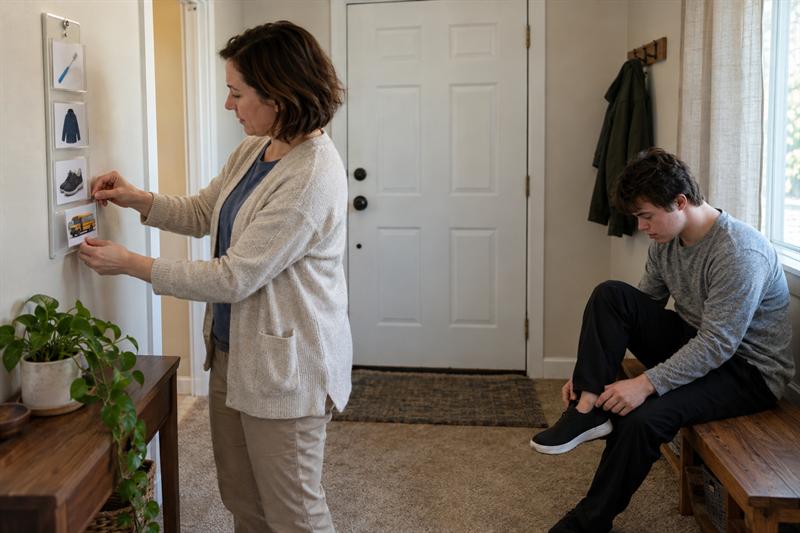
What support for an individual with IDD really means
Support for an individual with IDD means helping daily life work better in practical, observable ways. That can include communication, routines, safety, daily living skills, independence, and participation at home, at school, and in the community.
A common mistake is treating support like it begins and ends with appointments. In reality, many challenges show up between appointments, when a person has to move through routines, transitions, tasks, and environments that may ask more of them than their current support system can handle.
- Daily living tasks such as dressing, eating, hygiene, and following routines
- Communication support across home, school, and community settings
- Structure during transitions, outings, and unplanned changes
- Skill-building that supports more independence over time
- Coordination across caregivers, providers, and other environments
Support needs do not look the same from one person to another. Some people struggle most with transitions. Others do well in familiar routines but find busy settings, social situations, or less structured parts of the day harder to manage. Broad advice can miss those differences. What matters is how the person functions in real situations.
Support goes beyond appointments and programs
Appointments can guide planning, but they do not carry the day by themselves. What often gets missed is what happens before, after, and between formal services. This is where repeated problems usually begin to show up.
Many families run into this pattern. A person may know parts of a skill, but the home routine may be inconsistent, expectations may shift across caregivers, or the environment may change faster than the person can adjust. That can lead to more stress, more confusion, and slower progress.
Why needs can look different from one person to another
Needs vary because daily demands vary. Communication differences, sensory load, adaptive skills, transitions, and environment can all shape how support needs show up.
If a person does well in one setting and struggles in another, that often means the support is not transferring well across environments. It does not always mean the person cannot do the skill. It may mean the structure, prompts, or expectations are not clear enough in the new setting.
Start with strengths, daily patterns, and support needs
A good place to begin is by looking at what is already working, where the day gets harder, and what tends to trigger breakdowns. That often gives a clearer picture than starting with assumptions about what the person should be able to do.
A common pattern is focusing first on the most visible problem without tracing where it starts. But the visible problem is often the end of the chain, not the beginning. If mornings are rushed, transitions are unclear, and support changes from one caregiver to another, those issues can build on each other and create bigger problems later in the day.
- What routines already go relatively smoothly
- What times of day create the most stress
- Which settings bring the biggest change in behavior or participation
- What support seems to help the person succeed more consistently
If a pattern keeps repeating, it often points to a support gap rather than a one-time issue. This is where a simple written structure can help. A one-page ABA support plan for home, school, and caregivers can help make expectations clearer across the people involved.
What the person does well already
Start with strengths because they show where support is already working. Look for tasks the person completes more independently, settings where participation is better, motivators that increase engagement, and routines that feel more stable.
Strengths are not just encouraging details. They are useful clues. If a person handles a structured evening routine well but struggles in the morning, that may suggest the issue is not ability alone. The structure around the task may be part of the problem.
Where daily routines tend to break down
Common pressure points include mornings, transitions, outings, unstructured time, and bedtime. These are the places where unclear expectations, low predictability, skill gaps, or environmental overload tend to show up quickly.
This often gets worse when adults treat every hard moment as a separate problem. If the same type of breakdown happens across different parts of the day, the issue is usually bigger than one incident. It can point to a routine or support plan that needs to be adjusted.
How routines can make daily life more manageable
Routines can reduce friction because they make expectations easier to understand and repeat. When a person knows what comes next, transitions may feel more manageable, participation may improve, and daily demands may feel less chaotic.
That does not mean every routine should be rigid. A routine that only works under perfect conditions may fall apart as soon as the day changes. Strong routines provide structure, but they also help prepare the person for small changes without everything unraveling.
Families often notice this as support needs change over time. A routine that worked well for a younger child may stop working as independence expectations increase. The demand may have changed, but the support may not have kept up. For older children and teens, ABA support for adolescents focused on independence, routines, and community participation can help families think through those shifts more clearly.
Morning, meal, school, and bedtime routines
These routines matter because they can affect the rest of the day. If getting ready in the morning consistently falls apart, that stress may carry into school, transportation, and later transitions.
Meal routines and bedtime routines can affect the day in similar ways. When these parts of the day are unstructured, the person may have less capacity for coping, participation, and communication later. Repeated strain in these routines is often one of the first signs that support needs to be adjusted.
Using consistency without becoming rigid
Consistency helps when it creates clarity. It can become a problem when the person can only function if nothing changes.
The goal is not to remove all change. The goal is to make change easier to handle. If a routine only works when the same adult gives the same prompt in the same order every time, the support may be too fragile. That usually means the routine needs to be strengthened so it carries over better in daily life.
If daily support keeps breaking down in the same places, it may be time to adjust the plan.
- Mornings are consistently rushed, delayed, or emotionally difficult
- Skills work with one caregiver but fall apart with another
- Outings, transitions, or community tasks keep ending early
- Previously manageable routines now lead to more stress or resistance
When these signs keep repeating, the issue is often not motivation alone. The support plan, expectations, or current level of structure may need to change.
Building life skills one step at a time
Life skills should be taught in a way that matches the person’s actual daily needs. The most useful goals are usually the ones that reduce dependence, improve participation, and make routines easier to complete across settings.
A common mistake is choosing goals because they sound impressive or because they seem easiest to teach. That can lead to effort without enough real-life carryover. A better approach is to focus on skills that solve repeated problems in the day.
Families who want more examples around daily living routines can also review life skills training for children through everyday routines to see how these goals connect to independence in a practical way.
Self-care, communication, and daily living skills
Useful life skills often include dressing, hygiene, toileting routines, meals, asking for help, and following a familiar sequence of steps. Communication also belongs in this category because daily life often gets harder when a person cannot consistently express needs, choices, or discomfort.
If one skill affects multiple parts of the day, it usually deserves priority. For example, a clearer way to request help can reduce frustration during routines, transitions, and outings all at once. That is often a stronger starting point than smaller goals that do not change much day to day.
Breaking larger tasks into teachable steps
Large tasks usually become more manageable when they are broken into smaller parts. This helps the person build success in sequence rather than being expected to complete a full routine before they are ready.
Consistency matters here. If one caregiver expects full independence, another gives too much help, and a third changes the sequence entirely, the skill may stall. This is where support often breaks down. The task is being taught, but not in a way the person can repeat across people and settings.
Supporting community participation in a realistic way
Community participation often works best when the setting matches the person’s current support needs. Taking part in outings, errands, and social settings can be valuable, but it usually needs structure. Simply expecting someone to adapt on the spot often leads to frustration and early exits.
A common pattern is that families try to increase exposure without enough preparation. That can result in harder transitions, more stress, and less confidence the next time. Community participation often becomes more functional when the plan fits the person, not just the destination.
For families looking at this in more detail, community participation in ABA for outings, errands, and everyday social settings explains how structure can carry into real environments.
Preparing for outings and transitions
Preparation should focus on what tends to break down first. That might be waiting, moving from the car into the setting, tolerating a change in pace, or handling an unexpected delay.
Many families notice this in community-based support. The outing itself is not always the hardest part. The transition points often are. If repeated difficulty shows up before entering, while waiting, or when leaving, that often means the support plan needs to be built around those moments rather than around the outing as a whole.
Choosing environments that match current support needs
Start where success is more likely. Quieter, shorter, more predictable settings often create better learning conditions than busy environments with too many demands at once.
This matters because repeated overwhelm does not usually build confidence. It may teach avoidance. A better sequence is to build participation where the person can succeed, then increase complexity as support improves.
Working with schools, providers, and family supports
Support often becomes more effective when the adults involved are aligned on what matters most. When routines, prompts, and expectations change too much from one setting to another, the person may have to relearn the same task in multiple ways. That can slow progress and increase confusion.
This is one of the most common reasons skills look inconsistent. The person may understand the task, but the support may not be consistent enough for the skill to hold across environments. If home, school, and caregivers are working from different assumptions, daily life often feels harder than it needs to.
Why shared expectations matter
Shared expectations can reduce confusion and help skills transfer. When adults use similar routines, language, and goals, the person often has a clearer path to success.
The benefit is not just smoother behavior in the moment. It can also support better generalization, stronger follow-through, and fewer breakdowns during transitions. This becomes especially important when more than one caregiver is involved.
When multiple settings send mixed signals
Mixed signals usually produce mixed results. If one setting allows a routine to drift, another requires independence too quickly, and another uses different prompts entirely, the person may respond with frustration, dependence, or avoidance.
In many cases, fewer shared goals work better than too many disconnected ones. The issue is often not lack of effort. It is lack of alignment. Once expectations become clearer across settings, support usually becomes more stable.
When a formal evaluation or reevaluation may help
When support needs change, older assumptions may stop helping. A formal evaluation or reevaluation may become useful when daily life is showing a different pattern than before and the next step is no longer clear.
This often comes up when routines that once worked now break down more often, when communication needs look different, or when school and community demands outgrow the current support plan. The problem is not always that the person has regressed. In some cases, the support picture is simply outdated.
At Strive ABA Consultants LLC, families often reach this point when they are no longer sure whether the issue is a routine problem, a growing skill gap, or a need for updated evaluation information. If the question is whether the next step is a consultation, assessment, or reevaluation, this guide to which ABA appointment is next can help make that distinction easier.
Signs that support needs may have changed
Watch for repeated changes in routines, transitions, communication, school demands, or community participation. If the person used to manage a setting or task more smoothly and no longer does, that often points to a mismatch between current needs and current support.
Another pattern is when a skill still appears in one place but disappears in another. That often means the support plan no longer transfers well enough across settings. Ignoring that pattern can make the problem harder to sort out later.
How updated information can guide next steps
Updated information can help families see what has changed, what strengths are still present, and what support now makes the most sense. That clarity matters because decisions become harder when everyone is reacting to the same problem differently.
Evaluations and reevaluations are not magic solutions, but they can reduce guesswork. When daily challenges have shifted, clearer information can support better planning and more useful support choices.
A simple support-planning framework for families
A useful support plan should make decisions easier, not more complicated. One way to do that is to separate what needs to be stabilized now, what should be built next, and what can be revisited later.
This is where many families gain traction. Instead of trying to fix every issue at once, they focus on the few patterns that affect the day most. That often leads to better consistency and less overwhelm for everyone involved.
What to focus on now, next, and later
Now should focus on the part of the day that breaks down most consistently. That is often the routine causing the biggest spillover effect into school, community participation, or caregiver stress.
Next should focus on one or two life skills that make daily life more functional. Those are often the skills that improve participation across more than one setting.
Later should focus on increasing flexibility, independence, and more complex participation as support becomes more stable. This phased approach often works better because it treats support like a system, not a list of unrelated concerns.
Questions to ask when choosing support options
- What challenge shows up most often?
- Which settings are affected most clearly?
- Is the issue a skill gap, a routine problem, or an environment problem?
- What support is needed now versus later?
- Would updated evaluation information make the next step clearer?
If the same challenge keeps affecting multiple parts of the day, support planning often needs to become more deliberate. Small adjustments may help for a while, but repeating patterns usually require a clearer structure.
Key Takeaways
- Supporting an individual with IDD means making daily life more manageable, not just attending appointments.
- Routines, communication, life skills, and community participation often work best when they are planned together.
- Repeated breakdowns in the same routines usually point to a support gap, not a one-time issue.
- When skills stop carrying over across settings, the support plan often needs to be updated.
- When daily patterns have changed, an evaluation or reevaluation can help clarify what support may be needed next.
Company Approach
At Strive ABA Consultants LLC, the focus is not just on identifying a service. It is on understanding how daily patterns, routines, communication, and environment are affecting the person’s ability to function across real settings.
This matters because support often breaks down in predictable ways. Families may reach a point where what used to work no longer works, or where school, home, and community expectations are no longer aligned. When that happens, clearer evaluation and reevaluation pathways can help replace guesswork with a more useful plan.
Strive ABA Consultants LLC provides autism evaluations and reevaluations for families who need that kind of clarity. For families dealing with delays, changing support needs, or uncertainty about what comes next, that step can be a practical way to move forward.
Conclusion
The real problem is rarely just one hard routine or one isolated challenge. It is often a support system that no longer matches the person’s current needs across daily life. When that goes unaddressed, routines may keep breaking down, skills may stop carrying over, community participation may get harder, and families may spend more time reacting than planning.
That is why waiting can make the situation harder to untangle. If repeated routine breakdowns, changing support needs, or uncertainty about next steps are showing up more often, Strive ABA Consultants LLC may be a practical next step to consider. Autism evaluations and reevaluations can help clarify what has changed, what support may be needed now, and how to move forward with a plan that fits real life.
FAQ
What is the best way to start supporting an individual with an intellectual or developmental disability?
The best place to start is with daily patterns. Look at what goes smoothly, where the day consistently breaks down, and which situations create the most stress. That often gives a much clearer picture than starting with a broad label alone.
For example, if transitions are the main problem but self-care tasks are relatively stable, the support plan should start with transitions. What matters most is identifying the pressure point that keeps affecting the rest of the day.
How do routines help individuals with developmental disabilities?
Routines help by making expectations easier to understand and repeat. When the order of events becomes more predictable, transitions often improve, participation may get stronger, and less energy is spent reacting to uncertainty.
The important distinction is that routines should support function, not rigidity. A routine is working when it creates stability and still allows the person to handle reasonable change without everything falling apart.
What kinds of life skills are most important for someone with IDD?
The most important life skills are the ones that improve daily function in meaningful ways. That often includes self-care, communication, following routines, asking for help, and completing basic daily living tasks more independently.
The key is relevance. A goal matters more when it reduces repeated stress across the day than when it simply sounds developmentally appropriate on paper.
How can families support community participation without overwhelming the individual?
Community participation often works better when the environment matches the person’s current support needs. Shorter, more predictable outings often build more success than high-demand settings that create repeated overload.
What commonly gets misunderstood is the idea that more exposure automatically helps. A better approach is to prepare for transition points, choose settings more carefully, and build complexity gradually.
When should a child or individual with developmental disabilities have a reevaluation?
A reevaluation may become important when daily functioning no longer matches the current plan. That often shows up when routines that used to work are breaking down more often, when school or community demands have changed, or when skills no longer carry over across settings.
The key distinction is that reevaluation is not only about confirming a diagnosis. It can help clarify what has changed and what kind of support now fits best.
What should be included in a support plan for an individual with IDD?
A support plan should include the routines that matter most, the skills that need to be built, the settings where support is needed, and the strategies that help the person succeed more consistently. It should also make clear what needs attention now and what can be addressed later.
A useful plan is not just a list of concerns. It is a way to organize priorities so the same problems stop repeating across caregivers and environments.