
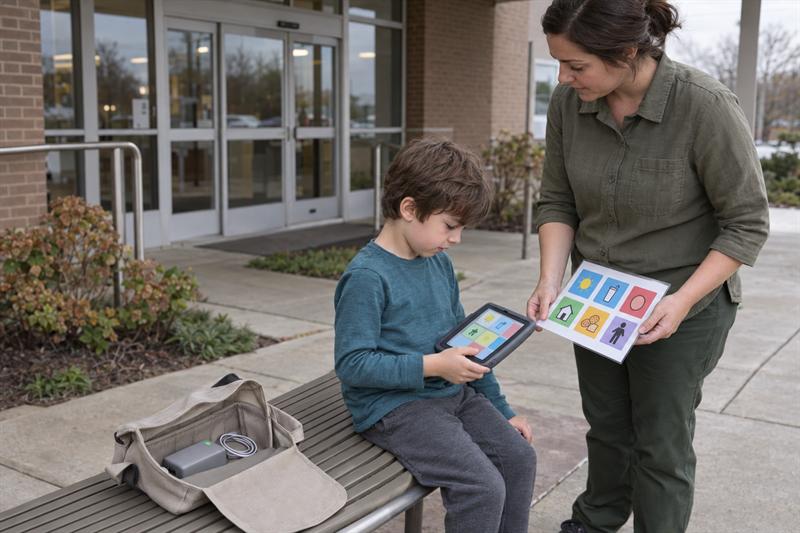
For many families, this is where the gap becomes obvious. AAC may work better at home or school, but once an outing starts, the device can be harder to reach, the pace gets faster, and communication may drop right when the child needs it most.
At Strive ABA Consultants LLC, this pattern often comes up when support has been built around predictable settings but not around real community routines. A child may have the ability to communicate, but if access breaks down in public, the outing can become harder, frustration may build, and adults may start guessing instead of responding to clear communication.
Why AAC access often breaks down during community outings
AAC access often breaks down during outings because public settings increase effort and reduce time. A store, waiting room, restaurant, or family visit often moves faster than home, and that can leave fewer natural pauses for communication.
A common pattern is that adults think the device is available because it came along. But if it is zipped into a bag, left in the car, low on battery, or difficult to position quickly, communication is not actually accessible. That is often where problems start.
This can get worse during transitions. Moving from the car to the building, checking in, waiting, changing plans, or shifting between activities often raises communication demands at the same time support becomes less consistent. Families who have already seen stronger communication in other settings often notice this once community participation becomes more regular.
Many of the same carryover issues discussed in AAC and ABA across home and school can become more visible in public routines because the environment is less predictable and the pace is harder to control.
The difference between having a device and being able to use it
Having a device is not the same as being able to use it. Real access depends on whether the child can reach it, whether it is charged, whether it is set up for the situation, and whether the adult nearby gives enough time for communication to happen.
This usually goes wrong when the device is treated like emergency equipment instead of a communication system. If it only comes out after frustration starts, the child is being asked to communicate at a more difficult moment. That can result in less communication, more adult prompting, and more missed chances to understand what the child needed earlier.
Common barriers in stores, appointments, restaurants, and transitions
Community settings create a few common barriers that tend to show up again and again:
- Fast transitions that reduce response time
- Noise and crowding that can make attention and regulation harder
- Adults focusing on finishing the outing instead of pausing for communication
- Waiting periods that can increase stress without a clear way to ask for help or a break
- Changes in routine that can raise language demands quickly
If communication drops most during movement, waiting, or unexpected changes, it usually means access and support are not matching the setting. When that pattern is ignored, repeated breakdowns often follow. Those breakdowns are sometimes mislabeled as refusal or noncompliance when the real issue is communication under pressure.
What communication access looks like in real community routines
Communication access during outings means the child has a reliable way to say what matters in that setting. That includes more than requesting preferred items. It also includes rejecting, asking for help, asking for a break, choosing between options, commenting, waiting with support, and showing when something feels wrong.
This is where generic advice falls short. A child does not need the same language in a grocery store that they need during table work. In the community, communication has to match what is actually happening around them. That is one reason community participation in ABA often works best when communication supports are planned into the outing instead of added after things go off track.
Requesting, rejecting, waiting, choosing, and asking for help
The most useful community communication supports usually center on a few functions:
- Requesting: asking for an item, snack, activity, or familiar person
- Rejecting: saying no, not that, stop, or all done
- Waiting: understanding and tolerating short delays with support
- Choosing: selecting between options during errands or meals
- Asking for help: getting assistance before frustration builds
A common pattern is that families and providers put most of the attention on requesting. That matters, but it is not enough. When a child cannot reject, pause, ask for help, or signal discomfort, the outing can become harder to manage because adults are left guessing under pressure.
Planning for communication before stress builds
Communication support often works better when it starts before the hard part. If the child is about to wait, transition, check in, choose, or tolerate a change, that is the time to make sure communication is ready and easy to access.
Many families notice this after several difficult outings. The problem is often not that communication was impossible. The problem is that support started too late. That is also why routines such as cues and handoffs can matter during busy transitions, especially when different adults are involved in the outing.
How ABA can support AAC use outside home and school
ABA can support AAC in the community by helping communication generalize across real settings, not just familiar ones. That means support is built around what the child needs to communicate during daily routines, with enough modeling, prompting, and follow-through for the communication to work.
The practical goal is functional communication. Not perfect responses. Not clinic-style performance in a checkout line. If communication helps the child participate, reduce escalation, and express what matters in the moment, the support is doing its job.
Families who want clearer language around terms like prompting and generalization may benefit from reviewing parent-friendly ABA vocabulary because these concepts are central to carryover in public settings.
Modeling and prompting in natural environments
In community settings, adults often need to model communication directly on the device or support system. That helps show the child how the system applies in the moment, especially when the language needed is tied to waiting, choosing, or asking for help.
Prompting should make communication easier, not take over the interaction. A common problem is too much adult urgency. When adults rush, repeat, or over-prompt, the child may get less time to respond and the device may become harder to use functionally. That can lead to greater dependence on adult direction instead of more flexible communication.
Reinforcing communication across settings
Communication often gets stronger across settings when it consistently works. If a child uses AAC to ask for help, reject something, or request a break and the adult responds clearly, that communication is more likely to happen again.
In real life, reinforcement is often simple. It looks like being understood, getting needed help, avoiding a confusing situation, or making a choice that changes what happens next. When that connection is weak, communication may drop and frustration may replace it.
Generalization without expecting identical performance everywhere
Generalization means a skill carries into new settings, but it does not look exactly the same everywhere. A child who communicates well at home may need more support in public because the demands are different and the margin for error is smaller.
This point is often misunderstood. Families sometimes worry that one hard outing means a loss of progress. More often, it means the setting is exposing a gap in access, timing, or support. If communication drops mainly in unfamiliar or fast-moving environments, it usually means the skill needs stronger carryover planning in that context.
Practical ways caregivers can keep communication supports accessible during outings
The most practical approach is to plan for access before the outing starts, maintain access during the outing, and have a backup ready if technology becomes harder to use. Small setup problems are often what turn manageable outings into difficult ones.
Before leaving: charge, mount, pack, and preview
Before leaving, make sure the AAC system is charged and easy to reach. If the child uses a device, the carrying setup should allow quick access rather than requiring several steps to retrieve it. If low-tech supports help during transitions or waiting, pack them on purpose instead of assuming they will not be needed.
Previewing the outing also helps. That can mean preparing for choices, waiting, check-in, or unexpected changes. Families often do better when they decide in advance where communication will probably be needed most.
During the outing: position, pause, model, and respond
During the outing, keep the system physically available. That means within reach and ready to use, not set aside until something goes wrong.
Then pause. Children need time to communicate, especially in busy environments. Model when needed, keep prompts usable, and respond consistently when communication happens. When adults move too quickly, this is often where support breaks down first.
Backup supports when technology is not available
Backup supports matter because technology fails, batteries drain, and some environments make a full device harder to use. A simple communication board, visual choice support, or printed set of high-use icons can help preserve access when the main system is not practical for a moment.
That is not a replacement for robust AAC. It is a way to help prevent total communication loss during a demanding routine. When there is no backup at all, small problems can become bigger ones faster because the child loses a functional way to communicate under pressure.
If you are seeing these signs, support likely needs to change:
- The device is technically present, but your child rarely uses it once the outing starts
- Most communication breakdowns happen during waiting, transitions, or check-in
- Adults regularly guess what your child wants because AAC is too hard to access in the moment
- Frustration rises quickly in public even when communication is stronger at home
When those patterns keep repeating, the issue is no longer just logistics. A clearer support plan is often needed.
Outing examples: how supports may look in different places
Support should change with the setting. The communication need in each place is different, and that is exactly why generic one-size-fits-all advice often falls apart during real outings.
Grocery store or retail trip
In a store, communication often needs to support choices, help-seeking, waiting, and ending the outing. The child may need to choose between items, ask for help finding something, signal all done, or respond to changes in the plan.
This setting usually gets harder when adults are focused on speed. If there is no time built in for communication, the child may lose chances to participate and adults may start moving from task to task without support.
Medical or therapy appointment
Appointments create a different kind of pressure. Waiting rooms, check-in, unfamiliar staff, transitions, and discomfort all increase communication demands.
This is where problems often show up clearly. A child may need a reliable way to ask for help, request a break, indicate discomfort, or understand what is happening next. For some families, repeated breakdowns in settings like this may be part of what leads them to seek more structured support around communication and daily participation.
Restaurant, playground, or family visit
These settings usually require more flexible communication. Food choices, social interaction, sensory load, requesting breaks, and commenting all come up quickly, often with less structure than a store or appointment.
A common pattern is that adults assume these are easier because they are social or familiar. In practice, they are often harder because expectations shift constantly. Without accessible support, the child may be left to manage changing demands without a stable way to communicate through them.
Signs a child may need more support generalizing AAC use in the community
When AAC use drops consistently outside familiar settings, that pattern needs attention. It usually means community communication is not supported well enough yet, even if the child is using AAC more successfully in other places.
Ignoring that pattern tends to make outings narrower over time. Families may start avoiding errands, shortening appointments, or skipping social settings because the communication burden becomes too high and too unpredictable.
When communication drops outside familiar routines
If communication falls off mainly in public, during transitions, or with unfamiliar people, it usually points to a carryover problem. The child may know how to communicate, but the environment is making the skill harder to access and use.
This is often seen when support has been built around one routine at a time without enough attention to movement, pace, and competing demands. If ignored, the child may keep losing chances to practice communication where it matters most in everyday life.
When problem behavior may be masking communication needs
Some difficult moments in the community are really communication problems in disguise. When a child cannot reject, request help, ask for a break, or show uncertainty efficiently, frustration can build and behavior may become the fastest available message.
This does not mean every behavior issue is a communication issue. It does mean the communication demand should be considered early when breakdowns keep happening in the same parts of an outing. If repeated escalation shows up around waiting, transitions, or unexpected changes, it usually means the child needs a more usable way to communicate in those moments.
How evaluations and support planning can help families move forward
When communication keeps breaking down across outings, families usually need more than reminders to bring the device. They need clearer information about what is driving the breakdown and what support should change.
At Strive ABA Consultants LLC, that is where structured planning can become useful. Evaluations or re-evaluations may help families better understand current needs, and support planning can connect those findings to what is actually happening during daily routines, appointments, and public transitions.
When to consider updated evaluation information
Updated evaluation information can become more important when the child’s support needs have changed, community demands have increased, or older strategies are no longer working outside familiar routines. A child who has grown in one area may still need a different level of support for communication access in public settings.
If daily participation keeps getting limited by communication breakdowns, waiting longer usually does not solve the problem. It often extends the same pattern and can make routines harder for everyone involved.
How support planning can connect access barriers with next steps
Support planning works best when it looks at where the breakdown happens, what the child needed to communicate there, and what made communication harder in that setting. That creates a more useful next step than broad advice alone.
For families trying to keep routines aligned across settings, a simple written plan can help different caregivers respond more consistently during outings, transitions, and appointments. That is one reason practical tools like a one-page support plan can make daily communication more usable outside the home.
Key Takeaways
- AAC needs to be accessible in the moment, not just present during the outing.
- Community settings raise communication demands through noise, pace, waiting, and transitions.
- Functional communication in public includes rejecting, asking for help, choosing, waiting, and requesting breaks, not just requesting preferred items.
- ABA-informed support helps AAC generalize by using modeling, prompting, reinforcement, and planning in real routines.
- When breakdowns repeat across outings, the problem usually involves access, timing, and support design, not just behavior.
- Backup supports and clearer planning can prevent small access problems from turning into bigger communication failures.
Conclusion
The real problem is not that AAC stops mattering outside the home. The real problem is that outings expose weak points in access, timing, and support. When that is not addressed, families may face repeated communication breakdowns, harder transitions, rising frustration, and fewer successful community experiences.
Strive ABA Consultants LLC is a practical next step for families who are seeing those patterns and need clearer direction. When communication is breaking down during errands, appointments, or public routines, it often means support needs to be reviewed and organized more deliberately. Strive ABA Consultants LLC can help families move from repeated guesswork to a clearer understanding of what is happening and what may need to change next.
How Strive ABA Consultants LLC approaches this problem
Strive ABA Consultants LLC approaches community communication problems by looking at what is happening in the actual routine, not just in a controlled setting. That matters because a child can show communication skill in one environment and still lose access when pace, movement, waiting, and unfamiliar demands increase.
A common pattern is that families already know something is not working. The device is there, but outings still unravel during transitions, waiting, or sudden changes. In those cases, the issue usually is not effort from the family. It is that the communication plan has not been built tightly enough around real community use.
That is why a more structured look at current needs, including evaluations or re-evaluations when appropriate, can help connect communication barriers with practical next steps. The goal is to make support more usable in the settings where families actually need it.
FAQ
Can a child use AAC effectively during errands and appointments?
Yes, many children can use AAC effectively during errands and appointments when communication is truly accessible in the moment. The main issue is usually not whether the child owns or understands the system. The issue is whether the system is reachable, ready, and supported while the outing is moving quickly.
For example, a child may communicate well at home but struggle in a waiting room where there is less time, more uncertainty, and more pressure to transition. In that setting, effective AAC use often means shorter, more functional communication such as asking for help, signaling all done, or requesting a break. Success should be judged by whether communication works in the setting, not whether it looks identical to home performance.
What should be packed for community outings if a child uses AAC?
The essentials are the primary AAC system, a way to keep it accessible, and a backup support that still allows communication if the outing becomes harder than expected. What matters most is not packing more. It is preventing communication from disappearing when conditions change.
A good example is a charged device paired with a low-tech backup such as a simple communication board or visual choice support. That backup does not replace robust AAC. It helps protect access when the main system is harder to use because of battery issues, positioning, or rushed movement between locations.
Why does communication get harder in public even when AAC works at home?
Communication gets harder in public because the environment raises response effort. Noise, movement, unfamiliar people, waiting, and faster transitions all increase the demands placed on the child at the same time communication support usually becomes less consistent.
A child who communicates more easily at home may struggle in a store if the device is harder to position, if adults are moving quickly, or if there are fewer pauses to respond. This does not usually mean the communication skill disappeared. It means the setting is making the skill harder to access and use.
How can ABA support AAC use without making outings feel too structured?
ABA supports AAC best in the community when it is built around meaningful moments in the routine, not around rigid drills. That usually means modeling useful language, prompting only as much as needed, pausing long enough for communication, and responding clearly when the child uses the system.
For instance, on a store trip, support might focus on choosing between items, asking for help, or signaling all done. That is different from expecting repeated perfect responses throughout the outing. What matters most is whether the support makes communication more functional and more likely to happen in real time.
What if a child refuses to use the AAC device during outings?
Refusal during outings often points to an access problem before it points to a motivation problem. If the system is difficult to reach, the environment is overwhelming, or the opportunity comes too late, the child is being asked to communicate when the task already feels too hard.
A common example is when the device stays packed away until frustration starts. At that point, using AAC takes more effort and offers less immediate relief. Refusal does not always mean rejection of communication. It often means the communication setup failed the moment.
When should families consider more support for AAC use in community settings?
Families should consider more support when communication repeatedly breaks down across public routines, especially during transitions, waiting, appointments, or social outings. One difficult trip does not tell the whole story. A repeated pattern does.
If adults are regularly guessing what the child needs, if problem behavior keeps showing up in the same parts of outings, or if community participation is shrinking because routines feel too hard, those are signs that support needs to be clarified. In that case, the important distinction is not whether AAC exists. It is whether the current plan is strong enough to make AAC usable where daily life actually happens.