

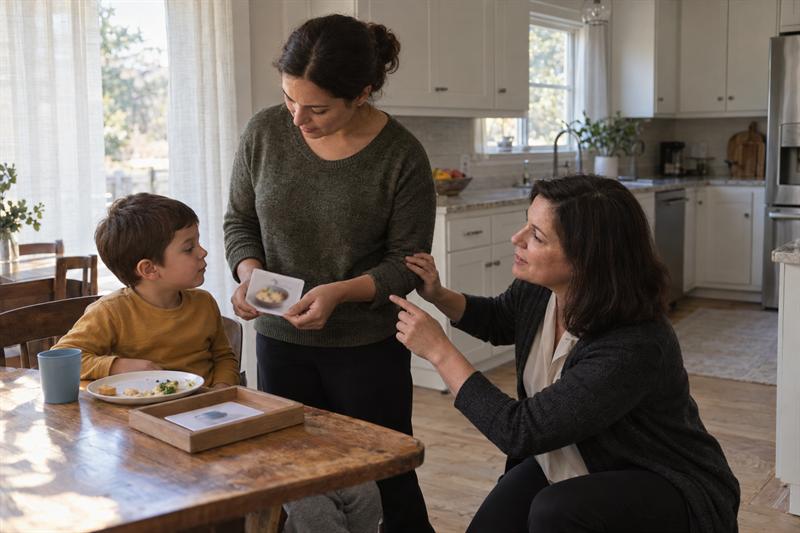
What parent training in ABA actually means
A simple definition in plain language
Parent training in ABA is a service that teaches caregivers how to support a child’s goals during everyday routines such as transitions, play, meals, dressing, communication, and community activities. It is sometimes called caregiver training, family training, or parent coaching, but the purpose is generally the same: helping support carry over outside the therapy session.
That distinction matters. A child may work on skills during direct ABA sessions, but daily life is where those skills are actually used. When caregivers understand the plan and how to respond during the moments that keep breaking down, support is usually more consistent and easier to use.
Why it is part of many ABA treatment plans
Many families assume ABA happens only between the child and therapist. In practice, many of the situations families want help with happen before, after, or between sessions. Morning routines, handoffs, meals, sibling interactions, bedtime, and community outings do not pause because therapy ended for the day.
- Skills need to work across settings, not just during direct sessions.
- Caregivers are present during many of the routines where support breaks down.
- Parent training helps connect the treatment plan to real family life.
A child may do well in session, but the home routine can still fall apart because the adults supporting that routine were never shown what to do, when to do it, or what to look for. That gap often leads to frustration on both sides.
For families new to the field, this plain-language guide to ABA therapy helps explain how parent training fits into the broader service model.
How parent training is different from direct ABA therapy
Direct ABA therapy focuses on the child’s individualized goals during treatment sessions. Parent training focuses on teaching caregivers how to support those same goals across daily life. The two services work together, but they are not the same thing.
This is one of the most common points of confusion. If parent training is treated like a substitute for direct treatment when a child still needs direct support, progress can stall. If direct treatment happens without meaningful caregiver coaching, skills may stay too tied to the session and be harder to use at home or in the community.
What the child works on in direct sessions
During direct sessions, the child may work on communication, transitions, routines, play, independence, flexibility, behavior support, or other individualized goals. The focus is on teaching and practicing those skills within a planned treatment structure.
What caregivers learn during training
During parent training, caregivers usually learn how to:
- respond more consistently during specific routines
- support replacement skills the child is already learning
- notice patterns that should be shared with the clinical team
- use supports that make the routine more predictable and manageable
A common problem is that families are told to “be consistent” without enough detail to act on that advice. That leaves caregivers with a goal but no clear way to reach it. Useful parent training breaks the routine down into specific situations, specific responses, and specific follow-up.
Why both may matter for daily routines
Many routines involve more than one kind of support need. A child might need direct teaching to build a communication or transition skill, while the caregiver needs coaching on what to do when that routine starts to unravel at home. Meals, bedtime, school preparation, community outings, and sibling interactions are common examples.
For a clearer explanation of who handles what on the team, readers can review the roles of the BCBA, RBT, and other ABA team members.
Who is involved in ABA parent training
The BCBA’s role
The BCBA typically oversees assessment, goal selection, caregiver coaching, progress review, and treatment updates. In parent training, that means the BCBA should be able to explain why a strategy is being used, how it connects to the treatment plan, and what the caregiver should expect to track or practice.
Problems tend to start when services are too vague. If no one can explain who is guiding the parent-training plan or how goals are being adjusted over time, families are left with scattered advice instead of a clear support process.
The RBT or therapist’s role
An RBT or therapist may support implementation during sessions and may help model strategies that are already part of the supervised treatment plan. That can be useful, especially when a caregiver benefits from seeing a routine supported in real time.
The key point is role clarity. Families should be able to tell who is observing, who is coaching, who is changing the plan, and how those pieces fit together.
The role of parents, grandparents, sitters, and other caregivers
Parent training is often most helpful when the adults who share routines understand the same expectations and supports. That includes parents, grandparents, sitters, after-school caregivers, and sometimes school staff, depending on the setting and service model.
When one caregiver uses a predictable routine and another responds differently, the child ends up navigating competing patterns for the same daily task. That usually makes the routine harder, not easier. Families working on that issue may find it helpful to read how to share ABA routine supports with grandparents, sitters, and other caregivers.
What happens during a parent training session
A strong parent training session is active and specific. It should not feel like a vague check-in or a lecture with no connection to real routines.
Observation and discussion
The session may start with a recent challenge or a routine that keeps breaking down. The clinician may ask what happened before the issue, what happened after, and what has already been tried.
That matters because effective support depends on context. If the routine is not understood clearly, the coaching may stay too general to help.
Modeling and guided practice
The clinician may model part of the routine or show how a support is meant to be used, then coach the caregiver through practicing it. This is often the most useful part of parent training because it turns abstract advice into something the caregiver can actually apply.
For example, a caregiver may be shown how to prepare a child for ending screen time, how to use a visual cue before the transition, and how to respond if the transition starts to become more difficult. That is very different from simply being told to “give more warnings.”
Reviewing what worked between sessions
Good parent training includes follow-up. The caregiver and clinician review what fit the routine, what did not work, and what needs adjustment.
This tends to work better when goals are narrow and tied to a routine the family deals with every day. It often gets harder when the plan is too broad, too complicated, or disconnected from what the family can realistically carry out.
If you are seeing these signs, clearer parent training support may be needed:
- The same routine breaks down every day, even though therapy goals are in place.
- Different caregivers handle the same problem in completely different ways.
- You are hearing ABA terms but still do not know what to do in the moment.
- Review meetings describe progress, but daily routines still feel stuck.
When those patterns show up, the next step may need to happen at the caregiver-coaching level, not through broad advice alone.
Common formats for caregiver training in ABA
Parent training does not happen in only one format. The most practical option usually depends on where the routine breaks down, who needs to participate, and what kind of support the family can realistically use.
In-home coaching during routines
In-home parent training is often the most direct format because the coaching happens where real routines occur. Meals, dressing, after-school transitions, bedtime, community preparation, and sibling routines are easier to address when the environment is visible.
This is often a strong fit when the issue is routine-specific. If the problem shows up in the home, support is usually easier to apply when the coaching also happens there.
Clinic-based meetings
Clinic-based meetings can be useful for reviewing goals, asking questions, learning new strategies, or observing parts of the treatment approach. This format may work well when the parent-training focus is more about reviewing the plan than observing a home routine directly.
Telehealth and hybrid support
Telehealth or hybrid support can help when scheduling, transportation, or distance make fully in-person coaching harder to maintain. For some families, that format makes it easier to keep the review and problem-solving process moving.
At Strive ABA Consultants LLC, access matters because support still has to be workable. When families are balancing transportation, caregiving schedules, and school demands, the format that helps most is usually the one the family can maintain consistently.
School collaboration when appropriate
Some parent-training goals overlap with school routines, transitions, communication systems, or supports across settings. In those cases, caregiver coaching is often stronger when the adults involved are working from shared expectations instead of separate plans.
Families managing that kind of crossover may also benefit from guidance on keeping ABA consistent across home, center, and school settings.
Goals parent training may focus on
Parent training goals should be tied to routines that matter in daily life. They should not stay at the level of broad behavior labels.
Communication and following directions
Caregiver coaching may focus on how to support requests, reduce confusion, or improve follow-through during everyday demands. This is especially important when breakdowns happen because the routine moves too fast, directions change, or communication supports are not used consistently.
Transitions, routines, and flexibility
Transitions are one of the most common targets because they affect so many parts of the day. Morning routines, leaving preferred activities, switching tasks, and getting ready for bed are where many families start to see repeated stress.
This often becomes harder when each adult handles the transition differently or when expectations change from one setting to another. Families looking for routine-level organization may find a one-page ABA support plan for home, school, and caregivers useful.
Play, social interaction, and independence
Some parent-training goals focus on helping a child participate more independently in family routines, play activities, or simple self-help skills. The point is not to repeat therapy language at home. The point is to support the child in the situations that already matter to the family.
Reducing stress around common daily situations
In many cases, parent training targets the moments families describe as exhausting, repetitive, or hard to predict. That might be getting out the door, handling a denied item, moving from school to home, or managing the hour before bedtime.
If those situations are ignored, families may start planning around the breakdown instead of improving it, which can make the routine feel even narrower over time.
How to tell whether parent training is meaningful
Not all parent training is equally useful. Some programs provide structured coaching tied to real family routines. Others mention caregiver support but offer very little guidance that a family can actually use.
Signs of individualized coaching
- Goals are tied to specific routines the family wants to improve.
- The provider explains who leads the training and how often it happens.
- The coaching includes practice, feedback, and review.
- Caregiver questions shape the session instead of being treated like side issues.
- The plan fits what the family can realistically carry out.
Useful parent training respects the realities of the household. If the plan only works under ideal conditions, it usually will not hold up in the routines that need support most.
Red flags that the service is too vague
- No one can explain what happens in a parent-training session.
- The advice stays generic and never connects to a specific routine.
- There is no follow-up on what worked or did not work.
- Different team members give conflicting directions.
- The family is expected to “be consistent” without being shown how.
When those red flags are present, families may end up carrying more pressure with less clarity. That can slow decision-making and keep the same daily problems in place.
Questions to ask an ABA provider about parent training
Families comparing providers should ask direct questions. This is one area where clearer answers usually reveal stronger structure.
Questions about format and frequency
- Is parent training in-home, clinic-based, telehealth, or a mix?
- How often does it happen?
- What does a typical session include?
- How flexible is the format when routines change?
Questions about goals and review
- How are parent-training goals chosen?
- How do you decide which routines to focus on first?
- How is progress reviewed with caregivers?
- What changes if the strategy does not fit the family routine?
Questions about coordination across caregivers and settings
- Can grandparents, sitters, or other caregivers be included?
- How do you help keep supports consistent across home and school?
- What happens when different settings use different expectations?
These questions matter because they help show whether the service is built around real implementation or broad reassurance. If the answers stay vague, the support usually does too.
How parent training fits with evaluations and next steps
Some families searching this topic are still trying to understand where they are in the ABA process. They may be waiting on an evaluation, preparing for a reevaluation, or trying to sort out what type of appointment comes next.
When families are still seeking clarity
Parent training can still be part of the broader planning conversation even when a treatment plan is not fully in place yet. Families often want to understand what caregiver involvement will look like before they commit to a service path.
This is especially relevant when delays or unclear recommendations are already creating stress. Without a clear picture of what support will involve, families may have a harder time choosing the right next step.
How evaluations, re-evaluations, and service planning connect
Evaluations and re-evaluations help shape priorities, identify support needs, and clarify what kind of service structure makes sense. Parent training fits into that process by helping families see how goals could translate into actual daily routines.
Strive ABA Consultants LLC offers autism evaluations and re-evaluations, so this planning stage is not treated like a separate conversation from real-life support. Families may receive information from one part of the process but still not know how daily life is supposed to improve. That gap is often where clearer parent-training planning becomes important.
Key Takeaways
- Parent training in ABA is caregiver coaching, not simply observing therapy.
- It is often most useful when goals are tied to specific daily routines.
- Families should understand who leads the training, what sessions include, and how progress is reviewed.
- Vague parent training can lead to vague results. Clear structure usually supports better follow-through.
Conclusion
The real problem is not that families are unwilling to participate. It is that parent training is too often explained in broad terms while the daily routines that need help keep getting harder. When that gap is not addressed clearly, the same transitions, communication breakdowns, and home stress points may keep repeating even when services are technically in place.
Strive ABA Consultants LLC can be a practical next step for families who need clearer support planning, especially when parent training, evaluations, or re-evaluations all seem to be overlapping at once. These patterns rarely improve with vague advice alone. They are more likely to improve when caregivers understand the plan, the routine focus is clear, and the next step fits how life actually works at home, school, and in the community.
Company approach
At Strive ABA Consultants LLC, parent and caregiver support fits into a broader view of access, planning, and real-world implementation. Families are not just looking for definitions. They are trying to understand what support will look like in actual routines, how services connect, and what needs to happen next when progress feels stalled or unclear.
That is why Strive ABA Consultants LLC approaches this work as both an educational and planning issue. Whether a family is preparing for autism evaluations, re-evaluations, or trying to understand how ABA recommendations translate into daily life, clearer structure often supports better decisions and more usable support.
FAQ
Is parent training in ABA the same as watching my child’s therapy?
No. Watching therapy and receiving parent training are not the same thing. Observation can be useful, but parent training is meant to help caregivers understand what to do during real routines, how to respond consistently, and how the plan connects to daily life.
A useful difference is practice. If a caregiver watches a session but is never coached through school pickup, dinner, or bedtime, the most difficult parts of the day may remain unchanged. Structured coaching helps fill that gap by turning the treatment plan into something the family can actually use.
Who usually provides parent training in ABA?
Parent training is usually led or overseen by the BCBA because that role handles treatment planning, clinical decision-making, and progress review. An RBT or therapist may support implementation within the plan, but the family should still know who is directing the coaching and why.
That distinction matters when families are comparing services. If no one can explain who sets the goals, how changes are made, or how caregiver feedback affects the plan, the service may be too loose to feel dependable.
How often do ABA parent training sessions happen?
There is no single standard schedule. Frequency depends on the goals, the service structure, and how much support the family needs to carry strategies into daily routines.
The more important question is whether the schedule matches the problem being addressed. A routine that breaks down every day usually needs more than occasional broad advice. It needs enough contact and review to adjust what is actually happening at home.
Can grandparents or other caregivers join parent training sessions?
Yes, when they are part of the child’s regular routines, involving them usually helps. The more shared caregivers a child has, the more important it becomes that everyone understands the same routine supports and expectations.
That matters because inconsistency across adults is one of the most common reasons routines stay difficult. When one caregiver uses a clear plan and another responds very differently, the child may have to navigate competing patterns in the same situation.
What should parents ask before starting caregiver training in ABA?
Parents should ask who leads the training, what a typical session includes, how routines are selected, how progress is reviewed, and whether other caregivers can be included when needed. Those questions quickly show whether the service is structured or vague.
What often gets misunderstood is that “family-centered” does not automatically mean usable. The answers should connect to real routines, not just general promises about collaboration or support.
Is parent training useful if my child is still being evaluated or services have not started yet?
It can be, because understanding what caregiver involvement may look like helps families evaluate the service path ahead. Parent training is part of the broader planning picture, not just something that matters after everything else is finalized.
This usually matters most when families are already trying to make sense of next steps. If the evaluation process explains needs but not how those needs may be addressed in daily life, parent-training guidance can become an important missing link.