

Quick Answer: ABA daily living skills focus on teaching children how to complete real-life tasks with increasing independence, not just reducing behaviors. When therapy does not directly target these functional skills, children may still struggle with routines, self-care, and everyday independence even as behavior improves.
Introduction
Many families see progress in therapy but still face the same challenges at home. Getting dressed takes too long. Transitions lead to frustration. Simple routines like brushing teeth or following directions break down quickly.
This gap is common. Behavior may improve, but independence does not automatically follow. ABA therapy is most effective when it includes the skills children need to function in daily life, not just behavior reduction.
What Are Daily Living Skills in ABA Therapy?
Daily living skills are the everyday tasks that help a child function more independently at home, at school, and in the community. In ABA therapy, these are often referred to as adaptive skills and are taught in a structured, step-by-step way.
Difference Between Behavior Reduction and Skill Building
Behavior reduction focuses on decreasing behaviors that interfere with learning or daily routines. Skill building focuses on teaching what to do instead. Both matter, but they serve different roles.
A child may show fewer challenging behaviors and still rely heavily on adults for basic tasks. When skill development is not addressed directly, independence often remains limited.
Why Daily Living Skills Matter for Long-Term Independence
Daily living skills support a child’s ability to manage routines, communicate needs, and participate in everyday activities with less assistance.
Small gaps in independence often become more noticeable over time. As expectations increase at school and in the community, tasks that once seemed manageable with support can turn into ongoing challenges.
For a deeper look at how these skills are prioritized, see how ABA therapy goals are developed and measured over time.
Types of Daily Living Skills ABA Therapy Teaches
ABA therapy breaks daily living skills into clear categories so they can be taught consistently and practiced across different environments.
Self-Care Skills (Hygiene, Dressing, Toileting)
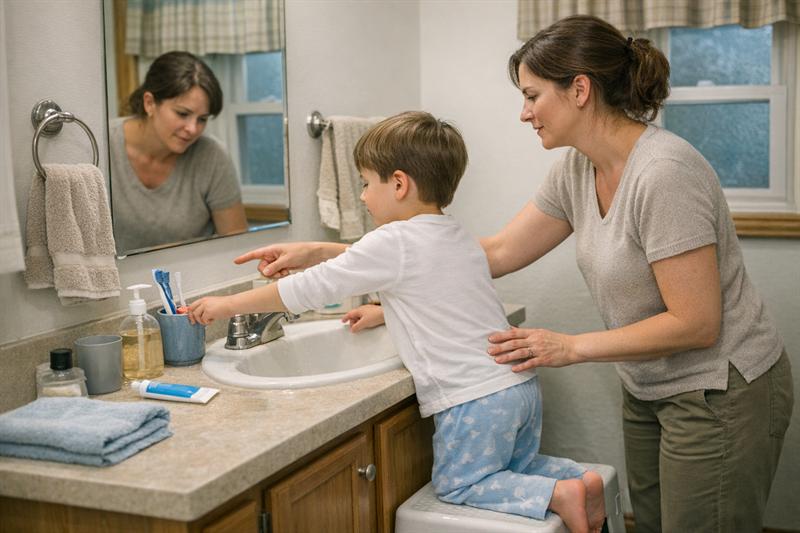
- Brushing teeth and washing hands
- Getting dressed with less assistance
- Toileting routines
- Tolerating hygiene-related sensory input
These routines are often some of the most noticeable stress points at home. When they are inconsistent or avoided, they can stay a daily source of frustration for both the child and family.
Home and Routine Skills (Cleaning, Mealtime, Transitions)
- Following morning and evening routines
- Cleaning up toys or materials
- Participating in meals
- Transitioning between activities
Some children show a skill in one setting but not another. A child may complete tasks during therapy but struggle to do the same at home, leading to inconsistent routines.
Communication for Daily Needs
- Requesting help
- Expressing wants and needs
- Understanding simple instructions
Communication supports independence. When a child cannot clearly express needs, even simple routines can break down. Learn more about how ABA builds communication skills step-by-step.
Community and Safety Skills
- Following directions in public settings
- Waiting appropriately
- Basic safety awareness
- Navigating simple social expectations
These skills support participation outside the home. Without them, everyday independence in community settings can stay limited.
How ABA Therapy Teaches Daily Living Skills
ABA uses structured teaching methods to turn complex tasks into teachable steps. This approach helps children learn, practice, and use new skills more consistently.
Breaking Skills Into Manageable Steps (Task Analysis)
Each skill is broken into smaller steps and taught in sequence. For example, brushing teeth includes multiple actions that need to be completed in order.
When one step is missing or unclear, the entire routine can become harder to complete.
Using Reinforcement to Build Consistency
Reinforcement helps children repeat and retain new skills. Consistent reinforcement can make routines more reliable over time.
When reinforcement is inconsistent, progress may slow and skills are less likely to carry over into daily routines.
Prompting and Gradual Independence
Support is provided at the start and gradually reduced as the child gains independence. This process is important for long-term success.
If support is removed too quickly or not reduced at all, independence can stall. Learn more about how prompting works and when to fade support.
Practicing Skills in Real-Life Environments
Skills are practiced in the environments where they are used, such as home, school, and community settings.
A child may complete a task in a structured setting but have trouble doing the same in daily life without additional practice across environments.
What Progress Looks Like Over Time
Progress in daily living skills usually develops step by step. It often begins with full support and moves toward greater independence through consistent practice.
From Full Support to Partial Independence
Children start with guidance and gradually take on more responsibility. This transition takes time and consistency.
When the process is rushed, skills may remain inconsistent and still require frequent support.
Generalizing Skills Across Settings
Skills need to transfer across home, school, and community settings to be useful in everyday life.
A child may perform well in one setting but not in others, which can signal that generalization is still developing. For more on this, see why ABA skills don’t carry over and how to improve generalization.
How Parents Support Daily Living Skill Development at Home
Consistency at home plays a major role in how well skills develop and hold up over time.
- Use consistent daily routines
- Break tasks into clear, repeatable steps
- Reinforce small successes right away
- Practice skills during real daily activities
When routines vary from day to day, progress can slow and skills may be harder to maintain.
If This Sounds Familiar, It’s Time to Take Action
If daily routines still feel difficult despite ongoing therapy, it may point to a gap in how skills are being taught or practiced.
- Your child completes tasks in therapy but not at home
- Simple routines require constant prompting
- Independence is not improving over time
- Skills break down in different environments
These patterns usually improve when skill instruction is more targeted and practice is built into daily routines across settings.
When to Seek an ABA Evaluation for Skill Development
An evaluation helps identify where skill gaps exist and how to address them effectively. It gives families a clearer picture of what a child can do independently and where support is still needed.
What looks like resistance is sometimes a missing step, an unclear expectation, or a skill that was never fully taught.
Understanding what happens during this process can help families move forward with confidence. See what happens during an ABA assessment.
Conclusion
When ABA therapy focuses only on behavior, independence can lag behind. This can lead to ongoing struggles with routines, self-care, and everyday tasks that should become more manageable over time.
These challenges often become more noticeable as expectations grow. Without direct skill instruction, children may continue to rely on support for tasks they could learn to do more independently.
Strive ABA Consultants LLC focuses on identifying these gaps and building practical skills that carry over into daily life. With the right evaluation and structured plan, families can see more consistent progress where it matters most.
If independence is not improving, the next step is to look at how skills are being taught and where changes may be needed.
Key Takeaways
- ABA daily living skills focus on building real-world independence
- Skills include self-care, routines, communication, and safety
- Structured teaching methods support consistent learning
- Independence develops gradually through guided practice
- Consistency at home plays a critical role in progress
Frequently Asked Questions
What are daily living skills in ABA therapy?
Daily living skills are tasks like dressing, hygiene, eating, and following routines that support independence. In ABA, these skills are typically taught using structured, step-by-step methods. When these areas are delayed, an evaluation can help identify where support is needed.
How does ABA help with independence?
ABA supports independence by teaching functional skills and addressing barriers that make those skills harder to use consistently. Techniques like prompting and reinforcement help children move toward greater independence over time. If progress is limited, the teaching approach may need adjustment.
What are examples of daily living skills for children with autism?
Examples include brushing teeth, getting dressed, following routines, communicating needs, and building basic safety awareness. These skills are often grouped into self-care, home, communication, and community areas. Identifying gaps helps guide effective therapy planning.
At what age should daily living skills be taught?
Daily living skills can be introduced as soon as delays or support needs are identified. Early goals often focus on basic routines, with more complex skills added over time. An evaluation helps determine the right starting point.
Can ABA therapy help with self-care skills like toileting and dressing?
Yes, ABA therapy is commonly used to teach self-care skills by breaking them into smaller steps and practicing them consistently. A structured plan can improve reliability and independence in these routines.
How long does it take to see progress in daily living skills?
Progress depends on the child, the skill being taught, and how consistently it is practiced across settings. Some skills improve quickly, while others take longer. Regular review helps track progress and adjust the plan as needed.