

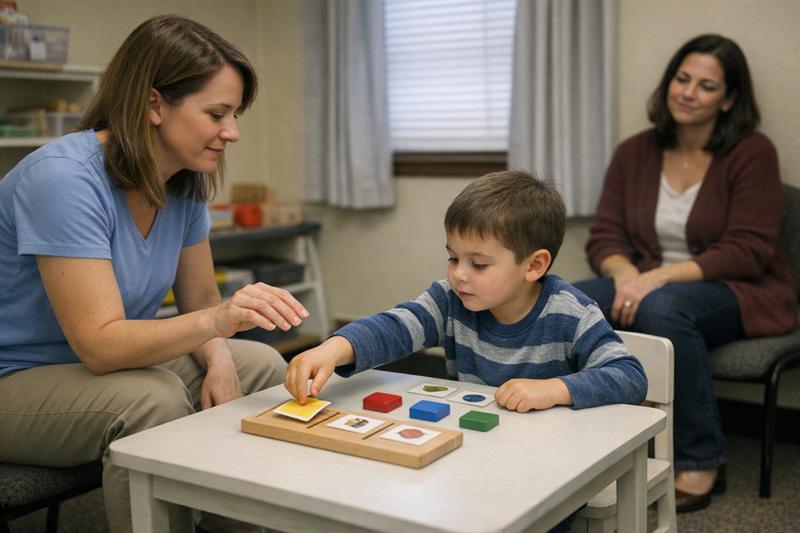
Quick Answer: Prompting in ABA is structured help used to guide a child to the correct response. When that help is not reduced at the right time, it can lead to reliance and limit independence.
This is where many families start to feel unsure. A child completes tasks during therapy or at home, but only with help. At first, that can look like progress. Over time, it becomes clear the skill is not carrying over.
At Strive ABA Consultants LLC, this pattern often comes up during evaluations and re-evaluations. Skills may appear learned, but they are still tied to prompts instead of natural cues. That gap is what this article explains.
What Is Prompting in ABA?
Prompting in ABA is the use of cues or assistance to help a learner respond correctly while building a new skill. These supports are planned and temporary.
The goal is not just a correct response. The goal is independence. When prompting is used well, it helps move a child toward that outcome. When it is not, progress can stall.
If you’re still getting familiar with how structured teaching works, it helps to understand what ABA therapy involves during assessment and early skill building.
Why Prompting Is Used in Skill Acquisition
Prompting helps reduce errors early in learning. Instead of guessing, the child is guided toward the correct response.
This can lead to quicker early progress and less frustration. But it can also create problems if prompting is not faded over time.
A common pattern is that the child begins to rely on help instead of attempting independently. That shift can be subtle at first and become more noticeable over time.
The Role of Prompts in Learning New Behaviors
Prompts are a bridge between not knowing and doing something independently. They are not the end goal.
This is where confusion often happens. A correct response with a prompt can look like mastery, but the prompt is still doing part of the work.
The Prompting Hierarchy Explained
The prompting hierarchy organizes support from more intrusive to less intrusive. It provides a clear structure for how help is given and how it is reduced.
- Full physical guidance
- Partial physical guidance
- Modeling
- Gestural prompts
- Verbal prompts
- Independent response
This structure helps move progress toward independence instead of keeping a child dependent on support.
Least-to-Most Prompting
Least-to-most prompting starts with minimal help and increases only when needed. This encourages the child to attempt the response independently first.
This approach works well when the child has some familiarity with the skill. It reduces the risk of giving more help than necessary.
Most-to-Least Prompting
Most-to-least prompting begins with full support and gradually reduces it. This is often used when teaching a new or more complex skill.
It helps establish correct responding early, but it requires a clear plan to reduce support. Without that, reliance can build quickly.
Choosing the Right Approach
The right approach depends on the child’s current skill level, how they respond to mistakes, and how quickly they learn.
One common issue is using the same approach for every skill. That can lead to uneven progress and missed opportunities for independence.
Types of Prompts in ABA (With Examples)
- Physical prompts: guiding a child’s movement, such as helping them complete a step in brushing teeth
- Verbal prompts: spoken cues like “say juice” or “what do you need?”
- Gestural prompts: pointing or signaling toward the correct item or action
- Visual prompts: pictures, schedules, or written cues that guide behavior
- Model prompts: demonstrating the action for the child to copy
Each prompt type provides a different level of support. The key is not just which prompt is used, but how it is reduced over time.
This is especially important in communication development. Early prompting is common, but it should shift toward independence, as explained in how ABA builds communication skills step by step.
What Is Prompt Fading?
Prompt fading is the process of reducing assistance so the child begins responding to natural cues instead of prompts.
This is where learning becomes functional. Without fading, the skill often stays tied to the teaching setting.
Why Fading Matters for Independence
Independence is the outcome that matters. Prompting without fading limits how far a skill can go.
This often shows up when a child performs well in sessions but struggles in everyday situations. The skill has not fully transferred.
Signs a Prompt Should Be Faded
- Responses are consistently correct
- The child responds more quickly
- There is less hesitation
- The same prompt is being used repeatedly
When these signs are present and prompts stay the same, progress often slows.
Common Fading Strategies
Fading can involve reducing physical guidance, adding a delay before prompting, or switching to a less intrusive prompt.
This is where timing matters. Fading too slowly can build reliance. Fading too quickly can increase errors. Both can disrupt progress.
Prompt Dependence: What to Watch For
Prompt dependence happens when a child waits for help instead of responding on their own.
This is something many families notice after initial progress. It often develops gradually and can be mistaken for steady learning.
Why Prompt Dependence Happens
This usually starts when prompts are not reduced or when prompted responses are treated the same as independent ones.
A common pattern is that the child learns to wait for the cue before responding. Over time, that can become the default response pattern.
How ABA Programs Prevent It
Strong ABA programs track performance and adjust prompting based on clear patterns.
They also focus on reinforcing independent responses more than prompted ones. This helps shift learning toward independence.
For a closer look at how structured programs support progress, see what makes an ABA program effective.
How Professionals Decide When to Prompt or Fade
Prompting decisions are based on how the child is performing over time, not guesswork.
Without consistent tracking, support can become inconsistent. That often leads to unclear progress.
Data Tracking and Decision-Making
Data helps show whether a skill is improving, staying the same, or becoming too dependent on prompts.
This can be difficult to see without tracking. What looks like progress may actually be repeated prompted responding.
Individualized Programming
Each child responds differently to prompting. Programs are adjusted based on those patterns.
This is often where gaps show up during re-evaluations. A fixed approach can miss how the child actually learns.
How Parents Can Support Prompting at Home
Consistency between therapy and home supports better learning. When prompting differs across settings, skills are less likely to carry over.
Consistency Across Environments
Using similar levels of support helps the child understand expectations. When those expectations shift, confusion can increase.
Avoiding Over-Prompting at Home
Helping too quickly is one of the most common patterns at home.
A child who is capable of responding may begin to wait simply because help is expected. This can slow independence.
This connects closely with reinforcement patterns. For practical guidance, see how to reinforce positive behavior without creating dependency.
Mid-Article Check: When Prompting Is Becoming a Problem
If the same type of help is used repeatedly, it usually means independence is not developing.
- Your child pauses and waits before responding
- The same prompt is needed every time
- Skills stay limited to therapy settings
- Progress looks steady but does not expand
When these patterns show up, support is no longer moving the skill forward. This is often a sign that the teaching approach needs to be adjusted.
When to Seek Professional Guidance
If prompting is not decreasing or progress feels unclear, the teaching approach may need a closer review.
This is often when families seek an evaluation or re-evaluation to better understand what is limiting independence.
At Strive ABA Consultants LLC, this is a common point of focus. Looking closely at how prompting is being used can help explain why progress has slowed.
Key Takeaways
- Prompting supports learning but is not meant to be permanent
- Different prompts provide different levels of support
- Fading is what leads to independence
- Prompt dependence is common when fading is delayed
- Clear data and structure guide effective decisions
Conclusion
Prompting is a useful tool, but it only works when it leads to independence.
When prompts are not reduced, children can begin to rely on them. This slows progress and limits how skills carry over into daily life.
Strive ABA Consultants LLC focuses on identifying where that process is breaking down. Through evaluations and re-evaluations, the goal is to help move skills from supported responses toward more independent use.
If support feels constant or progress has leveled off, the next step may be to take a closer look at how prompting is being used. Clear answers can lead to clearer progress.
FAQ
What is prompting in ABA therapy?
Prompting is the use of cues or assistance to guide a correct response. It can include physical, verbal, gestural, visual, and model supports. When prompting is not clearly structured, an evaluation may help clarify the right level of support.
What are the different types of prompts in ABA?
The main types are physical, verbal, gestural, visual, and model prompts. Each varies in how much help it provides. A structured plan helps determine which type fits each skill.
What is prompt fading in ABA?
Prompt fading is reducing assistance so the child responds more independently. This can include delaying prompts, using less intrusive prompts, or gradually reducing physical guidance. If independence is not increasing, the fading plan may need adjustment.
What is the prompting hierarchy in ABA?
The prompting hierarchy organizes support from more intrusive to less intrusive. It guides how assistance is provided and reduced. This structure helps move skills toward independence.
How do you avoid prompt dependence in ABA?
Prompt dependence is reduced by fading prompts and reinforcing independent responses. Tracking progress helps guide that process. When dependence appears, the teaching plan often needs to be adjusted.
When should prompts be removed in ABA therapy?
Prompts are usually reduced when responses become more consistent and quicker. Keeping them too long can increase reliance. If progress slows, a closer review can help determine what to adjust next.