
Quick Answer: ABA communication skills are typically built in a structured sequence, starting with simple requests and progressing toward more interactive language. When communication is limited or unclear, frustration can build quickly and may show up as behavior until those skills are taught in a clear, functional way.
Many families reach a point where their child wants something but cannot express it clearly. That gap shows up fast. It can look like guessing, pointing, or escalating behavior when needs are not understood. This is often where communication work in ABA begins.
At Strive ABA Consultants LLC, communication is one of the most common areas addressed during evaluations. A child is not simply “lacking words.” Often, they do not yet have a reliable system for getting needs met, responding to others, or participating in daily routines. When that system is built step-by-step, progress is easier to track and more likely to carry across settings.
Why Communication Is a Core Focus in ABA Therapy
Communication is not just about talking. It is about being able to express needs, respond to other people, and participate in everyday situations.
When communication is limited, behavior often increases because needs are not being understood. If a child cannot request, refuse, or respond, frustration can build and show up as tantrums, avoidance, or withdrawal.
- Speech is one form of communication, but not the only one
- Functional communication gives a clearer alternative to problem behavior
- Early communication skills support learning across daily routines
This is why ABA often prioritizes communication early. It is not treated as just one goal among many. It becomes a foundation that supports other skills. For a broader view of how communication fits into treatment, see what makes an ABA program effective.
Where Communication Starts: Understanding Your Child’s Baseline
Every child starts in a different place. Some use gestures. Some repeat words without clear meaning. Some do not respond consistently. This starting point, or baseline, helps guide what should be taught first.
Nonverbal Communication and Early Signals
Communication often begins before words. This can include pointing, leading an adult to an item, eye gaze, or vocal sounds.
Families sometimes assume “no speech” means “no communication.” In reality, communication is usually already happening, just not in a consistent or functional way yet. If this stage is overlooked, later skills can be harder to build because the foundation is unclear.
Assessments Used to Identify Communication Needs
ABA assessments look at how a child communicates in real situations, not just what they can say on demand. This includes observing motivation, responses, and how communication changes across environments.
If goals are set without a clear baseline, progress can become inconsistent. A structured evaluation, like those used during ABA assessments, helps align communication goals with the child’s current level.
Step 1: Teaching Requests (Mands)
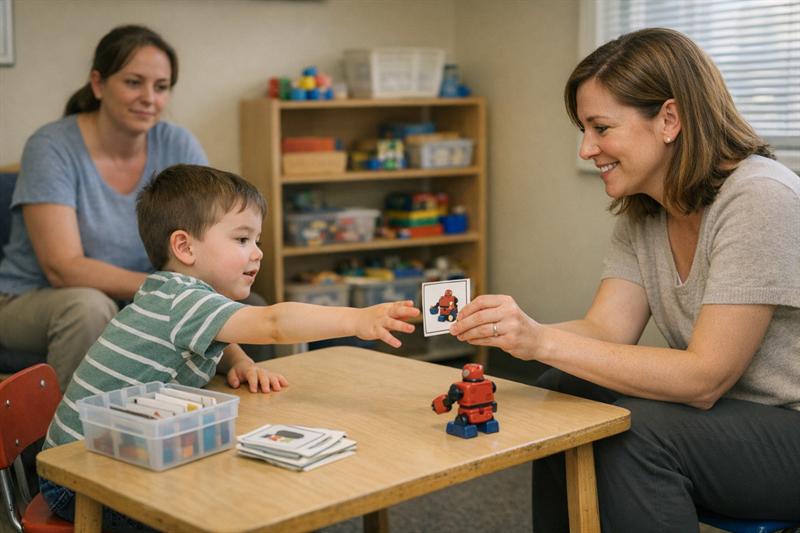
A mand is a request. It is often one of the first communication skills taught in ABA because it has immediate value for the child.
This step focuses on helping a child ask for what they want, such as a snack, a toy, or help. The key factor is motivation. Communication is more likely to develop when it is directly tied to something meaningful.
Why Requesting Is the Foundation
This is often where progress begins. When a child learns that communication leads to a result, they are more likely to use it consistently.
As requesting improves, challenging behavior related to frustration may start to decrease. Instead of crying or grabbing, the child has a clearer way to communicate. That can change daily routines in a noticeable way.
Examples of Early Requests
- Pointing to a desired item
- Using simple signs
- Handing over a picture (PECS)
- Saying a single word
- Using an AAC device
If requesting is not established first, later skills can be less reliable. Communication may be introduced, but not yet in a way the child can use consistently across situations.
Step 2: Labeling and Vocabulary (Tacts)
A tact is labeling something in the environment. This step expands communication beyond immediate needs.
Instead of only asking for things, the child begins to name objects, people, and actions. This builds awareness and creates a more usable vocabulary.
Building Awareness of the Environment
This stage includes identifying items like “ball,” “dog,” or “car.” It connects words to real-world meaning.
Pacing matters here. If labeling is rushed or taught inconsistently, later conversation can feel limited because the child does not yet have enough language to draw from.
Expanding Word Use Beyond Needs
Language becomes more flexible. A child may move from “want juice” to identifying “juice,” “cup,” or simple features of an item.
This step helps bridge basic communication and more natural language use.
Step 3: Answering Questions and Conversation (Intraverbals)
An intraverbal is responding to someone else’s words. This is where communication becomes more interactive.
From Simple Responses to Conversation
This often begins with answering simple questions like “What do you want?” or “Where is your shoe?”
One common challenge is expecting conversation too early. When requesting and labeling are not yet solid, this step can break down. A child may repeat phrases without clear understanding or avoid responding altogether.
Building Back-and-Forth Communication
This stage develops turn-taking and simple exchanges. Over time, it can grow into more natural conversation.
When earlier steps are in place, this stage tends to move more smoothly. When they are not, conversation often stalls.
Step 4: Generalizing Communication in Real Life
Learning a skill in therapy is only part of the process. It also needs to carry over into everyday situations.
Practicing at Home, School, and in the Community
A child may communicate well during sessions but not at home or school. This usually means the skill has not generalized yet.
Generalization requires practice across environments and with different people. For a closer look at how this works, see how to generalize ABA skills across home, school, and community.
Reducing Prompt Dependence
Prompts are helpful early on, but they should be faded over time. If they are not, the child may wait for cues instead of initiating communication independently.
This is one reason progress can appear stronger in sessions than in daily life. Communication may be present, but not yet functional without support.
How ABA Supports Nonverbal and Minimally Verbal Children
Communication does not depend on speech. ABA can use different methods based on what the child can access and use consistently.
- AAC devices
- Picture Exchange Communication System (PECS)
- Sign language
- Gestures and visual supports
Families often wonder whether introducing alternative communication will delay speech. In practice, waiting for speech can delay communication itself. Introducing another communication method early gives the child a way to express needs now while still supporting overall language development.
Common Challenges in Communication Development
- Plateaus where progress slows
- Echolalia without clear functional use
- Prompt dependence
- Frustration-related behaviors
Communication programs are often less effective when steps are rushed or foundational skills are skipped. When that happens, skills may appear present but are not yet reliable.
If those gaps continue, progress usually slows and behavior concerns can become more frequent. At that point, it is often necessary to return to the earlier communication foundation.
How Parents Are Involved in Building Communication Skills
Progress depends on consistency across environments. Therapy sessions alone are usually not enough.
Skills may improve during sessions but not carry over if they are not practiced outside of therapy.
Parent involvement creates more opportunities for communication throughout the day. Everyday routines become part of the learning process. For practical strategies, see how parent training supports daily routines.
Without that consistency, progress often becomes slower and less reliable.
Key Takeaways
- Communication is built step-by-step, not all at once
- Requesting (mands) is often the starting point
- Labeling (tacts) builds usable vocabulary
- Conversation (intraverbals) develops later
- Communication does not depend on speech alone
- Consistency across environments supports long-term progress
Conclusion
The core issue is often not just delayed speech. It is a communication system that has not been fully developed yet. When that system is unclear or incomplete, frustration can build, behavior may increase, and progress can become inconsistent.
This usually does not improve through time alone. Communication needs to be built in the right order, starting with what the child can already do and expanding from there.
Strive ABA Consultants LLC focuses on identifying where communication breaks down and building it step-by-step. With thorough evaluations, individualized planning, and support across environments, communication can become more functional and easier to use in daily life.
If a child is struggling to express needs, respond, or engage, a structured evaluation can help identify the current level and guide what to teach next.
Frequently Asked Questions
How does ABA improve communication skills?
ABA improves communication by teaching it in a structured sequence, often starting with requests and building toward more interactive language. It uses reinforcement and repeated practice to support consistent use. An evaluation helps determine where to begin.
What are mands, tacts, and intraverbals in ABA?
Mands are requests, tacts are labels, and intraverbals are conversational responses. These skills are often taught in sequence to build functional communication. They help guide what skills may come next.
Can ABA help a nonverbal child communicate?
Yes, ABA can support communication using tools like AAC, PECS, and gestures. These methods provide a way to express needs without relying on speech alone. The approach is based on what the child can use consistently.
How long does it take to see communication progress in ABA?
Progress depends on the child’s starting point and how consistently skills are practiced. Basic requesting may develop sooner, while back-and-forth conversation usually takes more time. Ongoing assessment helps guide the pace and next steps.
What is the difference between speech therapy and ABA for communication?
Speech therapy often focuses on speech, language, and related communication development, while ABA focuses on how communication is used in everyday situations. ABA targets functional use, including when and why to communicate. Many children benefit from both approaches together.
At what age should communication therapy begin for autism?
Communication support can begin as soon as delays are identified. Early support can help build a stronger foundation for later skills. An evaluation helps determine the most appropriate starting point.