

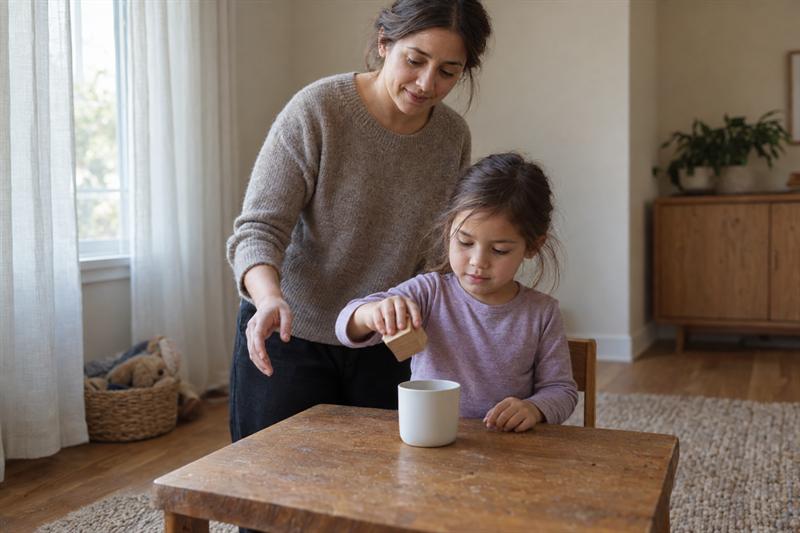
What prompting means in ABA
Prompting in ABA is a teaching support. It helps a learner start, complete, or respond to a task more successfully while the skill is still being learned.
In simple terms, a prompt is the extra help given before or during a response. That help might be a gesture, a visual, a spoken reminder, a model, or hands-on assistance. If a child completes a task only after that help is given, the response was prompted rather than fully independent.
If you want a basic refresher first, this parent-friendly ABA vocabulary guide explains prompt and fade in plain language.
Why prompts are used in the first place
Learning usually does not start with independence. New skills often begin with support, especially when a child is learning a routine, a communication response, or a multi-step task.
Families may notice this early in services. A child may know part of a routine but still pause, wait, or guess when the next step is unclear. Prompts help make the task clearer so the child can practice the right response instead of repeating errors.
- They help a child understand what response is expected
- They can reduce frustration during new or difficult tasks
- They support practice when a skill is not yet consistent
- They can create a clearer path toward independence when used well
Some skills need more support at the start than others. Communication goals, safety routines, and daily living tasks may call for more direct teaching because the response needs to be clear and usable, not just approximate.
This point is easy to miss when support is mistaken for progress by itself. Prompting is part of teaching. The goal is for the support to decrease as the skill becomes more stable.
The real goal: independence, not long-term prompting
The goal of ABA teaching is not simply getting a correct response in the moment. The goal is helping the child use the skill with less help, in more places, and with more people.
A child who answers correctly only after a verbal cue is in a different place than a child who answers without any cue at all. Both responses matter, but they mean different things. Prompted success shows the child can perform with support. Independent success shows the skill is becoming usable without someone setting it up first.
This is a point that can create confusion for families. A task may look successful during a session, but the support level still tells an important part of the story. If the same help is still doing most of the work, the skill is not yet holding up on its own.
This is also where progress can stall. When support stays too heavy for too long, the child may start waiting for help instead of responding to the instruction, the routine, or the environment. That pattern can make carryover and generalization harder.
Common types of prompts families may hear about
ABA teams may use different kinds of prompts depending on the skill and the learner’s needs.
- Verbal prompts: spoken reminders or directions, such as “say help” or “get your shoes”
- Gestural prompts: pointing, looking toward an item, or using a hand motion
- Visual prompts: pictures, schedules, written steps, or visual cues placed in the environment
- Model prompts: showing the child what to do first so the child can copy it
- Physical prompts: guiding part or all of the movement, from light assistance to full hands-on support
Not every goal uses every prompt type. A child learning a handwashing routine may need visuals and modeling. A child working on communication may respond better to a pause, a gesture, or a brief verbal cue. A child learning a motor sequence may need more physical support at first.
One detail that matters here is how easy the support will be to reduce later. Some forms of help are generally easier to fade than others, which is one reason prompt selection matters at the start of teaching.
What a prompt hierarchy means
A prompt hierarchy is the order in which support is used, either from less intrusive help to more intrusive help or the reverse, depending on the goal. It gives structure to teaching so support is planned rather than random.
Least-to-most prompting usually starts with the smallest amount of help and adds more only if needed. Most-to-least prompting usually starts with stronger support and then reduces it as the learner becomes more accurate.
There is no single hierarchy that fits every child or every task. A safety routine, toileting step, or motor action may need a different prompt plan than answering a question or making a request. What matters is that the support is used consistently and for a clear reason.
What fading prompts means
Fading prompts means reducing support so the child does more of the skill independently. That reduction can happen by changing the prompt type, making the prompt less intense, waiting longer before giving help, or using the support less often.
This is one of the clearest signs of meaningful progress. If a child moves from full physical help to a model, then from a model to a gesture, and then starts completing the step without any extra cue, the skill is becoming more independent. The exact sequence may look different from one goal to another, but the direction should be clear.
When fading is handled well, the child is more likely to respond to the routine, the environment, or the instruction itself instead of waiting for the same extra help every time.
For families reviewing goals and support plans, what an ABA treatment plan should include can help make the teaching plan easier to interpret.
What prompting and fading can look like in everyday routines
Communication example
A child learning to ask for help might first need a direct verbal prompt such as “say help.” Later, the support may shift to a shorter cue, a gesture toward a communication device, or a pause that gives the child time to initiate.
If the child only asks after hearing the full verbal prompt every time, the skill is not yet independent. If the child starts asking after a brief pause or a smaller cue, that usually shows the support is being reduced in a useful way.
Daily living example
Handwashing is a practical example because it includes several steps. A child may begin with visual supports, a model of the first step, or partial physical guidance for turning on the faucet.
Over time, the child should need less of that support. Families often notice that a child can complete the middle of the sequence fairly well but still stalls at the start or end. That can help show where the prompt is still carrying the routine.
For a deeper look at independence goals tied to routines, life skills in ABA gives useful context.
Transitions, play, or community example
A child may transition well in therapy after a countdown or visual cue but need more support at home, in the car, or during errands. That does not mean the teaching was ineffective. It often means the skill has not generalized yet.
This is where families can get mixed signals. A skill may look solid in one setting, then break down elsewhere when the prompt, routine, or pace changes. In many cases, that means the skill is still tied to a specific context instead of being flexible across settings.
If carryover is a challenge across settings, how to plan skill carryover from ABA sessions to home, school, and community is a helpful next read.
When families worry about prompt dependence
Prompt dependence means the child has started relying on the help instead of the natural cue, instruction, or routine. That does not mean every prompted response is a problem. It means the support may be doing too much of the work.
One common pattern is waiting. The child knows part of the task but pauses until the same reminder, gesture, or assistance appears. Another pattern is setting-specific success, where the skill happens with one adult or in one place but drops off when the prompt changes.
- The child waits for a familiar reminder before starting
- The task stops when the prompt is removed
- The skill happens with one adult but not with others
- The routine works in therapy but breaks down at home or in the community
This can get worse when every adult prompts differently. The child may end up relying on inconsistent help instead of learning what to respond to in the routine itself.
If you are seeing the same prompt used over and over with little change, it is worth looking more closely at the teaching plan.
- The child completes the skill only after the exact same cue
- Support has stayed at the same level for an extended period without a clear explanation
- Success drops sharply when a different person runs the routine
- The child performs in session but not in daily life
When those signs are showing up together, the prompt strategy or carryover plan may need a closer review. That usually means the support is not yet translating into usable independence.
How prompting may show up in progress reports and review meetings
Progress notes and review meetings often separate independent responses from prompted responses because they show different stages of learning. If a report says a child was correct with prompts, that means the response happened with help. It does not mean the skill is fully mastered.
This is something families commonly misread. “Correct” sounds like the main takeaway. In practice, the support level matters just as much because it shows how close the child is to using the skill without assistance.
A report that shows more correct responses with lighter prompts can still reflect meaningful progress. A report that shows accuracy staying tied to the same heavy prompt over time may point to a slower move toward independence. That is the distinction families should listen for during meetings.
Questions families can ask if support does not seem to be fading
- What kind of prompt is being used most often for this goal?
- How is the team deciding when to reduce support?
- Is the child using this skill in more than one setting?
- What does independent performance look like for this specific goal?
- Which part of the routine still needs the most help?
These questions help move the conversation past “is progress happening?” and into “what kind of progress is happening?” That usually gives families a much clearer picture of whether the child is moving toward usable independence.
If you need a broader framework for those conversations, this ABA care team meeting guide can help families prepare.
How families can support consistency without over-prompting
Families usually help most by staying consistent with the plan instead of adding extra reminders out of habit. More words are not always better. Repeating the same cue too quickly can teach the child to wait rather than act.
This is something many families recognize in busy home routines. An adult gives an instruction, repeats it several times, adds gestures, and then finishes the step for the child. The routine gets done, but the child had very little space to respond independently.
A more useful approach is to use the agreed-on cue, allow enough time for a response, and keep supports consistent across caregivers. If visuals or step-by-step routines are part of the plan, they need to be used the same way at home rather than replaced with a different prompt style each day.
Families trying to align routines across adults may also find how to build a caregiver consistency plan for ABA support helpful.
Key Takeaways
- Prompting in ABA is a teaching support, not the final goal
- Fading prompts matters because independence is what makes the skill more usable in real life
- Correct with prompts and independent performance are not the same thing
- Prompt dependence often shows up as waiting, setting-specific success, or breakdown when support changes
- Progress is clearer when help is decreasing and the skill is carrying over across people and settings
Conclusion
The real issue is not whether prompts are used. The real issue is whether support is leading to independence or quietly becoming part of the routine itself. If that pattern is not addressed, a child may keep succeeding only when the setup is just right, and the skill may break down when the person, place, or cue changes.
That is why families need more than definitions. They need a practical way to interpret prompted performance, spot where carryover is breaking down, and understand whether the teaching plan is actually moving toward independence.
Strive ABA Consultants LLC can be a practical next step for families who need clearer guidance around evaluations, reevaluations, and what support should look like when progress is hard to interpret. When the same prompt is carrying the skill, when routines fall apart across settings, or when reports sound positive but daily life tells a different story, clearer review and planning can help families move forward.
Company Approach
At Strive ABA Consultants LLC, the focus is on helping families make sense of what support looks like in real routines, not just in clinical language. That matters when a child can perform a skill during structured teaching but still struggles to use it across home, school, or community settings.
Strive ABA Consultants LLC also offers autism evaluations and reevaluations for families who need clearer next-step planning. When prompting, carryover, or independence concerns point to a larger need for updated recommendations or a closer look at support needs, that added clarity can make decisions easier.
FAQ
Is prompting in ABA a bad sign?
No. Prompting is not a bad sign by itself. It is a teaching tool used when a skill is still developing and the child needs support to respond correctly.
The key distinction is whether the child is becoming less dependent on that support over time. A child who now needs a quick gesture after previously needing full physical help is moving in the right direction. A child who still needs the same exact prompt every time is in a different place, even if the response is technically correct.
How do I know if prompts are being faded appropriately?
Prompts are being faded appropriately when the support becomes lighter, less frequent, or less necessary as the child learns the skill. The direction should be clear, even if the pace is not perfectly steady.
For example, a child who once needed a full spoken reminder to ask for help might later respond to a pause or a point toward a communication device. That shift matters because it shows the child is doing more of the work. What families should expect is not instant independence, but a teaching pattern where the support is doing less over time.
What is the difference between a prompt and a cue in ABA?
A cue is the signal that tells the child what to do. A prompt is the extra help added to make that response more likely to happen correctly.
If a parent says, “Put your shoes on,” that instruction is the cue. If the child does not respond and the adult points to the shoes or models the first step, that added support is the prompt. The difference matters because the long-term goal is for the child to respond to the cue without needing the extra layer of help.
Can too much prompting make a child rely on help?
Yes. Too much prompting can lead to waiting, especially when help comes too fast or in the same form every time.
A common example is repeated verbal reminders. If the child hears the next cue before having time to process or attempt the step, the routine can start revolving around the adult’s reminders instead of the child’s response. What is often misunderstood is that over-prompting does not just look like “a lot of help.” It also looks like help arriving so predictably that the child stops trying before it appears.
Why can a child do a skill in therapy but still need prompts at home?
Because a skill that works in one setting is not automatically generalized to another. The environment, people, timing, materials, and pace can all change what the child is responding to.
A child may wash hands in a therapy setting with the same sink, same sequence, and same visual supports each session, then stall at home where the setup is different and the routine is less structured. That often means the skill is still tied to one context. It does not necessarily mean the learning was ineffective. It usually means the skill still needs support to carry over across settings.
What should parents ask if a progress report says “correct with prompts”?
Ask what type of prompt was needed, how much of the task still required support, and whether that support is decreasing over time. “Correct with prompts” only tells part of the story.
There is a big difference between a response that happens after a brief gesture and one that requires full physical assistance. There is also a difference between needing help in one setting and needing help everywhere. What matters most is how close the child is to doing the skill without that extra support and whether that gap is getting smaller.