

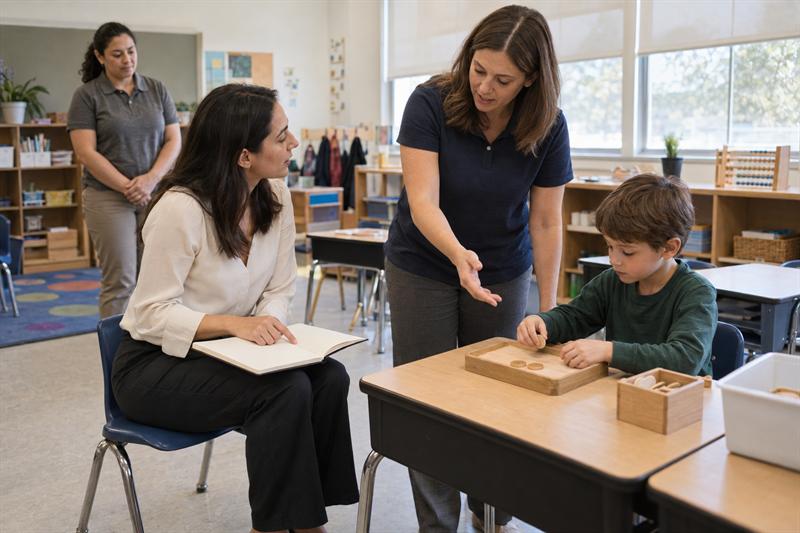
School-based ABA usually refers to behavior support provided in the school environment and tied to school-day needs like transitions, classroom participation, communication, peer interaction, and following routines. It is not one fixed service model, which is why the same term can describe different kinds of support.
At Strive ABA Consultants LLC, this question often comes up when families are preparing for a meeting or trying to make sense of a recommendation that sounded important but stayed vague. Often, the term gets introduced first and the details come later. That is where confusion can start, because parents may think they are agreeing to one type of support when the school is describing something else.
What school-based ABA means
School-based ABA means ABA-informed support provided in a school setting to help with behavior, learning, communication, participation, routines, and social functioning during the school day. The most important point is not the label itself. It is what the support actually includes.
Some students receive support tied to classroom routines and transitions. Others need help with participation, communication, or replacement skills when certain demands are linked to repeated breakdowns. In practice, “school-based ABA” works as an umbrella term, and families need to know what is under that umbrella in their child’s situation.
A simple definition in everyday language
School-based ABA is support that uses ABA strategies in the school setting to help a student take part more successfully in daily school routines, learning activities, communication, and behavior expectations. It is built around what is happening during the school day, not around a generic therapy model.
Why schools and providers may use the term differently
This is one of the biggest reasons families feel confused. Different teams use the same phrase to mean different things, and that can lead to mixed expectations if nobody slows down and defines it clearly.
- Some use school-based ABA to mean direct student support during parts of the school day.
- Some use it to mean observation, planning, and consultation with school staff.
- Some use it to mean staff coaching, behavior planning, or a mix of several supports.
Parents may hear “ABA” and picture one-to-one therapy, while the school is really talking about classroom strategy changes or team consultation. That misunderstanding can create frustration later, especially when families expect frequent direct sessions and the plan turns out to be more consultative. For a clearer breakdown of consultative models, see What Is ABA Consulting? How It Differs From Direct Therapy, Behavior Coaching, and OBM.
What school-based ABA can look like during the school day
School-based ABA can look very different depending on what is getting in the way of school participation. Strong plans are specific about where problems happen, what may be triggering them, and what support adults are supposed to use in response. When that detail is missing, the plan can stay too vague to use consistently.
Practical examples matter more than broad definitions here. Families need to know what support actually looks like during real school routines.
Direct support with a student
In some cases, school-based ABA includes direct support with a student during classroom routines, transitions, small-group activities, or other parts of the day where breakdowns keep happening. That support may focus on asking for help, moving between activities, tolerating changes, following directions, or staying engaged long enough to complete tasks.
It does not automatically mean one-to-one support all day. That is another point that commonly gets misunderstood. Direct support is one model, not the default in every setting.
Observation, planning, and consultation
Sometimes the most important school-based ABA work happens before anyone directly intervenes. A provider or consultant may watch where routines break down, identify patterns, review what happens before and after problem behavior, and help the school team adjust the plan.
This usually matters most when adults know there is a problem but cannot explain why it keeps repeating. For example, a student may be described as “having a hard time” across the day when the issue is actually narrower, like transitions after lunch, work refusal during writing tasks, or escalation when directions change too quickly. Once the pattern is clearer, the support plan may become more usable.
Staff coaching and classroom strategies
School-based ABA may also include coaching for teachers, aides, or other staff so the student gets more consistent support across the day. This usually focuses on what adults should do before a problem starts, how to respond when a student is beginning to struggle, and how to reinforce replacement skills instead of reacting only after behavior escalates.
- using clearer transition warnings
- breaking tasks into manageable steps
- teaching a consistent way to ask for help or a break
- responding the same way across staff members
This is where progress can stall when no one is coordinating the adult response. One adult gives extra prompts, another removes demands, another redirects verbally, and another ignores the pattern entirely. The student may end up getting inconsistent feedback, and the problem can keep repeating because the plan is not being used the same way.
What goals school-based ABA often focuses on
School-based ABA usually focuses on goals that affect participation in the educational environment. That means the goals should connect to what a student needs to do during the school day, not just to broad ideas like “better behavior” or “more success.”
The strongest goals are observable. They describe what is getting in the way, what skill needs to be built instead, and what progress would look like in a real school routine.
Communication and classroom participation
Many school-based ABA goals focus on helping a student take part in instruction more effectively. That may include requesting help, following group directions, starting tasks, staying with a routine, or using a more effective way to communicate confusion or frustration.
Sometimes students get labeled as noncompliant when the actual issue is unclear expectations, weak communication supports, or demands that shift too fast. When the communication piece gets missed, behavior may become the main thing adults notice, and the real barrier can stay in place.
Social interaction and routines
Some goals focus on peer interaction and the routines that hold the school day together. That can include waiting, turn-taking, lining up, joining group activities, handling recess transitions, or participating during lunch and social time.
These routines may look small to adults, but they are where problems start for many students. A student who handles academic work fairly well may still struggle during less structured parts of the day. If those patterns are ignored, the team may end up responding to behavior in multiple settings instead of addressing the routine that keeps triggering it.
Behavior reduction and replacement skills
School-based ABA is not only about reducing behaviors that interfere with learning. It is also about teaching what a student should do instead. That is what makes the support practical.
- asking for help instead of leaving the area
- requesting a break instead of refusing the task
- using a taught transition routine instead of escalating during schedule changes
When replacement skills are missing, adults may end up reacting to the same problem again and again. That can lead to more interruptions, more frustration, and more confusion about why the behavior keeps returning.
If you are hearing the term school-based ABA and still do not know what the actual support plan is, that usually means more clarification is needed before the next meeting.
- The term has been used, but no one has explained whether support is direct, consultative, or coaching-based.
- You know there are concerns at school, but nobody has identified the specific routines where the problem starts.
- Different adults are describing the same issue in different ways.
- You have heard about goals, but not how progress will be reviewed.
When those signs are present, the next step is usually to define the support more clearly before the plan becomes harder to implement consistently.
Who may be involved in school-based ABA
School-based ABA usually involves more than one person. That matters because families sometimes assume one provider is handling everything, when the real plan depends on several adults carrying out different parts of the support.
The better the role clarity, the better the follow-through. When roles are unclear, support can become inconsistent quickly.
BCBAs, teachers, paraprofessionals, and families
- BCBAs: may help identify patterns, design strategies, review data, and guide how supports are used.
- Teachers: usually carry key responsibility for how support fits into instruction, routines, and classroom expectations.
- Paraprofessionals or aides: may help implement day-to-day strategies during specific parts of the school schedule.
- Families: help provide context, share patterns seen outside school, and understand how school support connects to other routines.
For families sorting out team roles more broadly, ABA Care Team Meeting Guide: Roles, Questions, and Follow-Up for Families can help organize who is doing what.
How collaboration usually works
Good school-based ABA depends on adults sharing the same understanding of the problem and using the same plan often enough for a student to learn from it. That usually means regular communication about triggers, routines, prompts, and what counts as progress.
This is where breakdowns commonly happen. One team member changes the approach, another misses the cueing plan, and another does not know the replacement skill being taught. Once that happens, the student may get mixed messages, and progress can slow because the environment is no longer predictable.
How school-based ABA is different from home or clinic ABA
School-based ABA is shaped by school demands. Home and clinic ABA are shaped by different routines, priorities, and people. The difference is not just location. It is what the setting requires a student to do and what the support is trying to change in that setting.
Families comparing models usually need this distinction early. Without it, they may expect school-based support to function like home or clinic therapy, and that can create frustration later.
Setting and priorities
- School-based ABA: focuses on participation in the educational environment, including routines, transitions, communication, and behavior that affects learning.
- Home or clinic ABA: may focus on a broader mix of communication, daily living, behavior, play, family routines, and community carryover depending on the plan.
For a broader comparison of service settings, see In-Home vs Center-Based ABA Therapy: A Practical Fit Guide.
Skills addressed in each setting
Some skills overlap across settings, such as transitions, communication, self-regulation, and asking for help. What changes is the context. A transition goal at school might center on moving from recess to class. A transition goal at home might focus on ending screen time or leaving for appointments on time.
This usually matters more than families expect. When the setting changes, the cues, demands, people, and routines change too. That means a skill that looks strong in one setting may still break down in another unless carryover is planned clearly.
Why some children benefit from more than one support model
Some children need support in more than one setting because the same challenge is showing up in different ways across the day. A child might manage in a clinic but struggle in busy school routines, or do better at school and still need help with home routines and caregiver consistency.
The key is not adding services automatically. The key is matching support to where breakdowns are actually happening. When that step gets skipped, families may end up with services that sound comprehensive but do not target the setting where support is breaking down most.
When families usually hear about school-based ABA
Most families do not start by searching for school-based ABA because they already understand it. They start searching after someone at school, during an evaluation, or in a planning conversation uses the term without enough explanation.
That timing matters. It usually means the family is trying to make a decision quickly while still learning the language around the recommendation.
After evaluations or reevaluations
Families may hear about school-based ABA after new information comes up about communication, behavior, participation, or learning needs. In some cases, an evaluation or reevaluation helps explain why a student is struggling across certain routines or why previous supports have not been enough.
At Strive ABA Consultants LLC, evaluations and reevaluations can be part of that larger clarity process. Sometimes families know something is not working at school, but they still do not have a clear picture of which needs are driving the problem. Without that clarity, support plans can stay too broad and too reactive.
During IEP planning or school problem-solving meetings
School-based ABA often comes up when a team is discussing barriers to participation, classroom functioning, or behavior that is interrupting learning. That does not automatically tell a family what the support will look like. It tells them the team sees a need for a more structured behavior-support discussion.
That is why planning details matter so much. If a meeting ends with a label but not a defined support model, the family leaves without enough information to evaluate the recommendation well. For help getting organized before that conversation, see School ABA Planning Meeting Agenda: Roles, Questions, and Next Steps.
When behavior or participation concerns affect learning
School-based ABA is usually discussed when repeated patterns start interfering with the school day. Those patterns tend to show up in specific routines rather than everywhere at once.
- transitions between activities keep leading to escalation
- classroom directions break down before tasks even begin
- peer routines become a repeated source of stress or conflict
- task avoidance keeps interrupting instruction
If these patterns are ignored, they can spread. A problem that starts in one routine may begin affecting the next routine, and then the rest of the day can start to feel unstable for both the student and the adults supporting them.
Questions families can ask if school-based ABA is mentioned
The best next step is not accepting or rejecting the term on the spot. It is clarifying what the team actually means by it. That is what allows families to understand whether the recommendation fits the problem being discussed.
This is also where many families regain control of the conversation. Once the questions get specific, vague recommendations usually become much easier to evaluate.
What support will actually be provided?
- Does this mean direct support with the student, consultation with staff, observation, or coaching?
- Where during the school day will the support happen?
- Which routines or situations is the plan designed to address?
If no one can answer those questions clearly, the recommendation is still too vague. That usually means more planning is needed before expectations are realistic.
Who is responsible for each part of the plan?
- Who is designing the support plan?
- Who is carrying it out during the day?
- Who is tracking what is working and what is not?
- Who is updating the family?
This usually makes hidden gaps easier to spot. A plan can sound stronger on paper than it works in practice when nobody is clearly responsible for implementation and follow-through.
How will progress be reviewed?
- What goals are being tracked?
- How will progress be measured in daily school routines?
- When will the team review whether the plan is working?
Progress review matters because support that is not being reviewed usually drifts. The plan stays in place, but no one is checking whether the problem is actually getting better, staying the same, or shifting into a new routine.
Key takeaways
- School-based ABA is a broad term, and the label alone does not explain what support a student will receive.
- It may involve direct support, consultation, behavior planning, staff coaching, or a combination of these.
- The main goals are usually tied to school participation, routines, communication, and behavior that affects learning.
- Role clarity and consistent implementation matter as much as the plan itself.
- When the details stay vague, misunderstandings usually follow and implementation can become weaker.
Conclusion
The real problem is not just understanding the phrase “school-based ABA.” The bigger issue is that vague use of the term can lead families to make decisions without a clear picture of what support is actually being recommended. When that is not addressed, expectations can drift, implementation can become inconsistent, and the student may be the one who feels that instability first.
Strive ABA Consultants LLC can be a practical next step when families need clearer understanding around evaluations, reevaluations, and ABA-related support planning. This article has outlined several patterns that commonly cause confusion: broad labels, unclear roles, weak carryover, and plans that do not match the routine where the problem starts. When those patterns are showing up, clearer planning is usually needed next, and Strive ABA Consultants LLC helps families move forward with that clarity.
Company approach
At Strive ABA Consultants LLC, the focus is not on using more terminology. The focus is on making the support picture clearer so families understand what is being recommended, why it is being discussed, and what details matter most before a plan moves forward.
That matters most when a family is dealing with delays, mixed messages, or school concerns that still do not have a usable explanation behind them. Strive ABA Consultants LLC provides evaluations and reevaluations that can help families get clearer about needs, planning, and what questions to ask when school-based ABA enters the conversation.
FAQ
Is school-based ABA the same as ABA therapy?
No. School-based ABA can include ABA-informed support during the school day, but it does not always look like direct ABA therapy in a home or clinic setting. In some schools, it involves direct support with a student. In others, it focuses more on consultation, behavior planning, or coaching staff on strategies that fit the classroom.
The most important distinction is what the support actually includes. A family may hear “school-based ABA” and assume it means one-to-one therapy, while the school is really describing observation and strategy development for classroom routines. What changes the decision is not the label alone, but the scope, setting, and goals of the support being discussed.
Who provides school-based ABA in a school setting?
School-based ABA may involve several people rather than one single provider. A BCBA may help design strategies, review data, or guide implementation. Teachers and paraprofessionals may carry out supports during daily routines. Families may also be part of the communication and planning process.
A useful distinction is that the person writing or guiding the plan may not be the person using it moment to moment in the classroom. One adult may observe patterns and recommend changes, while classroom staff apply those supports during transitions, group instruction, or peer activities. That means families should pay attention to both who oversees the plan and who implements it day to day.
What does school-based ABA help with?
School-based ABA often focuses on helping a student participate more successfully in the educational environment. That can include communication, transitions, classroom routines, task completion, peer interaction, and behaviors that interfere with learning.
One commonly misunderstood point is that the goal is not only to reduce challenging behavior. It also involves teaching replacement skills, such as asking for help, waiting, shifting between activities, or using a more effective way to communicate frustration. The support is usually tied to how the student functions during the school day, not just to behavior in isolation.
How is school-based ABA different from home or clinic ABA?
The biggest difference is the setting and what that setting requires. School-based ABA is generally focused on participation in the educational environment, such as following routines, transitioning, engaging in instruction, or interacting with peers. Home or clinic ABA may address a broader set of routines, skills, or family goals outside the school day.
Some skills overlap across settings, like communication or self-regulation, but the priorities can still look different. A child might work on transitions in both places, yet the school version may center on moving between classroom activities, while home-based work may focus on morning routines or leaving preferred activities. What matters most is how the setting shapes the goals, expectations, and people involved.
Why would a school recommend school-based ABA?
A school may bring up school-based ABA when a student’s behavior, communication, routines, or participation is affecting learning or access to the school day. The recommendation often comes up during school problem-solving, after new information from evaluations or reevaluations, or when a team is trying to make supports more consistent.
This does not automatically point to one specific service model. Sometimes the issue is that staff need better strategies for transitions or classroom participation. In another situation, the team may need more structured planning around behaviors that interfere with instruction. The same recommendation can lead to different types of support depending on the actual concern being addressed.
What should families ask when school-based ABA is brought up in a meeting?
Families should ask what support is being proposed, who will provide it, where it will happen, and how progress will be reviewed. Those questions turn a broad label into a concrete plan.
A useful example is asking whether “school-based ABA” means direct work with the student, consultation with staff, or a combination of both. Another helpful question is how the team will know whether the support is working. These details matter because two plans can use the same term but look very different in practice. The key issue is clarity about scope, roles, and goals.