

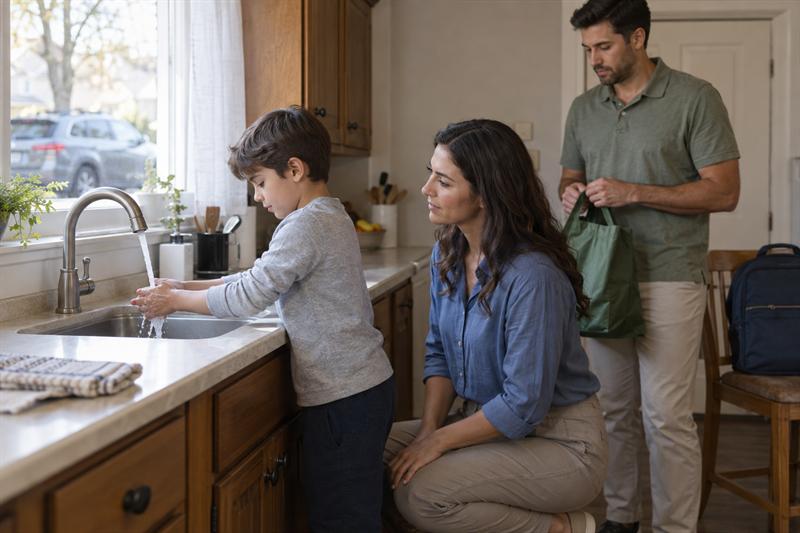
What Are Life Skills in ABA?
Life skills in ABA are practical, everyday skills that help a person participate more independently at home and in the community. These goals are chosen because they affect real routines like getting dressed, washing hands, leaving the house, following a simple plan, or managing transitions more successfully.
At Strive ABA Consultants LLC, this distinction matters because a skill is only useful if it works when it is actually needed. Families often run into this issue: a child can do part of a task during a session, but the same routine may break down during a rushed morning, an errand, or a caregiver handoff.
Life skills in ABA may include:
- personal hygiene and self-care routines
- dressing and toileting steps
- home routines and household participation
- waiting, transitions, and safety expectations
- community outings and public routines
- skills that support long-term independence
How life skills differ from academic or purely social goals
Life skills focus on function. Academic goals may center on classroom performance, and social goals may center on interaction, but life skills are about whether a person can move through daily routines with less support and more consistency.
That difference matters because routine difficulty can create pressure quickly. When a person has trouble completing key parts of a morning routine, tolerating an errand, or following simple steps outside one setting, it can affect family stress, participation, and access to everyday activities.
Why functional independence matters across ages
Functional independence matters in childhood, adolescence, and adulthood because daily routines do not necessarily get simpler over time. Expectations often expand across school, home, transportation, errands, peer settings, and community participation.
Independence is not all-or-nothing. A common mistake is treating independence as something that only counts when no help is needed. In practice, progress often starts with fewer prompts, smoother transitions, better follow-through, and more reliable participation across settings.
Common Life Skills ABA Programs May Target
Life skills goals should look familiar to families because they come from routines that already happen every day. One common problem is that a support plan sounds broad, but it does not match the routines that break down most often.
Strong life skills planning usually targets the routines that affect participation, stress, and daily consistency the most.
Self-care and personal routines
These are some of the most common daily living skills in ABA because they come up every day and can affect independence when they are inconsistent.
- dressing
- toothbrushing and hygiene
- toileting routines
- handwashing
- morning and bedtime routines
Home and household participation
Life skills are not limited to personal care. They also include the ability to take part in routines that keep the household moving.
- cleaning up after activities
- simple meal participation
- putting items away
- following a home routine
- participating in chores at an appropriate level
Community access and public routines
Community routines are where many skills are tested under more realistic conditions. Families looking for deeper examples of this area can also read Community Participation in ABA: Structured Support for Outings, Errands, and Everyday Social Settings.
- tolerating errands
- waiting in line
- staying with a caregiver
- following simple plans during outings
- navigating public expectations with support
Safety, waiting, transitions, and flexibility
These skills are easy to underestimate, but they often determine whether a routine goes smoothly or falls apart. Routines can become much harder when a child is expected to manage transitions or public settings before those foundation skills are stable.
- responding to stop or wait directions
- transitioning between activities
- tolerating changes in routine
- following safety expectations in familiar settings
How ABA Teaches Life Skills
ABA teaches life skills by breaking routines into teachable steps, using support intentionally, and reducing that support as the person becomes more consistent. The goal is not only to get a task done once. The goal is to build a routine that is more likely to hold up across real conditions.
A person does not become more independent simply because a goal was written down. Progress depends on how the routine is taught, where it is practiced, and whether support is faded in a way that carries into daily life.
Breaking routines into teachable steps
Many daily routines look simple until they are broken down. Handwashing, getting ready to leave the house, or putting items away each involve multiple actions, timing demands, and transitions.
ABA often uses task analysis to teach those routines step by step. This helps identify where a breakdown may be starting. In practice, the difficulty is not always the final step people notice. It can begin earlier, such as with shifting attention, tolerating interruption, or remembering what comes next.
Prompting, reinforcement, and fading support
Support is added so the person can practice the routine successfully, then reduced over time so the skill does not stay dependent on adult help. That is an important distinction. A routine that only works with full prompting is not yet functioning independently.
One common pattern is support staying too high for too long, especially when everyone is focused on getting through the day quickly. This can make a person look capable in one context while still depending heavily on help in another. For families trying to make sense of terms like prompt, fade, and generalization, Parent-Friendly ABA Vocabulary: Baseline, Prompt, Fade, Generalization, Data, and Goals can help.
Practicing skills in the settings where they are actually needed
Generalization is what turns a taught skill into a usable one. A child may wash hands with one therapist in one sink and still struggle to do it at school, in a public restroom, or during a rushed transition at home.
At Strive ABA Consultants LLC, that is treated as a planning issue, not just a performance issue. If a routine only works in one place, it may mean the skill has not been practiced across enough settings, people, or expectations. For a deeper look at that process, see How to Plan Skill Carryover From ABA Sessions to Home, School, and Community.
If the same skill works in session but falls apart during normal routines, the plan may need to be adjusted.
- the person completes the task with one provider but not with family or school staff
- the routine works when there is extra time but breaks down under normal time pressure
- support stays high even after repeated practice
- public outings expose skill gaps that are not obvious at home
That often means the issue is not effort. It may be that the routine has not been planned for carryover across real settings.
Why Community Access Is Part of Life Skills Training
Community access is part of life skills training because everyday functioning does not stop at the front door. Many routines only become meaningful when they work in stores, waiting rooms, parking lots, sidewalks, and other shared settings.
This is where challenges often become more visible. A skill that seems stable at home may break down in public because the demands are different. Noise, waiting, movement, unfamiliar expectations, and limited recovery time can raise the difficulty.
Outings, errands, and public expectations
Public routines usually involve more than one skill at the same time. A person may need to follow directions, wait, stay near a caregiver, shift between activities, and tolerate unpredictability during a single outing.
- following directions during errands
- managing transitions in public
- waiting
- walking with a group
- handling simple purchases or exchanges when appropriate
For adolescents, these expectations often increase over time. Readers planning for that stage can explore Community Participation for Adolescents With Autism: Outings, Errands, and Peer Settings.
Building readiness before expecting independence
Independence should not be treated like a switch that flips once a person reaches a certain age. This is where many plans go wrong. Expectations can rise before readiness is in place.
Some people first need more consistency with waiting, transitions, safety, or tolerating public routines with support. If that foundation is skipped, community goals can become stressful instead of functional. The result may be more prompting, more avoidance, and less participation over time.
What Independence Planning Looks Like in Practice
Independence planning in ABA means choosing goals based on what the person needs to do more reliably in daily life, then sequencing those goals in a realistic order. It is not a list of ideal future skills. It is a practical plan tied to current routines, support needs, and the settings that matter most.
At Strive ABA Consultants LLC, the most useful planning starts with where support breaks down now. That is how daily living, community access, and long-term independence can connect in a way that improves everyday function.
Choosing goals that match current support needs
The strongest goals are usually not the most impressive ones. They are the ones that reduce daily friction. Families often notice this with transitions, hygiene routines, or outings that consistently go off track.
If a routine happens every day and breaks down every day, that is often where support needs to start. A goal tied to real routine pressure often produces more meaningful progress than one chosen only because it seems developmentally important in theory.
Planning for carryover across home, school, and community
Consistency across settings matters more than one-time success. If a person can complete a routine in one place but not another, the skill is not yet stable enough to support independence.
This is where teams may need better alignment around expectations, cues, and follow-through. When support changes too much between home, school, and community settings, routine breakdown can continue even when everyone is working hard.
Adjusting goals for adolescents and adults
Independence planning changes as routines change. Older learners may need support with community participation, schedule-following, transitions between settings, and more consistent daily routines that fit increasing expectations.
That broader planning can also matter beyond autism. For families supporting older individuals with developmental disabilities, Supporting Community Routines for Adults With IDD: A Practical Family and Staff Guide offers related guidance.
Signs a Life Skills Goal Is Meaningful
A meaningful life skills goal improves daily life in a way people can actually notice. It should make routines more workable, reduce dependence on constant prompting, and show up across more than one setting.
If a goal looks fine on paper but does not change what happens during real routines, it is often too disconnected from daily function.
Functional value
The skill should help with a routine that regularly affects daily life. If it does not reduce stress, improve participation, or make a recurring routine more manageable, it may not be the right priority yet.
Consistency across environments
The skill should start showing up in more than one setting or with more than one person. If success only happens under narrow conditions, that is a sign the plan still needs work.
Reduced dependence on prompts
Progress usually includes needing less help over time. If the same level of prompting is still required again and again, independence is not increasing even if the task is technically being completed.
How Families Can Support Life Skills Between Sessions
Families do not need to turn home into therapy all day for life skills to improve. In many cases, the best support comes from using the routines that already exist and making expectations more consistent across the people involved.
This usually works better than trying to create extra practice blocks that do not fit normal life. Routines often improve when support fits the day people are already having.
Building routines without turning home into therapy all day
Use regular daily moments like getting dressed, washing hands, cleaning up, or leaving the house. These are the routines that already matter, so they are often the best place for carryover.
What matters most is not doing more. It is using the same cues and expectations often enough that the routine becomes more predictable and less dependent on constant adult correction.
Coordinating with providers and caregivers
Shared expectations make a major difference. When one adult prompts heavily, another skips steps, and another changes the order, the person has to adjust to the routine each time.
Even small differences in wording, timing, or what counts as completion can keep a routine from stabilizing.
When to Seek Additional Evaluation or Support
Additional evaluation or reevaluation can become important when daily living delays are affecting access, participation, or planning. If routines keep breaking down, expectations are changing, or current goals no longer fit the person’s actual support needs, a more updated review may help.
This is especially relevant when families are trying to understand whether the current issue is a skill deficit, a generalization problem, a mismatch in expectations, or a broader change in functioning. For readers preparing for that process, What to Bring to an ABA Evaluation or Reevaluation: A Practical Family Checklist explains what helps most.
Key Takeaways
- Life skills in ABA focus on practical routines that affect daily function.
- A skill is not truly functional until it works across settings, people, and real routine demands.
- Community access is part of life skills because public routines can show whether a skill generalizes.
- Meaningful goals reduce daily friction and increase participation, not just task completion.
- Independence planning works best when goals match current support needs and are practiced where they matter.
Conclusion
The real problem behind life skills delays is not just that a task is hard. It is that everyday routines keep breaking down, and that breakdown can affect home life, community participation, and long-term independence. When that pattern is not addressed well, support may stay high, stress may stay high, and the same routines may keep failing in different settings.
Strive ABA Consultants LLC is a practical next step for families who need clearer support planning around daily living skills, community access, and independence goals. When a routine works in one place but falls apart everywhere else, it often points to a need for better assessment, a stronger carryover plan, or a more realistic sequence of goals. Strive ABA Consultants LLC can help clarify what is breaking down, what may need to be targeted first, and how to build support that holds up more consistently in real life.
FAQ
What are life skills in ABA?
Life skills in ABA are practical everyday skills used in routines at home and in the community. These may include hygiene, dressing, toileting, cleaning up, waiting, following simple directions during outings, and managing transitions.
The important distinction is that these are function-based goals. A routine matters because it helps the person participate more consistently, not because it checks off a developmental milestone.
What daily living skills can ABA help teach?
ABA can help teach daily living skills such as handwashing, toothbrushing, dressing, toileting steps, meal participation, and household routines. These are usually selected based on where support breaks down most often in daily life.
For example, a routine like getting ready for school may involve dressing, hygiene, transitions, and following a sequence under time pressure. That makes it more meaningful than teaching a single isolated step with no clear routine impact.
Is community access part of life skills training in ABA?
Yes. Community access is part of life skills training because many routines only become functional when they work in public settings. Waiting in line, staying with a caregiver, transitioning during errands, and following simple outing expectations are common examples.
This is where generalization becomes visible. A skill that looks stable at home but breaks down in a store or waiting room is not fully established yet.
How does ABA help with independence?
ABA helps with independence by teaching routines in steps, using support strategically, and reducing that support as consistency improves. The process usually includes task analysis, prompting, reinforcement, and repeated practice across settings.
Independence does not usually start with doing everything alone. It often starts with fewer reminders, more predictable follow-through, and less disruption during important routines.
How do you know if a life skills goal is appropriate?
A life skills goal is appropriate when it has clear daily value, matches the person’s current support needs, and can be practiced in the settings where it matters. Strong goals usually improve routines that happen often and create stress when they break down.
Three signs help clarify this: the goal improves a real routine, the skill begins to appear across more than one setting, and prompting decreases over time. If those pieces are missing, the goal often needs to be revised.
When should a family consider an evaluation or reevaluation for life-skills support?
A family should consider an evaluation or reevaluation when routine difficulties are affecting access, participation, or planning and it is no longer clear what type of support is needed. This often comes up when goals no longer fit, daily demands have changed, or progress in one setting is not transferring into others.
What matters most is whether better information would change the plan. If the answer is yes, updated assessment is often the next practical step.