

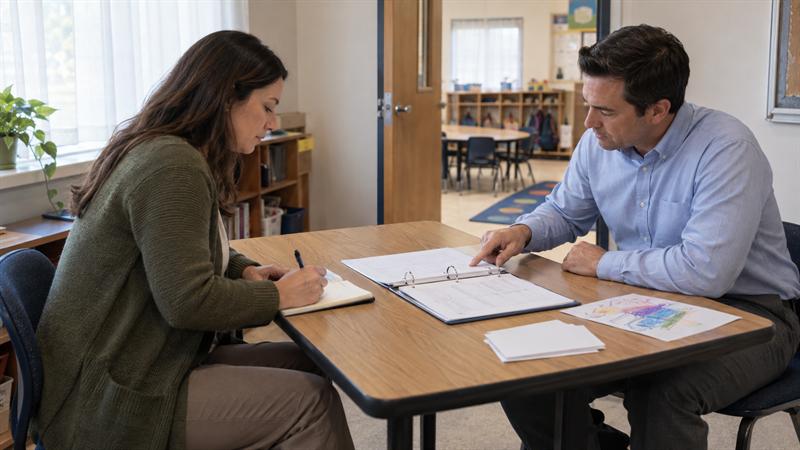
When a school raises concerns or a family sees the same problems showing up across routines, the next meeting can feel high stakes. At Strive ABA Consultants LLC, this is often the point where caring adults need a clearer structure so the conversation leads to something useful.
A strong school ABA planning meeting does not try to solve everything at once. It identifies the main concern, clarifies who needs to do what, and sets a realistic plan the team can actually follow.
For families who are still getting oriented, this guide to what school-based ABA is can help explain how support may look in a school setting before the meeting starts.
When a school ABA planning meeting may be needed
A school ABA planning meeting is often helpful when a student is having repeated difficulty in ways that affect learning, participation, safety, transitions, or communication across the school day. The issue is not that a challenge happened once. The issue is that the same concern keeps returning and the adults around the student need a more coordinated response.
- Behavior concerns affecting learning or participation
- Inconsistent responses across staff or settings
- Difficulty identifying helpful supports
- Communication gaps between home and school
- Need to coordinate school-based and outside services
A common pattern is that concerns start small, then become harder to manage because the team never pauses to define what is actually happening. One person describes refusal, another describes anxiety, another describes transition difficulty, and nobody leaves with a shared plan.
This type of meeting is also different from a general school check-in. A general check-in may review progress or concerns broadly. A school ABA planning meeting usually focuses on a specific support problem and what needs to change next.
Who should be in a school ABA meeting
The right people are usually the people who can describe the concern accurately, help make decisions about supports, and follow through after the meeting. That often includes family, school staff closest to the student, and any relevant support professionals. A larger meeting is not automatically a better one.
These meetings often become less effective when key decision-makers are missing or when people attend without a clear role. The result can be a meeting full of observations but no ownership.
Parent or caregiver role
Parents and caregivers bring context the school may not have. They may notice patterns around sleep, transitions, communication frustration, after-school recovery, or routine changes that help explain why the student is struggling during certain parts of the day.
They also help the team understand which changes matter most in daily life. That matters because a plan should focus on outcomes that improve school participation in ways that may carry into home routines, not just reduce stress during one class period.
Teacher and classroom staff role
Teachers and classroom staff usually have the clearest picture of when concerns happen during instruction, transitions, peer interactions, or task demands. They can identify what is already being tried and whether supports are realistic in the actual classroom environment.
In practice, a strategy may sound good in theory but break down during the real pace of the school day. That is why classroom staff need an active role in the discussion, not just a reporting role.
Student services or special education role
Student services staff, special education teachers, or case managers help connect the discussion to the school’s support system. They often help clarify documentation, accommodations, service coordination, and how progress will be reviewed.
If nobody owns the follow-up process, the plan may fade after the meeting. This role can help prevent that by making sure next steps are not just discussed but tracked.
Outside ABA provider or behavior consultant role, when involved
An outside ABA provider or behavior consultant can help the team look at patterns, strategy alignment, and support consistency across settings. Their role is not to take over school decision-making. Their role is to add structure and help the team think more clearly about what the student needs.
That distinction matters. When families or schools need help understanding different support models, this explanation of school-based ABA, behavior consultation, and staff coaching can help clarify what each option is designed to do.
What to prepare before the meeting
Better meetings often start with better preparation. The most useful information is specific, recent, and tied to actual routines. Broad concerns create broad conversations, and broad conversations often lead to weak plans.
- Examples of what the concern looks like
- When and where it tends to happen
- What happens right before and right after
- Supports already being used
- What seems to help at home or in other settings
- Questions about goals, communication, participation, or safety
A common mistake is showing up with labels instead of examples. Saying a student is having a hard time is real, but it does not give the team enough to act on. Saying the student struggles most during transitions to group work, after long waits, or when verbal directions come too quickly gives the team something they can actually plan around.
Families who want a practical way to organize what to bring can also review ABA home-school communication for shared goals. It helps turn day-to-day observations into information a school team can use.
A practical school ABA planning meeting agenda
This is the part that makes the meeting useful. A strong agenda helps the team move from concern to action without circling the same problem for most of the meeting. The order matters because the wrong sequence can lead to premature solutions, confusion, or disagreement about what the real issue is.
1. Define the main concerns clearly
Start by naming the concern in specific, observable terms. Avoid broad labels like noncompliance, defiance, or dysregulation unless the team also explains what those words mean in the student’s actual day.
For example, a clearer description might be that the student leaves their seat during independent work, refuses to transition to small group after lunch, or becomes distressed when a preferred activity ends. This keeps the team focused on what is happening rather than debating assumptions.
2. Review what is already happening
Before adding new strategies, the team should review what supports are already in place. That includes classroom responses, visual supports, schedules, communication tools, reinforcement systems, staff prompts, and any accommodations already being used.
Teams sometimes assume a strategy failed when the real issue was inconsistent implementation. If one staff member uses a support regularly and another does not, the team cannot judge whether the support itself is working.
3. Identify patterns, triggers, and barriers
Once the concern is defined and current supports are reviewed, the team can look for patterns. This may include time of day, transition demands, communication load, peer context, sensory strain, or the length of waiting required.
The team should also look at adult-side barriers. A plan may break down when staff do not have enough time, training, clarity, or consistency to use the strategy. This can result in the student being held responsible for a problem that is partly a systems issue.
4. Agree on priority goals
The meeting should narrow down to one or two priority goals. This is often more effective than trying to fix every concern at once. A small number of focused goals gives the team a real chance to implement supports consistently and tell whether progress is happening.
The best goals usually connect directly to school participation. That might mean improving transitions, increasing tolerance for teacher-led tasks, building functional communication, or reducing disruption around a predictable trigger during the day.
5. Assign supports, responsibilities, and communication steps
This is where the meeting either becomes a plan or stays a conversation. The team needs to decide who is doing what, when it will happen, and how updates will be shared between school and home.
- Who will use each agreed support
- When staff will apply it
- What the family will reinforce or monitor at home
- How progress or concerns will be communicated
If these details stay vague, the plan may fall apart quickly. Problems can become repetitive because everyone leaves thinking someone else is handling the next step.
If you are seeing these signs, the meeting may need more structure:
- The same concern has been discussed more than once without a written plan
- Different staff describe the student’s difficulty in very different ways
- The family hears that supports are being tried but cannot tell what they are
- No one can explain when the team will review whether the plan is working
When these indicators are present, the issue is no longer just communication. The team may need a more formal support process and clearer coordination.
6. Set follow-up timing and success markers
Every meeting should end with a follow-up plan. The team needs to know when they will check progress, what signs will show the plan is helping, and what will trigger revision if it is not.
Without this step, even a well-designed plan can lose momentum. The student may continue to struggle, adults may grow frustrated, and the next meeting may start from the same place as the last one.
ABA school meeting questions to ask
The best questions help the team move from broad concern to clear action. They should uncover patterns, define realistic supports, and make accountability visible. Generic questions produce generic answers, and generic answers do not usually change the school day.
Questions about behavior patterns
- When does the concern happen most often?
- What usually happens right before it?
- Are there settings or times when the student is more successful?
- Has the pattern changed recently?
These questions matter because they help the team avoid overreacting to isolated moments. If the concern shows up mainly during transitions, long waits, or complex verbal demands, that points the team toward a different plan than a concern that appears across the entire day.
Questions about skill-building and supports
- What skill might the student need more help developing?
- Which supports are realistic in the classroom as it actually runs?
- What has already been tried, and how consistently was it used?
- How will the team know whether the strategy is helping?
A common pattern is that adults focus only on stopping a behavior. That often misses the skill gap underneath it. When the team asks what the student needs help learning, the plan may become more functional and more sustainable.
Questions about communication and accountability
- Who will track progress?
- How will updates be shared with the family?
- When will the team meet again if the plan is not working?
- Who is responsible for adjusting the plan if concerns continue?
These questions keep the meeting from ending in uncertainty. If nobody owns the follow-up, the student may experience the same problem across more days and more routines before the team acts again.
Common mistakes that make school ABA meetings less effective
Many ineffective meetings break down in familiar ways. The issue is not always lack of concern. It is often lack of structure, specificity, and accountability.
- Talking in labels instead of examples: this keeps the team in opinion mode instead of problem-solving mode.
- Trying to address too many issues at once: this can lead to scattered plans and poor follow-through.
- Leaving without written next steps: this can result in different people remembering different decisions.
- Assigning strategies without checking implementation reality: this can cause plans to fail in the classroom even if they sound good on paper.
- Blending home and school priorities without clarification: this can create confusion about what the school can reasonably target during the day.
At Strive ABA Consultants LLC, this often comes up when meetings are rushed or built around urgency alone. Urgency matters, but a rushed plan can create more rework because the team has to revisit the same issue after a preventable breakdown.
For teams that need stronger coordination between systems, this guide on how schools and ABA providers can work together more effectively adds useful context around shared roles and consistency.
When additional evaluation or outside support may help
Some meetings reveal that the biggest problem is not effort. It is missing clarity. If the team cannot tell why a concern is happening, which supports fit best, or whether the student’s needs have changed, additional evaluation or outside support may be the next practical step.
- Support needs are still unclear after repeated discussion
- Previous information no longer reflects what staff and family are seeing now
- Behavior concerns have changed in frequency, intensity, or context
- The team is unsure whether the issue is mainly communication-related, developmental, environmental, or a mix of factors
This does not mean every difficult school meeting should lead to more assessment. It means the team should notice when planning is stuck because the underlying picture is incomplete. In those cases, updated evaluation information may help clarify what the student needs so the next plan is built on stronger information.
Key takeaways
- A school ABA planning meeting should end with a plan, not just a discussion.
- The most useful meetings define concerns in specific terms and focus on one or two priorities.
- Families, teachers, and support staff each bring different information that matters.
- If roles, responsibilities, and follow-up are not clear, the same concerns may return.
- When the team is missing clarity, additional evaluation or outside support may be the step that moves planning forward.
Conclusion
The real problem is not simply that a student is struggling at school. The bigger problem is when adults keep meeting about the same concern without building a plan that is specific enough to work. When that happens, support may become inconsistent, frustration can grow, and the student often carries the cost of a weak process.
That is why a structured school ABA planning meeting matters. It turns concern into action, separates observation from assumption, and makes follow-through visible. If your family or school team is dealing with repeated concerns, unclear support decisions, or a meeting process that keeps stalling, Strive ABA Consultants LLC may be a practical next step. Strive ABA Consultants LLC helps families and programs clarify support needs when repeated meetings are not producing enough direction.
Company approach
At Strive ABA Consultants LLC, the focus is on helping families and school-connected teams move from uncertainty to clarity. That means looking closely at what is actually happening, where the planning process is breaking down, and whether updated evaluation information is needed to support better decisions.
A common pattern is that people wait too long for the conversation to organize itself. It often does not. When concerns have repeated across routines, staff responses are inconsistent, or nobody can explain what the next step should be, the process may need more structure. That is where clearer evaluation or consultation support can become useful, especially for families in Oak Forest, Chicago, and Merrillville who are trying to understand the right next move without adding more confusion.
FAQ
What is a school ABA planning meeting?
A school ABA planning meeting is a focused discussion about how to support a student in the school setting when behavior, communication, participation, or routine-related concerns need a more coordinated plan. It is different from a broad check-in because the purpose is to define the concern clearly, review what is already happening, and assign next steps.
For example, if a student is struggling most during transitions, the meeting should not stop at saying transitions are hard. It should identify which transitions are difficult, what happens before the problem starts, what staff are currently doing, and what will change next. That distinction is what turns the meeting into a planning tool instead of a summary of concerns.
Who should attend an ABA meeting at school?
The most useful attendees are usually the people who know the student’s daily patterns, can help make support decisions, and are responsible for follow-through. That often includes a parent or caregiver, classroom teacher, special education staff or case manager, and other relevant school personnel involved in the student’s support. An outside ABA provider or consultant may also be included when coordination across settings is part of the issue.
What matters most is not having the most people in the room. What matters is having the right people. If the meeting includes people who cannot speak to the concern directly or cannot support implementation, the conversation can get bigger without becoming clearer.
What questions should parents ask in a school ABA meeting?
Parents should ask questions that reveal patterns, define supports, and make responsibility clear. Strong questions include when the concern happens most often, what tends to happen right before it, which supports are already being used, and how the team will know whether the plan is working.
It is also important to ask what skill the student may need more help developing. That helps the team move beyond behavior labels and toward instruction. If the issue is really about waiting, transitions, communication, or task tolerance, the plan needs to reflect that. This is where meetings often become more effective because the support target becomes clearer.
How is a school ABA planning meeting different from an IEP meeting?
A school ABA planning meeting is usually narrower and more focused on immediate support strategy, implementation, and coordination. An IEP meeting often covers a broader range of educational planning topics, services, goals, and formal school documentation.
There can be overlap, but the practical difference is focus. A planning meeting might spend most of its time on one recurring support problem and how staff will respond to it across the day. That makes it useful when the team needs clarity around a specific issue before making bigger program decisions.
What should families bring to a school ABA meeting?
Families should bring specific examples, not just concerns in general terms. Useful information includes when the issue tends to happen, what seems to make it easier or harder, what supports help at home, and which questions the family wants answered before the meeting ends.
A short written list is usually more useful than trying to remember everything in the moment. For example, noting that a student struggles most after long waits, during transitions away from preferred activities, or when directions come too quickly gives the team a much stronger starting point than saying the day has been difficult overall.
When should a family consider an autism evaluation or reevaluation after a school meeting?
A family may consider an autism evaluation or reevaluation when repeated meetings are not producing enough clarity to guide support. This usually means the team is still unsure what is driving the concern, previous information no longer fits the student’s current needs, or support decisions keep stalling because nobody has a clear picture of what has changed.
That does not mean every school concern requires more assessment. It means reevaluation can become important when the existing information is no longer strong enough to support good planning. In those cases, clearer evaluation information can help the team stop guessing and build a plan around the student’s current profile.