

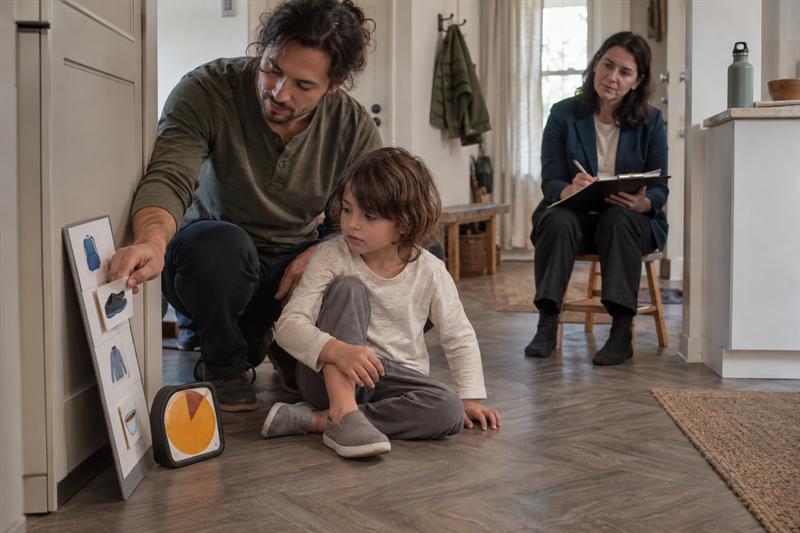
At Strive ABA Consultants LLC, this process often starts with one clear concern: the same part of the day keeps going off track, and nothing stays consistent long enough to improve it. Families are usually not looking for a broad definition of ABA. They want to know what support at home can look like when routines, transitions, and caregiver responses are where the problem starts.
What Is ABA Behavior Consultation at Home?
ABA behavior consultation at home is a structured way to look at why specific routines break down and what may need to change around them. The focus is not only the behavior itself. It also includes the routine, the expectations, the timing, the communication demands, and how adults respond in that moment.
Families may describe the issue as one behavior, but the deeper problem is often a mismatch between the routine and the support available in that routine. That is why home-based behavior consultation usually centers on observation, pattern identification, and practical changes the household can repeat.
If you want a broader overview of consultation models, this guide to what ABA consulting is and how it differs from direct therapy explains the bigger picture.
How home consultation differs from direct ABA therapy
Home consultation and direct ABA therapy can both happen in the home, but they do not serve the same purpose. Consultation usually focuses on assessing routines, identifying triggers, clarifying caregiver responses, and shaping a workable plan. Direct therapy usually focuses on ongoing teaching, intervention delivery, and skill-building over time.
This distinction matters because families often assume that any home-based ABA service follows the same process. It does not. If the main question is, “Why do these routines keep falling apart?” consultation is often the more direct starting point. If the main question is, “How do we teach and build this skill consistently over time?” direct therapy is often the better fit.
Why some families start with consultation
Some families start with consultation because they need clarity before they need a larger service model. This often happens when everyone in the home is trying to help, but no one can explain why the same problems keep repeating.
Another common situation is when the issue looks bigger than one routine but smaller than a full therapy plan. Families may need help sorting out whether the next step is behavior support, a more formal treatment path, or broader developmental clarification through an evaluation or reevaluation.
When Families Usually Seek Home-Based Behavior Consultation
Families often seek home-based behavior consultation when the same parts of the day keep leading to stress, conflict, or shutdown. The issue is rarely random. It usually shows up in predictable places where demands, transitions, or expectations are not lining up with the supports in place.
- Morning routines become rushed and argumentative
- Transitions away from preferred activities lead to repeated escalation
- Meals, hygiene, homework, or bedtime turn into daily conflict points
- Different caregivers respond differently, so the child gets mixed signals
- What works in one setting does not carry over at home
For families trying to sort out fit, planning for home-based ABA with routine fit and caregiver communication in mind is often part of the decision.
Routines that break down repeatedly
Mornings, meals, bedtime, hygiene, getting out the door, and transitions after preferred activities are some of the most common examples. When those problems happen every day, they can start shaping the whole household.
This usually gets worse when families try to solve each incident as a separate problem. When the same breakdown shows up across several days or in the same part of the schedule, the routine usually needs a closer look, not just the individual moment.
Inconsistent responses across caregivers
This is where many home problems start. One caregiver gives extra time, another repeats instructions, and another steps in only after the situation escalates. Even when everyone is trying to help, inconsistent responses often lead to more confusion, more testing of limits, and less predictable outcomes.
When that pattern is present, families often need a shared response plan more than scattered advice. A practical next step is learning how to build a caregiver consistency plan for ABA support so the same expectations carry across adults.
When home stress affects the whole household
By the time families look for consultation, the issue often reaches past one routine. Siblings are affected. Parents may start planning the day around avoiding one specific trigger. Simple activities can begin to feel harder than they should.
If that pattern goes unaddressed, the home can start revolving around prevention instead of participation. That may mean fewer successful routines, less independence, and more stress for everyone involved.
What a Home-First ABA Consultation Process Looks Like
A home-first ABA consultation process should help families see how support breaks down and what may need to change. Generic advice is not enough here. Families need a process that makes the pattern easier to spot and easier to address.
In many cases, the household already knows which routines are hardest, but no one has mapped why those routines keep failing. That is why the consultation process works best when it moves step by step through the daily pattern instead of reacting only to the hardest moment.
Step 1: Start with family priorities and daily pain points
The first step is identifying which routines are causing the most strain and why the family is seeking support now. That keeps the process grounded in daily life instead of abstract goals.
A strong consultation does not begin with a generic list of possible concerns. It begins with the routines that are already disrupting the day. If mornings are making the entire household late and dysregulated, that is not a side issue. That is the right place to start.
Step 2: Look at routines, triggers, and what happens before and after the behavior
This step looks closely at the full sequence around the problem. That includes pacing, transitions, communication demands, waiting, environmental distractions, and what adults do immediately before and after the behavior.
A common pattern is that the visible behavior gets most of the attention, while the trigger is often built into the structure of the routine. Families can get clearer about that process by reviewing an ABA routines map for identifying where support breaks down across home, school, and community settings.
Step 3: Identify where support breaks down
Once the routine is mapped, the next job is identifying the breakdown point. In many cases, the problem is not the behavior alone. The routine may be asking for more than the current support structure is providing.
- Expectations may be unclear
- Transitions may be too abrupt
- Waiting may last too long
- Communication demands may be too high for the moment
- Caregiver follow-through may shift from one adult to another
If this step is skipped, families may end up reacting to the same symptom over and over instead of building a more stable plan.
You may need action, not more guesswork, if these signs sound familiar:
- The same routine falls apart at roughly the same time every day
- Different caregivers are handling the same behavior in different ways
- What works once does not hold across the week
- The family is spending more energy preventing blowups than building workable routines
When those signs are present, the issue often calls for a structured home consultation process.
Step 4: Build practical recommendations for the home
Recommendations should match the home that actually exists, not an ideal version of it. This often includes clearer transitions, simpler directions, visual supports, better sequencing, or more consistent caregiver responses.
This is where generic plans often fail. If the recommendation depends on perfect timing, one caregiver, or a calm environment every day, it usually will not hold. The goal is not a plan that looks good on paper. The goal is a plan that can be repeated under normal household conditions.
Step 5: Adjust the plan so it is realistic to repeat
Even a good strategy needs to fit the household. Routines change. Caregivers rotate. Energy and time vary across the week. A workable consultation process accounts for that from the start.
Families sometimes try a strategy once, see a brief improvement, and then watch it fade because it was never built for repeat use. When that happens, the issue is often not the strategy itself. It is that the plan was not adjusted to fit real life.
What Is Usually Assessed During an In-Home Consultation
An in-home consultation looks at more than behavior frequency. It also looks at the routine conditions that lead to repeated breakdowns and the support conditions that may be maintaining them.
Environment, timing, and transitions
This includes the physical setup, noise, distractions, rushed pacing, and how one activity changes into the next. Transition points are where many routines fail because they combine demand, movement, and uncertainty all at once.
If these parts of the environment are ignored, families may keep focusing on the last visible behavior instead of the routine conditions that contributed to it.
Communication demands and skill gaps
Some routines ask for skills that are not fully supported in that moment. A child may be expected to stop a preferred activity, wait, shift attention, follow several steps, or ask for help clearly, all at once.
When that happens, the behavior is not separate from the communication demand. This can show up as refusal, delay, escalation, or withdrawal because the routine is asking for more than the current support makes manageable.
Caregiver coordination and consistency
Consultation also looks at whether adults are using the same expectations, prompts, and follow-through. This matters because even strong strategies can fall apart when implementation changes from one person to the next.
If one adult gives repeated reminders, another negotiates, and another ends the demand altogether, the routine does not become clearer over time. It can become less predictable. That may mean more confusion and slower progress.
What Families Can Expect After the Consultation
After the consultation, families should expect clearer understanding, more targeted recommendations, and a better sense of what needs to change first. The output should not be vague reassurance. It should explain the routine problem in a way the household can use.
Recommendations that fit daily life
Recommendations often include changes to transitions, visual cues, routine order, prompting, communication supports, and caregiver response patterns. The goal is to make the routine more understandable and more repeatable.
This usually works best when recommendations are simple enough to carry across the week. If a family needs a deeper framework for how goals and supports fit together, this guide to behavior goals in an ABA plan can help connect routines, supports, and review expectations.
Support across home, school, and other caregivers
Home consultation can also help families line up expectations across settings. That matters when a routine works with one adult, breaks down with another, or changes completely between home and school.
If cross-setting consistency is not addressed, progress may stay limited to one environment. That can lead to confusion for caregivers and less reliable carryover for the child.
When evaluation or reevaluation may also be relevant
Sometimes the consultation process makes it clear that the issue is bigger than one routine plan. Families may need broader clarification about developmental needs, changing support levels, or whether updated assessment would be helpful.
In those cases, consultation helps organize the question. It can show whether the next need is a routine-focused support plan, a more formal treatment path, or an evaluation or reevaluation to better understand what support should look like next.
How to Tell Whether Home-Based ABA Consultation Is the Right Fit
Home-based ABA consultation is the right fit when the main problem is repeated routine failure, unclear patterns, or inconsistent implementation across caregivers. It is not the best fit for every situation, but it is often a practical starting point when families need to understand what is happening before deciding on a larger service path.
Good fit situations
- The same routines keep breaking down in similar ways
- Caregivers need a more consistent approach
- The family wants to understand what is driving the pattern
- The goal is to improve daily function at home, not just respond in the moment
If you are seeing those signs, the issue usually calls for routine analysis and caregiver coordination, not one more isolated tip.
When another level of support may be needed
If the family clearly needs ongoing skill-building, direct treatment may be the better fit. If the main question is diagnostic clarification or updated understanding of needs, evaluation or reevaluation may be more important first.
The key decision point is this: if the biggest gap is understanding the routine pattern, consultation is usually the most direct option. If the biggest gap is formal assessment or long-term treatment delivery, another path is likely needed.
Key Takeaways
- ABA behavior consultation at home is most useful when routines keep breaking down in predictable ways.
- The main issue is often the structure around the behavior, not just the behavior itself.
- Caregiver inconsistency is one of the most common reasons home plans fall apart.
- Strong recommendations need to fit real household routines or they usually do not last.
- When families understand the pattern, they can take a more practical next step.
Conclusion
The main problem is often not one isolated behavior. It is a home routine that keeps failing because expectations, transitions, communication demands, and caregiver responses are not working together. If that pattern is not addressed, the household can end up stuck in daily reaction, rising stress, and less consistent progress over time.
Strive ABA Consultants LLC can be a practical next step when families need more than general advice and less guesswork about what is happening at home. A home-first consultation helps identify where support is breaking down, what is making the routine harder, and what changes are realistic to repeat. When the same challenges keep showing up across the week, this is often the point where structured support becomes useful.
Company Approach
At Strive ABA Consultants LLC, home-based support is most useful when it stays grounded in the routines families are already trying to manage. That means looking closely at where mornings stall, where transitions trigger conflict, where expectations shift between caregivers, and where support plans stop matching real life.
This approach also helps families sort out what kind of next step makes sense. In some situations, the right move is a focused home consultation. In others, it becomes clear that broader planning, evaluation, or reevaluation is needed to answer bigger questions. The value is in making that decision based on observed patterns instead of ongoing trial and error.
FAQ
What is the difference between ABA behavior consultation at home and in-home ABA therapy?
ABA behavior consultation at home focuses on understanding patterns in routines, caregiver responses, transitions, and environmental demands. In-home ABA therapy focuses more on ongoing intervention and skill-building over time.
For example, if bedtime is falling apart every night, consultation would look at the full routine, what triggers the breakdown, and how adults are responding. Therapy would be more likely to center on sustained teaching and implementation of treatment goals. The key difference is that consultation helps explain the pattern, while therapy usually focuses on longer-term intervention delivery.
What kinds of problems can a home-based behavior consultation help with?
It can help with repeated routine breakdowns such as difficult mornings, transition problems, homework resistance, bedtime conflict, hygiene struggles, or inconsistent behavior support across caregivers. These problems usually show up in the same parts of the day because the routine itself is not working well.
What matters most is the pattern. If the same issue keeps happening in the same situation, that usually means the problem is built into the routine structure, the support level, or the caregiver response sequence, not just the final behavior.
What happens during an ABA consultation in the home?
An ABA consultation in the home usually starts with identifying the hardest routines, then looking at what happens before, during, and after the problem behavior. That includes expectations, timing, transitions, communication demands, environmental setup, and caregiver responses.
The point is not just to watch behavior. It is to figure out what the routine is asking for, where support breaks down, and what changes may make the routine more manageable. The result should be a clearer plan, not just a description of the problem.
How do families know if they need a consultation, an evaluation, or ongoing therapy?
The answer depends on the question the family is trying to solve. If the biggest issue is repeated home routine breakdowns and unclear patterns, consultation is usually the best fit because it helps explain what is happening and what may need to change.
If the question is broader and involves developmental clarification, changing support needs, or updated diagnostic understanding, an evaluation or reevaluation may be more relevant. If the need is clearly ongoing teaching and intervention, therapy is usually the better path. The decision changes based on whether the family needs pattern analysis, formal assessment, or sustained treatment.
Can home behavior consultation help improve consistency between caregivers?
Yes. In many homes, caregiver inconsistency is one of the main reasons routines stay unstable. When one adult gives extra time, another negotiates, and another stops the demand after escalation, the child experiences the routine differently each time.
Consultation helps identify those differences and organize a more consistent response plan. That does not mean every caregiver needs to sound identical. It means expectations, follow-through, and support cues need to be predictable enough for the routine to hold across adults.