

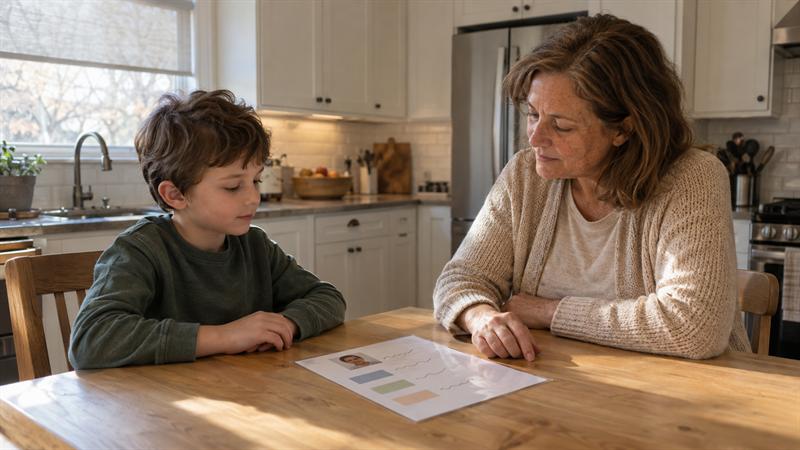
At Strive ABA Consultants LLC, families often run into this issue when support information is spread across texts, reports, school notes, and verbal updates. That can weaken carryover. One adult may give too much prompting, another may miss early signs of stress, and a third may not know what helps during transitions.
A one-page ABA support plan helps organize the most useful supports into a quick-reference tool. It does not replace a full treatment plan or evaluation. It gives caregivers a clearer way to respond across settings when routines change, when someone fills in, or when support needs to move from one adult to another.
What a One-Page ABA Support Plan Is
A one-page ABA support plan is a short caregiver-facing guide that summarizes the supports most likely to help in daily routines. It is built for usability, not completeness. The goal is to help different adults respond in a more consistent way at home, school, after-school care, or backup coverage.
This is where many families get stuck. They may already have the right information, but it is not in a format the next caregiver can use quickly. A one-page plan helps close that gap by keeping the focus on what helps, what to watch for, and what to do next.
For a broader system around caregiver communication, the ABA Caregiver Communication Toolkit shows how a one-page plan fits with other handoff tools.
How it differs from a full behavior plan
A full behavior plan often includes assessment detail, target behaviors, clinical reasoning, data procedures, and a more complete intervention structure. A one-page ABA support plan does not try to do all of that. It narrows the information down to what a caregiver needs in the moment.
- Full behavior plan: detailed and designed for broader treatment planning
- One-page support plan: short, practical, and designed for fast caregiver use
- Full behavior plan: explains the larger framework
- One-page support plan: tells the next adult what usually helps right now
That distinction matters. When a quick-reference tool is packed with too much detail, it can stop being useful. Caregivers do not need to sort through a report during a rushed school pickup, a difficult transition, or a substitute care situation.
When a one-page version is most helpful
A one-page version is often useful when multiple adults are involved and information needs to move with the child. Support often becomes less consistent during coverage changes, after-school transitions, weekends, or school-home handoffs. In many cases, that is a communication problem rather than an effort problem.
- When a new caregiver is stepping in
- When home and school are responding differently to the same routine or behavior
- When grandparents, sitters, or respite workers need a plain-language guide
- When transitions happen often and support breaks down during change
If transitions are the main pressure point, a companion resource like How to Create an ABA Transition Kit for Home, School, and Caregiver Changes can help families organize what needs to travel from one setting to another.
Who Should Use This Type of ABA Caregiver Support Plan
A one-page ABA caregiver support plan is often useful when the same child is supported by different adults across the day or week. The plan works best when those adults share a few stable responses, even if their settings look different. That is how consistency builds.
Parents and family caregivers
Parents and family caregivers often use the one-page plan as the anchor for everyone else. It can help keep routines, prompts, and expectations more stable across the people involved in care. That reduces the need to repeat the same instructions every time someone helps.
This can become more difficult when families rely only on memory or verbal handoff. Details get lost quickly. The result is that one adult knows exactly how to support a transition, while another walks in with no context.
Teachers, aides, and school support staff
School teams often benefit from short, actionable information that supports carryover without replacing school documentation. A one-page plan can help clarify what tends to work for communication, routines, and transitions. It should support coordination, not compete with existing school systems.
For ongoing back-and-forth between settings, Home-School Weekly Update for ABA: A Simple Communication Format for Teams is a useful companion because it can help keep the plan current instead of static.
Respite workers, babysitters, and replacement caregivers
Replacement caregivers often need the clearest version of the plan because they usually have less history and less time. This is where over-documenting becomes a problem. If the caregiver has to sort through too much detail, the main supports are easier to miss.
A common pattern is that temporary caregivers get broad instructions like “he struggles with transitions” or “just redirect her.” That can lead to inconsistent support because the adult still does not know what to say, when to say it, or what tends to work. The one-page plan should answer those questions directly.
What to Include on One Page
The strongest one-page ABA support plan includes the few pieces of information that improve follow-through right away. This is the core decision point of the whole document. If the page is filled with background information instead of action steps, it loses value.
At Strive ABA Consultants LLC, families sometimes try to be helpful by adding everything. That often makes the tool harder to use. A better approach is to include the supports another adult is most likely to need during routines, transitions, communication breakdowns, and moments of stress.
Child profile and communication essentials
Start with the communication details a caregiver needs first. That includes how the child best understands directions, how they usually communicate needs, and any sensory or preference information that affects daily support.
Helpful wording is specific. “Responds best to short directions and visual reminders” gives the caregiver something to do. “Has communication challenges” does not.
Daily routines and predictable supports
Include the supports that usually help the day go more smoothly. This often includes short routine previews, first-then language, advance warnings, movement breaks, visual schedules, or short choices.
This is where day-to-day problems build. When routines are predictable for one caregiver but not another, the child may start getting mixed cues. That can lead to more resistance, more prompting, and less carryover.
For families working on routines more broadly, Life Skills Training in ABA: Routine-Based Examples for Mornings, Mealtimes, and Community Routines shows how routine-based supports can carry through daily life.
Reinforcement and motivation
The plan should name what currently motivates participation. That might be specific praise, a short break, a preferred activity, or a choice-based reward. The key word is currently.
A common mistake is leaving old motivators on the plan after they stop working. That can leave caregivers following the document correctly and still getting poor follow-through. A one-page plan works best when it reflects what helps now, not what helped months ago.
Triggers, early signs, and calming supports
List the situations that commonly make support harder, the early signs the child is getting overwhelmed, and what tends to help before the situation escalates. This section should stay practical and observable.
For example, “gets tense when the routine changes without warning” is more useful than a broad label. So is “offer a short warning and a visual countdown” instead of “try to keep him calm.” Specific support may keep a small disruption from becoming a much bigger one.
Safety and supervision notes
Only include the safety information a caregiver needs immediately. The purpose is not to create a complete history. The purpose is to help the next adult act clearly and quickly if a known supervision need or immediate safety concern is relevant.
This section gets weaker when families add every concern they have ever had. That overload can make the truly important information harder to spot. Keep it direct, current, and limited to what affects care in the moment.
What helps during transitions
Transitions are one of the most common breakdown points in daily support. Even when a child is doing well in one part of the day, the shift to the next activity is often where problems start.
Helpful transition supports often include short advance notice, countdowns, visuals, preferred objects, or pairing the change with something predictable. The one-page plan should state which of those supports are most useful so the next adult is not guessing.
If handoff problems keep repeating, the support format may need to change.
- Different caregivers describe the child in completely different ways
- Transitions go smoothly with one adult and fall apart with another
- Replacement caregivers need frequent verbal coaching to get through basic routines
- Home and school are using different prompts, expectations, or calming supports
Those signs often point to the need for a clearer shared support format, not more scattered notes.
What to Leave Out of a One-Page ABA Support Plan
What stays off the page matters almost as much as what goes on it. A one-page tool becomes less useful when it tries to double as a report, a history, and a full treatment plan. That can cause caregivers to skim, miss key information, or ignore the document altogether.
Clinical detail that overwhelms caregivers
Long clinical explanations, old background details, and too many target behaviors do not belong on the one-page version. They have a place in broader documentation, but not in a handoff tool. The goal is immediate clarity.
This is where problems often start during substitute coverage. If the first thing a caregiver sees is a wall of information, the practical supports get buried. That can lead to guesswork, which usually leads to inconsistent responding.
Vague instructions that cannot be followed consistently
Vague guidance causes more inconsistency than most families expect. Phrases like “be patient,” “redirect when needed,” or “use ABA strategies” sound helpful, but they do not tell the next adult what to do.
Specific wording works better. “Offer two short choices,” “give a short warning before transitions,” or “use one-step directions when frustrated” gives the caregiver a usable response. That is the difference between a plan that gets carried out and a plan that gets interpreted differently by every adult.
A Simple One-Page ABA Support Plan Template
The best one-page ABA support plan is easy to scan, easy to update, and easy to hand off. It should look more like a practical support sheet than a condensed report.
Blank template structure
- Best ways to communicate with me
- What helps my day go smoothly
- What motivates me
- Early signs I may need support
- What usually helps
- Transition tips
- Important safety notes
- Who to contact with questions
That structure works because it follows the way caregiving decisions often happen in real time. The adult needs to know how to communicate, what to expect, what helps first, and what to watch for before a situation becomes more difficult.
Example wording families can adapt
Use short, direct language. For example:
- Best ways to communicate with me: Use short directions and show me the next step when possible.
- What helps my day go smoothly: Preview changes before they happen and keep routines predictable.
- What motivates me: Praise, short breaks, and choosing between two activities usually help me stay engaged.
- Early signs I may need support: I may get quiet, avoid the task, or repeat the same question.
- What usually helps: Offer one small next step and give me a short break if I am getting stuck.
- Transition tips: Give a short countdown and remind me what comes next.
Notice what this wording avoids: long explanation, heavy jargon, and vague labels. The plan should tell the next adult how to help, not just describe the child in general terms.
For families who need a broader set of tools around handoffs and consistency, the ABA Caregiver Communication Toolkit: One-Page Plans, Weekly Updates, Transition Kits, and Handoff Checklists brings those supports together in one place.
How to Use the Plan Across Home, School, and Replacement Caregivers
A one-page plan works best when the core supports stay consistent across settings, even when routines do not. The goal is not to make every setting look the same. The goal is to make the child’s key supports recognizable wherever care happens.
Keeping core supports consistent
If short directions, visual reminders, and advance warnings help at home, those same supports should appear in some form at school and in replacement care when possible. That consistency can reduce guesswork and improve carryover. It gives the child more predictable support from one adult to the next.
For a broader look at carryover across settings, How to Plan Skill Carryover From ABA Sessions to Home, School, and Community is a helpful next read.
Adjusting for setting without changing the whole plan
Some details should change by setting. A classroom transition looks different from a bedtime transition, and a babysitter will not use the same language as a school team. But the core support can still stay stable.
For example, “give a brief warning before changing activities” can apply in all three places. What changes is the routine around it, not the support itself. This is usually the most practical approach because it avoids creating a completely different system for every caregiver.
Common Mistakes That Make the Plan Less Useful
Most one-page plans break down for predictable reasons. They are too long, too vague, too technical, or too outdated. When that happens, the document still exists, but it no longer improves consistency.
Too long
If the caregiver cannot read it quickly, it is not working as a one-page tool. Length usually grows when families try to capture every concern instead of the most usable supports. That makes the page harder to scan when support is needed fast.
Too much jargon
Caregiver language works better than report language. Terms may be familiar to a clinical team but still slow down understanding for grandparents, sitters, school staff, or backup caregivers. When the wording is too technical, each adult starts interpreting it differently.
No update process
Supports change. Motivators change. Routines change. What used to work can stop working, and this is where inconsistency can quietly build over time.
If the page is not reviewed when routines shift or early signs change, the document starts guiding caregivers toward outdated responses. When families are seeing those kinds of shifts, When to Update an ABA Treatment Plan: A Family Checklist for Routines, Carryover, and Goal Fit can help clarify what needs revision.
When a Family May Need More Than a One-Page Plan
A one-page support plan improves communication and consistency, but it does not answer every larger support question. If the issue is uncertainty about the child’s current needs, not just caregiver handoff, the family usually needs more than a formatting fix.
New diagnosis questions
Families early in the process are often still figuring out which supports belong on the page in the first place. In that situation, the one-page tool can help organize care, but it does not replace the need for clearer guidance about support needs and next steps.
Changes in behavior or support needs
If what used to work is no longer working, the problem is often deeper than caregiver communication alone. A one-page plan can only summarize current supports. It does not solve outdated goals, changing routines, or support strategies that no longer fit.
When evals or reevals may help clarify next steps
When families need updated information for planning, services, or coordination, evals and reevals can help clarify what belongs in caregiver-facing tools. At Strive ABA Consultants LLC, that is where a more complete review may become helpful. The one-page plan still matters, but it works best when it reflects current needs instead of old assumptions.
Key Takeaways
- A one-page ABA support plan works best as a quick, shared handoff tool.
- It should focus on actionable supports, not full clinical detail.
- Communication, routines, motivators, early signs, transitions, and safety are the core areas to include.
- The page becomes less useful when it is too long, too vague, too technical, or out of date.
- Consistency improves when the same core supports travel across home, school, and replacement caregivers.
Conclusion
The real problem is not that families lack information. It is that the right information is often too scattered, too broad, or too difficult for the next caregiver to use in the moment. When that is not addressed well, routines can break down, transitions may get harder, and every new handoff can add to inconsistency.
Strive ABA Consultants LLC can be a practical next step for families who need clearer support planning, updated evaluation guidance, or a better way to translate recommendations into everyday caregiver use. When support needs are changing or care is spread across multiple adults, addressing handoff issues early can reduce confusion and improve consistency.
Company Approach
At Strive ABA Consultants LLC, the focus is on making support usable in real life. That means looking beyond what is written in a report and paying attention to where carryover actually breaks down: handoffs, routine changes, school-home gaps, and substitute coverage.
Families do not always need more information. Often, they need better organization of the information they already have, plus updated guidance when the child’s support needs change. That is why one-page tools, caregiver planning, evals, and reevals fit together. They address different parts of the same consistency problem.
FAQ
What should a one-page ABA support plan include?
A one-page ABA support plan should include the information a caregiver needs to act on right away: communication supports, routines that help, motivators, early signs of distress, calming strategies, transition tips, and any important safety notes. The main goal is not to summarize everything about the child. The goal is to make the most useful supports easy to follow.
For example, “responds best to short directions and a visual countdown before transitions” is much stronger than “has difficulty with change.” The first statement tells the caregiver what to do. The second only describes the challenge. That difference matters because caregivers need action steps, not just background.
How is a one-page ABA support plan different from a behavior intervention plan?
A one-page ABA support plan is a quick-reference tool for caregivers, while a behavior intervention plan is a more detailed document that explains the larger treatment approach. A full plan usually includes target behaviors, response strategies, and clinical reasoning. The one-page version pulls out the parts another adult needs during everyday routines.
This is not just a shorter format. It serves a different purpose. A behavior plan explains the intervention framework. A one-page support plan helps a teacher, sitter, grandparent, or backup caregiver respond in a more consistent way without sorting through larger documentation.
Can teachers or babysitters use the same ABA support plan?
Yes, as long as the core supports are written in a way that can travel across settings. Communication style, transition help, motivation, and early warning signs often stay relevant whether the child is at home, in school, or with a sitter. The setting changes, but the main support patterns often stay relevant.
For example, a short warning before transitions can help before cleanup at home, before a class change at school, or before leaving the playground with a babysitter. What gets misunderstood is the idea that consistency means every adult must do everything the same way. In practice, consistency means the most important supports stay recognizable from one setting to the next.
How often should a one-page ABA support plan be updated?
It should be updated when the information stops matching what helps now. That usually happens when routines change, motivators shift, transitions get harder, or early signs of distress start looking different. A fixed calendar matters less than whether the page still guides caregivers accurately.
A clear example is reinforcement. If the plan still lists a preferred item or activity that no longer motivates participation, caregivers can follow the document exactly and still run into resistance. An outdated plan can create inconsistency even when people are trying to stay aligned.
What should be left out of a caregiver ABA support plan?
Leave out long background history, heavy clinical jargon, too many priorities, and vague statements that do not tell the caregiver what to do. If a detail does not improve decision-making during actual care, it does not need to be on the one-page version.
A common mistake is filling the page with phrases like “be patient” or “redirect as needed.” Those ideas sound supportive, but they do not guide action. A better version would say, “offer two short choices” or “give a short warning before transitions.” The right level of detail is practical, not broad.
When is a one-page ABA support plan not enough?
A one-page ABA support plan is not enough when the main issue is uncertainty about the child’s current support needs. If behaviors are changing, routines no longer fit, or caregivers are unsure which strategies belong on the plan at all, the problem goes beyond communication.
That distinction is important. A one-page tool helps organize known supports. It does not discover them. When families are trying to sort out what has changed and why, updated planning through evals or reevals may be more useful than adding more detail to the page.