

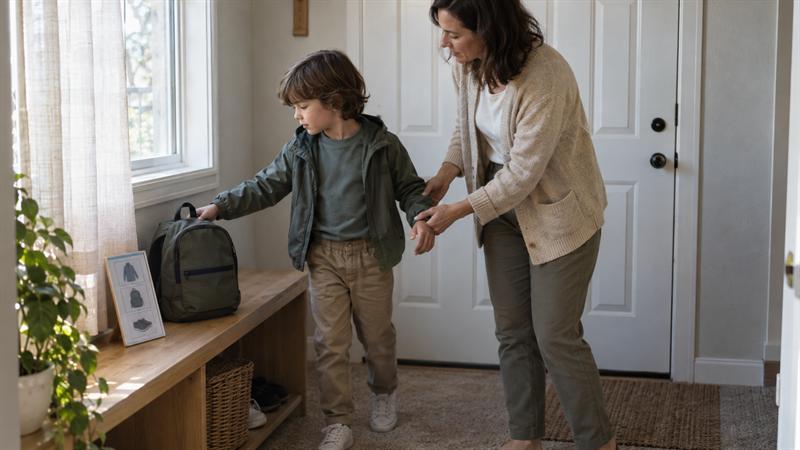
For many families, the issue is not effort. It is that simple routines are made up of many smaller skills, and one weak point can disrupt the whole sequence. At Strive ABA Consultants LLC, families often need support with routines such as dressing, hygiene, meals, transitions out the door, and public outings.
If you are trying to understand what life skills in ABA look like day to day, the answer is usually more practical than families expect. Instead of treating independence as one big goal, ABA teams often break routines into teachable parts such as sequencing, waiting, asking for help, tolerating changes, and moving to the next step with less support.
What life skills training in ABA looks like in everyday routines
Life skills training in ABA focuses on everyday tasks that help a child participate more independently at home and in the community. That includes daily living skills like dressing and hygiene, but it also includes the smaller routine skills that hold those tasks together.
A common pattern is that families describe one big problem, such as “mornings are hard” or “meals always fall apart.” When you look more closely, the routine may break down at a specific point. It might be starting the task, following the order of steps, waiting briefly, handling a change, or asking for help before frustration builds.
- Sequencing steps in a routine
- Using communication during routines
- Waiting and tolerating short delays
- Handling transitions between activities
- Completing self-help tasks with less prompting
Why routines are often a practical starting point
Routines are repeated, visible, and tied to real daily demands. That makes them easier to observe, easier to measure, and often more meaningful to families than isolated practice that does not connect back to everyday life.
This is also where problems become easier to spot. A child might do a skill once in a structured moment, then lose it when the family is rushing, when the environment changes, or when several steps need to happen in order. That is why routine-based work is often more useful than looking at a skill in isolation.
The difference between completing a task and building independence
A child can complete a task and still not be independent with that task. If every step depends on repeated reminders, physical help, or adult direction, the routine may still fall apart as soon as support changes.
This point is easy to miss. Families are sometimes told a child “can do” a task because the final result happens. What matters more is how the task gets done. If the child needs full prompting to start, move through steps, or recover from a small change, independence may still be limited.
Morning routine examples in ABA
Morning routines are one of the clearest places to see how life skills training works. They often involve time pressure, multiple transitions, and several tasks that need to happen in sequence.
One challenge ABA teams may address is that the child is not struggling with just one task. The routine may break because moving from one step to the next is hard, or because one missing item, one unexpected change, or one extra reminder leads to resistance and delay.
Getting dressed and choosing weather-appropriate clothing
Dressing is not just about putting on clothes. It can involve choosing between options, following a sequence, tolerating a change if a preferred item is unavailable, and asking for help with a zipper or button instead of stopping the routine altogether.
If this part is ignored, mornings may stay highly dependent on adult rescue. The child may wait for someone else to choose, prompt, fix, or finish each step, and that pattern can carry into other routines too.
- Following the order of dressing steps
- Choosing between two appropriate options
- Tolerating a different clothing choice when needed
- Requesting help with difficult fasteners
Brushing teeth, washing face, and hygiene sequencing
Hygiene routines are often where families see the gap between “knows the task” and “can do the task during a real morning.” A child might understand toothbrushing in theory but still need heavy support to start, finish, or stay on sequence.
A common pattern is that hygiene gets rushed or skipped because the adult ends up doing most of it. That can leave the routine looking completed without building much independence. In those cases, tools like step-by-step visuals and consistent cues can help the child move through the sequence more clearly. Families who want to understand that support in more detail can review prompting in ABA and when support is faded.
Packing a backpack or preparing to leave the house
Preparing to leave involves gathering items, checking what is needed, and moving through a short plan without losing momentum. This is where routine weakness often shows up as repeated backtracking, missed items, or needing an adult to manage the whole sequence.
If you are seeing constant last-minute searching or repeated reminders before leaving, it may mean the routine is too dependent on adult direction. The problem is not always forgetting. The routine may lack a clear structure the child can follow more independently.
Transitioning between steps with less prompting
For many families, transitions are the real morning problem. The child may complete one step but not move to the next without multiple prompts, physical guidance, or rising frustration.
This usually results in a routine that takes much longer than expected and becomes stressful for everyone involved. When transition support is not addressed directly, progress in individual tasks may not carry over well because the sequence still breaks down between steps.
If your mornings keep stalling in the same places, the routine may need more than reminders.
- The child completes one task but stops before the next step
- You repeat the same instruction several times every morning
- One small change throws off the whole routine
- The adult ends up finishing or directing most of the process
When those patterns are consistent, it often helps to break the routine into smaller teachable steps with a clearer plan for reducing prompt dependence.
Mealtime routine examples in ABA
Mealtimes involve much more than eating. They often include transitions, handwashing, sitting, waiting, requesting, using utensils, opening containers, and cleaning up.
This is where families often get stuck because the visible challenge looks like one issue, but the routine actually involves several different demands at once. When those demands are not separated clearly, mealtime stress tends to repeat without much change.
Washing hands and preparing for the meal
Before the meal starts, there is usually a short routine that needs to happen first. That can include moving to the sink, completing handwashing steps, and getting to the table without a long delay or resistance.
If this part is inconsistent, the whole meal may start off disorganized. That can lead to more prompting, more rushing, and fewer chances for the child to participate independently in the rest of the routine.
Sitting, waiting, requesting, and accepting small changes
Many mealtime challenges involve waiting, flexibility, and communication. A child may need support asking for a preferred item, waiting a short time for food, or handling a small change like a different cup, seat, or order of events.
This is something families commonly notice but do not always name clearly. The child is not just “having a hard time at meals.” The routine may break when expectations shift and the child does not yet have a reliable way to request, wait, or adapt.
Using utensils, opening containers, and cleaning up
Mealtime life skills also include practical self-help steps. Using a spoon or fork, opening a container, throwing trash away, wiping the table, or carrying a dish to the sink are all examples of routine-based participation.
If these steps are always skipped or done by adults, the child may lose chances to build independence in a routine that happens every day. Over time, that can keep the meal centered around adult management instead of shared participation.
Supporting participation without turning meals into pressure
Mealtime support should stay practical and individualized. In many cases, the most useful targets are participation skills like washing hands, sitting briefly, requesting help, cleaning up, or staying with the routine long enough to complete the next step.
What usually goes wrong is treating every mealtime challenge as the same kind of problem. That can lead to pressure, confusion, and goals that do not match the actual barrier. Clear routine targets often work better because they focus on what the child needs to do within the meal, not just what adults want the meal to look like.
Community routine examples in ABA
Community routines bring together several demands at once. Safety, communication, waiting, flexibility, and transitions all show up more clearly when the routine moves outside the home.
This is where many families need the most practical support. Outings may break down quickly when the child can handle pieces of the routine at home but has difficulty carrying them into public settings.
Walking safely in parking lots and public spaces
Community safety routines can include staying near an adult, stopping at transitions, and following short safety instructions while moving between locations. These are not abstract goals. They are routine steps that affect whether an outing can happen more safely and predictably.
If this area is weak, outings may become more limited because adults have to manage movement more closely. That can reduce opportunities for practice and may make community participation feel harder over time.
Waiting in line, tolerating delays, and following simple public expectations
Waiting is one of the most common hidden barriers in community routines. A child may be able to enter a store or attend an appointment, but the routine still breaks when there is a delay, a line, or downtime between steps.
This often gets worse when adults try to push through the outing without a plan for how waiting will be supported. If you are seeing escalation mainly during idle moments, it may mean waiting tolerance and routine structure need direct attention.
Ordering, paying, or handing items to a cashier when appropriate
For some children, community goals include brief functional communication in public settings. That might mean handing an item to a cashier, making a simple request, or participating in a short back-and-forth exchange at a level that fits the child’s current needs.
The key point is participation, not performance. Community routines often become more meaningful when the child has a clear, manageable role instead of being moved through the outing with no active involvement.
Practicing transportation-related or transition-related steps for outings
Getting ready for an outing is part of the routine too. Entering and exiting the vehicle appropriately, bringing needed items, and following the sequence of leaving, arriving, and returning are all teachable parts of community participation.
At Strive ABA Consultants LLC, access-related barriers matter because routines do not happen in a vacuum. When families are already juggling logistics, missed steps and weak transitions can make outings harder to sustain. That is why transportation-related preparation and transition planning are often where community routines succeed or stall.
How ABA teams break routines into teachable life skills
The reason routine-based ABA can work well is that it does not treat daily life as one large, vague goal. It looks at where the sequence breaks, what support is being used, and what may need to change for the child to do more of the routine with less adult management.
This is where families usually get the clearest direction. Instead of hearing “work on independence,” they can identify the specific step, support, and setting that need adjustment. For a broader look at how those supports connect across environments, see how to plan skill carryover from ABA sessions to home, school, and community.
Task analysis
Task analysis means breaking a routine into smaller teachable steps. “Get ready for school” is not one skill. It is a sequence of smaller actions, and the weak point is usually inside that sequence.
This matters because families often try to solve the whole routine at once. That usually fails. Once the exact breakdown point is clear, support can be targeted more effectively.
Prompting and fading
Prompting is the support used to help a child complete a step. Fading means reducing that support over time when the child is ready, so the routine does not stay dependent on adult direction.
A common pattern is that routines look stable only because adults are holding them together. When prompting is not reduced thoughtfully, the child may learn the routine with support but not the independence behind it.
Visual supports and environmental setup
Visual supports and environmental changes help make the next step clearer without relying only on repeated verbal reminders. That might include a checklist, a simple sequence card, or having needed items set up in a consistent place.
This usually works best when the support matches the exact part of the routine that is breaking down. If the problem is sequencing, a step guide helps. If the problem is transitions, the environment may need clearer cues about what comes next.
Caregiver coaching and carryover
Caregiver coaching matters because routines do not happen only during ABA sessions. The child has to use the skill with different adults, in different environments, and under real time pressure.
What usually goes wrong is expecting families to remember too many strategies at once or turn every routine into a therapy block. A practical approach is to focus on a few consistent supports that match the routine and can realistically be used day after day.
How goals are individualized across ages and support needs
Life skills goals should not look identical across children. The same routine can involve very different targets depending on age, support level, and what the child is ready to do next.
That is why checklist thinking alone does not work well. Families who want a bigger picture view can compare routine expectations across developmental stages in Ages and Stages of ABA Support: Toddler, School-Age, Teen, and Adult Planning.
Early learners
For early learners, life skills targets often focus on participation with support. That may include following a one-step direction, completing a simple self-help action, or moving through part of a routine with clear cues.
The goal at this stage is usually not full independence across the whole routine. It is building reliable participation in the steps that matter most right now.
School-age children
School-age goals often expand into longer sequences and more consistency across settings. Organization, cleanup, managing simple transitions, and using learned skills at home and in the community become more important.
If the child can do a skill in one place but not another, that usually means generalization needs direct attention. The skill may not be fully established yet in daily life.
Older children and adolescents
For older children and adolescents, goals may include stronger self-management and broader community participation. Personal routines, planning for outings, waiting in public spaces, and handling practical tasks with less supervision become more relevant.
This is where weak routine skills can become more limiting if they are left unaddressed. As children get older, daily life often depends more on being able to move through repeated routines with less adult control.
What families can look for in quality life skills programming
Quality life skills programming should be tied to routines that actually matter to the family. It should also make clear what the child is expected to do, what support is being used, and how that support will change over time.
If those pieces are missing, routines may stay vague, support may stay inconsistent, and progress can become hard to judge. Strong planning connects the goal to a real part of the day and makes the next step visible.
Meaningful goals tied to real routines
The strongest goals solve a real daily problem. If mornings are breaking down at dressing and transitions, those should be the targets, not a broad goal that sounds good on paper but does not reduce stress in real life.
This is one of the clearest signs of strong planning. The plan starts where the friction is highest, because that is where change matters most.
Generalization across home, school, and community
A skill that works in one setting but disappears elsewhere is not ready to stand on its own. Generalization should be part of the plan from the beginning, especially for routines that depend on different adults and environments.
If this is ignored, families may end up with progress that looks good in one context but does not hold where they need it most.
Family input and feasible practice expectations
Families need goals that fit real life. If the plan depends on too many steps, too much time, or perfect consistency from every adult, it will usually fall apart quickly.
A practical approach is to choose supports the family can realistically use. That creates better follow-through and clearer progress over time.
Key Takeaways
- Life skills training in ABA works best when it targets the exact part of a routine that keeps breaking down.
- Mornings, mealtimes, and community routines each contain multiple teachable skills, not one broad independence goal.
- Task completion is not the same as independence. Prompt dependence is often the real barrier.
- When routines are not broken into clear steps, adults often end up managing the whole process.
- Quality programming connects goals to real daily routines and plans for carryover across settings.
Conclusion
The real problem is not that a child “just needs more practice.” It is that daily routines break down at specific points, and those weak points can keep the whole routine dependent on adult support. If that is not addressed clearly, mornings may stay chaotic, mealtimes may stay stressful, and community participation may stay harder than it needs to be.
At Strive ABA Consultants LLC, the practical next step is to look at where the routine is breaking down, what support is holding it together, and what may need to change for the child to participate more independently. Addressing those patterns earlier can make routines easier to support across home and community settings.
Company Approach
Strive ABA Consultants LLC approaches life skills training by looking at real routine breakdowns, not just broad labels. When families are dealing with repeated problems in mornings, meals, or outings, the useful question is usually not “does the child have this skill?” It is “which part of the routine keeps breaking down, and what support may be making it harder to generalize?”
This matters because daily living concerns are not always static. If routines have changed, carryover is weak, or progress no longer matches the family’s day-to-day reality, a closer review of goals and support needs may help. In some cases, families are also trying to sort out whether current needs point to updated ABA planning or a reevaluation of current supports. Strive ABA Consultants LLC helps families in Oak Forest, Chicago, and Merrillville think through those next steps in a practical way so support decisions stay tied to what is happening in real life.
FAQ
What are life skills in ABA?
Life skills in ABA are everyday functional skills that help a child participate more independently at home and in the community. That includes dressing, hygiene, mealtime participation, following routines, waiting, requesting help, and handling simple community expectations.
The most useful distinction is that life skills are not just self-care tasks. A morning routine, for example, may involve getting dressed, moving between steps, tolerating changes, and asking for help before frustration builds. That is why life skills training usually works best when it is tied to repeated routines instead of isolated tasks.
How does ABA teach daily living skills during normal routines?
ABA teaches daily living skills by working inside routines the child already experiences, such as getting ready in the morning, preparing for meals, or completing parts of an outing. The routine is broken into smaller teachable steps so the team can identify where it actually breaks down.
For example, “getting ready for school” may include dressing, brushing teeth, packing needed items, and moving to the next step without repeated reminders. If the problem is really transition delay, teaching only the final task will not fix the routine. The support has to match the breakdown point, not just the general goal.
What are examples of daily living skills ABA may target at home?
At home, ABA may target getting dressed, brushing teeth, washing hands, cleaning up after meals, packing a backpack, following a short checklist, or transitioning from one step to the next. These are daily routine skills that affect whether the child can participate with less adult management.
What often gets misunderstood is that the visible task is not always the main problem. A child may know how to put on a shirt but still struggle with choosing between options, tolerating a change, or asking for help with a difficult step. In those cases, the target skill sits underneath the task itself.
Can ABA help with morning routines and mealtime challenges?
Yes, when the routine difficulty involves teachable participation skills such as sequencing, transitions, communication, waiting, or cleanup. Morning routines commonly break down around moving between steps, while mealtimes often break down around waiting, requesting, flexibility, or completing the routine from start to finish.
A useful example is a child who can brush their teeth once prompted but cannot move from dressing to hygiene without repeated adult direction. At meals, the issue may not be eating alone. It may be waiting briefly, asking for help, or tolerating a small change without leaving the table. That distinction changes what the goal should be.
How are life skills goals individualized in ABA?
Life skills goals are individualized based on the child’s current abilities, support needs, and the routines that create the most daily friction. The same routine can lead to very different goals depending on what the child can already do and how much support is still required.
For one child, a morning goal might be following one direction at a time with help. For another, it might be finishing a multi-step routine with fewer prompts. In community settings, one child may be working on staying near an adult, while another is practicing a short exchange at a checkout counter. What matters most is where the routine is breaking down now, not where someone assumes it should be.
What should families look for in a life skills training program?
Families should look for programming that connects directly to real routines, breaks those routines into clear steps, and makes support expectations visible. If the goal is vague, the routine may stay vague too.
A stronger plan names the actual routine problem, such as getting stuck between steps in the morning or needing repeated help through meal cleanup. It should also show how support will be used and when it should begin to fade. The most important factor is whether the plan reduces friction in everyday life, not whether it sounds comprehensive on paper.