

Quick Answer: Life skills goals for children often work best when they target one or two small after-school steps, pair them with clear cues, fade adult help over time, and reassess if the evening pattern stays stuck. At Strive ABA Consultants LLC, this window is a useful planning point because skills and supports can either transfer into daily life or remain limited to school and therapy.
The after-school to evening window can be where many routines break down. The child has just left a structured setting, then faces a fast sequence of home demands: going inside, putting belongings away, getting ready for snacks or dinner, starting homework, handling hygiene, and moving toward bedtime.
This can be a high-friction time because the supports that held the school day together are often missing at home. The schedule feels less predictable, the environment changes, the child is often more tired, and caregivers may be managing more than one demand at once. A life skills goal is usually most useful when it fits that real moment instead of staying as a broad label.
Why the After-School-to-Evening Window Is a Common Flashpoint
The Shift From School Structure to Home Demands
School usually offers more visible structure than home: a set schedule, clear locations, adult prompts, and a predictable order of tasks. At home, the sequence changes quickly. The child may move from the car or sidewalk to the kitchen, the desk, the bathroom, and the bedroom within a short period.
The lighting, noise, people, and work surface can all shift. In many cases, the skill is still present, but the child is responding to a different set of cues. This is a familiar pattern: a step that is easy in one setting can become harder when the environment changes.
Energy, Transitions, and Caregiver Fatigue
Many children arrive home with less energy and self-regulation than at the start of the day. By that time, they have spent the school day managing movement, attention, social interaction, and task demands. A simple transition, such as stopping a preferred activity to start homework, can become harder when fatigue is already present.
Caregivers often manage cooking, cleaning, communication, and multiple household needs at the same time. When both child and caregiver are using less capacity than during the school day, the evening routine can become more fragile. This often keeps pressure high even when both people are trying to keep the routine on track.
Why Evening Routines Often Reveal Missing Skills
A skill practiced in one setting may not always carry to another. A child may complete a step in a therapy room or classroom and still stall at the kitchen table. The evening stacks multiple tasks, transitions, and demands in a short window, so gaps can surface there more quickly.
This is often a transfer gap. The skill exists in one setting but has not yet become reliable in another. The goal is to make the home routine support the same behavior that is already emerging elsewhere. When the home context is adjusted, the child can use the skill where the family actually needs it.
What Life Skills Goals for Children Actually Mean
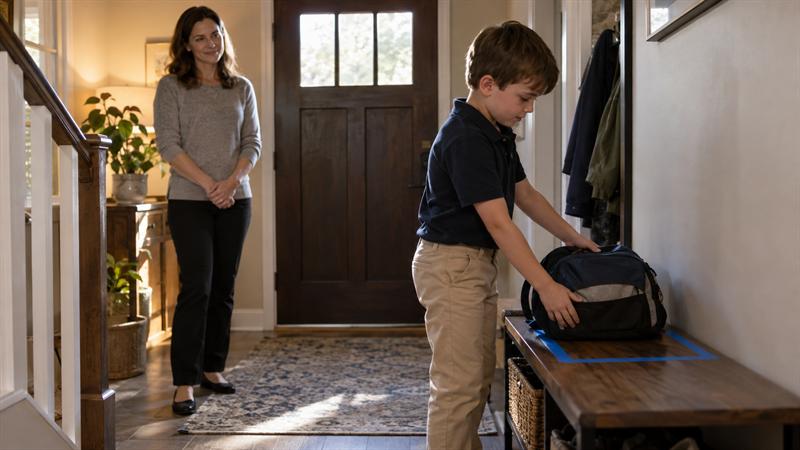
A life skills goal is a specific, observable routine behavior that the child is expected to participate in with decreasing adult support. It is not a broad outcome. “More independence” is an outcome. “Places the backpack in the marked cubby with a visual cue” is a life skills goal.
The difference matters because it gives the family something visible. Supported participation means the child completes the step with a prompt, model, or visual aid. Independent participation means the child starts or finishes the step when the routine cue appears, without adult direction. A strong goal is observable, specific, and tied to a routine that happens often enough to provide repeated practice.
This is how building independence through everyday routines becomes testable at home. The family can see the step, support the step, and decide whether the support should stay or fade.
Everyday Life Skills Goals That Fit the Evening Routine
The most useful evening goals often match the actual sequence of the day. They should reduce friction in the parts of the routine that create repeated prompting, waiting, resistance, or caregiver effort.
Arriving Home and Resetting
The first transition is moving from outside or the vehicle into the home. This is a useful place to start because it can set the tone for the rest of the evening.
- Goes to a set spot to place the backpack or shoes.
- Removes outerwear with a visual or verbal cue.
- Washes or sanitizes hands after entering the house.
- Moves from the entry area to the next routine with one clear step.
A brief reset can signal to the child that the school day is closing and the home routine is beginning.
Snacks, Meals, and Personal Hygiene
Snack and meal times include more than eating. They include waiting, sitting, using utensils, clearing a space, and moving to the next task. Hygiene goals are practical here because they repeat often.
- Washes hands before food with a visual cue at the sink.
- Places a plate or cup in a set location after eating.
- Uses a towel with a short verbal cue.
- Moves to the toothbrushing step with a natural cue.
High-frequency tasks are practical goal candidates because they can provide many practice opportunities each day.
Belongings, Homework Preparation, and Clean-Up
Homework is not only the academic task. It is the sequence around the task: pulling out the folder, finding the needed supply, sitting at the desk, starting the work, and putting materials away later. Belongings organization works the same way.
- Takes the homework folder from the backpack and places it on the desk.
- Lays out the next day’s lunch or clothing in a visible spot.
- Places a water bottle in a fixed location after use.
- Completes one clean-up step before moving to the next activity.
The target is not just completion. The target is initiation, especially the child starting the step from the routine cue rather than waiting for adult direction.
Bedtime Readiness and Sleep Transition
Bedtime can be one of the lengthier transitions of the evening. The child moves from a preferred activity into a restricted space, changes clothes, and shifts into quieter lighting and sound.
- Chooses and puts on pajamas with a visual reminder.
- Brushes teeth with minimal verbal prompting.
- Moves to the bed area with minimal physical prompting.
- Uses a comfort object or short wind-down step.
Bedtime strain can begin earlier than the final sleep cue. If the evening has been high-friction, the child may arrive at bedtime with less capacity to shift. A smaller goal, such as putting a book back on the shelf after reading, can be a more manageable starting point than a goal tied to the full sleep window.
Requesting Help and Communicating Needs
A critical life skills goal is the child’s ability to ask for help, a break, a drink, or the next step. This can be verbal, gestural, picture-based, or device-based depending on the child’s communication profile.
This goal can support many other goals. If the child cannot request the next step, the caregiver may have to guess. If the child cannot request a break, resistance can build before the adult can adjust the demand. A clear request can reduce pressure and give the caregiver a less ambiguous signal.
How to Choose Life Skills Goals for Children in a Way That Lasts
Start With One or Two High-Impact Targets
The most useful goals are often the ones that reduce the most friction in the actual evening. If the child gets from the car to the kitchen without support but stalls at hand-washing, the hand-washing step is the target. If the homework folder stays in the backpack every night, that step is the target.
Adding several new expectations at once can increase pressure. A smaller set of active goals can give the child clear targets and give the caregiver a workable way to support the routine without turning the evening into a series of demands.
Match the Goal to the Child’s Current Abilities
The goal should extend the child’s current level, not land beyond it. If a multi-step sequence is beyond the child’s current level, the target can begin with one or two steps. The baseline is the starting point. What does the child do independently, what do they do with support, and what have they not started yet?
Skipping the baseline can make it harder to match the goal to the child’s current level. If the child washes hands at school with a visual prompt but not at home, the goal is not simply “wash hands.” The goal is to support hand-washing at home with a visual prompt, then fade the prompt. That is a practical step the family can work on immediately.
Coordinate School, Home, and Therapy Expectations
The same skill can be targeted in three settings at once. If the school expects the child to store the backpack, therapy is working on hand-washing sequencing, and home expects homework to start by a set time, the child may receive three different “next” signals.
Consistency does not mean every setting uses the exact same method. It means the expected outcome is the same. The teacher, therapist, and caregiver should agree on the one or two evening priorities that matter most right now. A parent guide to ABA home-school communication for shared goals can help keep those priorities visible.
Build in Prompts, Supports, and Gradual Fading
A goal without a fading plan can lead to continued reliance on adult prompts. If the adult keeps giving the same prompt in the same spot, the child can learn to wait for the adult instead of following the routine cue.
Fading can be verbal, visual, or physical. A verbal prompt can move from a full sentence to a short cue to a gesture. A visual sequence can move from a full strip to a single card to no card. A physical prompt can move from hand-over-hand support to lighter touch to no physical support. The purpose is for the environment to prompt the child while the adult steps back.
How ABA-Informed Planning and Assessment Support Life Skills Goals
Assessment Clarity and Developmental Context
A life skills goal is easier to support when the team understands why the current routine is difficult. The barrier may be a skill gap, a communication gap, a sensory factor, a regulatory factor, or a task-demand mismatch.
- Skill gap: the child has not yet learned the step.
- Communication gap: the child cannot ask for the next step clearly.
- Sensory factor: the setting, sound, texture, or lighting makes the step harder.
- Regulatory factor: the child is tired, overstimulated, or having trouble shifting attention.
Assessment clarity matters because each barrier can point to a different support. An evaluation or reevaluation can help the team identify the likely driver instead of guessing.
Using Routine Observations to Select the Right Goals
Routine observation can turn a vague evening problem into a workable target. If the child starts the sequence at school but not at the sink, the plan changes. If the child stalls only after a loud transition, the environment becomes part of the target.
The practical takeaway is the same: the skill must be visible in the setting where families actually need it. A goal that remains only in a treatment sheet may not reduce evening friction on its own.
When a Reevaluation or Plan Adjustment Makes Sense
If a goal has been in place for a reasonable period and the pattern has not shifted, the next question is whether the goal, the support level, or the diagnostic picture needs a closer look. A stalled goal is a signal to review the plan, not simply to add pressure.
Reevaluation is part of careful planning. It can help the team see whether the current target is the right target, whether the support is still at the right level, and whether the child’s profile has changed in a way that affects the routine.
Supporting Life Skills at Home Without Creating Pressure
Choosing Supports That Fit the Child
The support should reduce the cognitive load of remembering the next step rather than add a new demand to memorize. Visual, environmental, and communication supports are useful because they make the expected step easier to access.
- Visual support: a step-by-step picture strip at the sink or a whiteboard showing the next three tasks.
- Environmental support: the toothbrush in the same place each night, the backpack cubby in a fixed spot, the homework folder visible rather than hidden in a drawer.
- Communication support: a first-then board, a break card, or a simple request for help if the verbal channel is not yet reliable.
Using Natural Routines Instead of Extra Demands
Many prompts can be built into the environment. The sound of a timer, shoes by the door, a visual card at the sink, or dimming light for bedtime can carry the cue. When possible, the environment can do the prompting instead of the adult repeating instructions.
This is how routine-based support fits into a child’s daily schedule without turning every transition into a negotiation. One clear step, one clear location, one clear cue. Then the next.
Keeping Tone, Expectations, and Reinforcement Consistent
If one caregiver gives a full physical prompt and multiple verbal reminders while another expects independent initiation, the child can receive two different messages about what success looks like. The family can agree on the goal step, the support level, and what happens when the child completes the step.
Reinforcement can be natural and simple. The child puts the backpack away, then their hands are free for the next desired item. The child starts the clean-up step, then the routine moves forward without an added demand. The point is not a token system. The point is that completion can lead to a clear, predictable consequence.
Generalizing Skills Across Caregivers and Settings
A skill that works with one adult but not another may not yet be generalized. The child may need the same prompt from a different caregiver, in a different room, at a different time, before the behavior becomes reliable. This is common.
The goal is for the routine itself to become the prompt. When the sink card, the timer, the fixed location, or the verbal cue from any caregiver can trigger the step, the skill may be moving beyond one person and one room.
Access, Consistency, and the Barriers Families Often Underestimate
Transportation, Scheduling, and Distance to Support
A goal that requires repeated support can be harder to maintain when the family has to manage long drives, tight pickup times, and multiple household demands. Transportation is a practical logistical factor. It can affect the consistency of practice.
When access is consistent, the child can receive predictable practice. When access is fragmented, progress can slow. A frequent contributor is that support is not available often enough in the setting where the routine actually happens.
Insurance, Financial Assistance, and Sustainable Access
Insurance verification, coverage questions, and cost concerns can create uncertainty at the exact moment families need consistency. Families exploring support may also consider financial assistance pathways or partnership-based options that can bridge the gap between need and access.
The practical question is not only whether a service is available. It is whether the family can access it consistently enough for the skill to develop. A schedule that fits the after-school and evening window can put the family in a stronger position than one that requires unpredictable trips or compressed appointments.
Partnerships That Connect School, Home, and Therapy
When school, therapy, and home are not communicating, the child can receive three slightly different expectation sets. A partnership model means each setting knows the evening priority, the support level, and the fading direction.
This does not require a formal committee. A brief check-in or a simple shared goal summary can be enough. This can create a single, coherent expectation that the child experiences across settings.
How to Track Progress Without It Feeling Like a Second Job
Use a Simple Baseline
Before starting the goal, note what the child currently does. The baseline can be simple: how many steps are completed independently, how many are completed with a visual prompt, how many are completed with a verbal prompt, and which steps are not started.
A quick note can be enough. “Yesterday, she washed hands with a few verbal cues and did not start the soap step on her own” gives the family a starting point without turning the home into a data room.
Track Participation, Not Perfection
The useful measure is whether the child participates and what level of support is needed. A simple scale is independent, supported, and not started. The goal is to see the prompt level shift over time.
- Independent: the child starts and completes the step from the routine cue.
- Supported: the child completes the step with a visual, verbal, or physical prompt.
- Not started: the child does not start the step even with support.
If the pattern stays flat for a meaningful period, the next move is to review the goal, the prompt, or the environment.
Adjust Prompts and Supports When the Pattern Stalls
A stall is information. The goal may be too advanced, the prompt may no longer be useful, the environment may have changed, or the child may be in a different developmental phase. Adjusting the plan is not giving up. A common process is observe, adjust, then observe again.
Small changes can help. Moving the visual card to a different spot, changing the time of day, shortening the sequence, or pairing the step with a more preferred item can change the outcome without adding pressure.
When to Reassess Goals, Services, or Team Understanding
Patterns That Suggest the Goal May Be Misaligned
If the routine keeps stalling after adjustments, the goal itself may be the issue. These patterns suggest a closer look:
- The same step fails at home even when it works at school.
- The child starts the step in a quiet setting but not when the evening stacks demands.
- The goal was chosen because it sounds impressive, not because it reduces real friction.
- The prompt is still being used at the same level for an extended period with no fade plan.
Signs That Additional Evaluation or Reevaluation May Help
A closer diagnostic look is useful when the family has adjusted the goal, the prompt, and the environment and the pattern still has not shifted. It is also useful when the child’s profile has changed in a way that affects the routine.
- The child’s communication, mobility, sleep, or sensory profile has changed.
- A new medical or developmental referral has been made.
- A previously progressing goal has stalled across settings.
- The family schedule or living situation has changed in a way that altered the routine.
If these signs appear together, the next step is usually not more pressure. It is a closer look at the goal, the support level, or the diagnostic picture.
When to Bring School, Medical, or Behavioral Teams Into the Conversation
The evening routine does not exist in one room. If the skill matters, the teacher, the medical team, the therapy team, and the family should be looking at the same picture. A short, focused conversation can clarify what each setting is expecting.
The question is not whether everyone uses the same method. The question is whether the expected outcome is the same. When the settings align, the child can receive a clearer message about what comes next.
Common Mistakes That Keep Evening Routines Stuck
Setting Too Many Goals at Once
Too many new evening expectations can create extra friction points. Many children can manage a smaller number of new active targets while older skills stabilize. Reducing the number of active goals can make it easier to see progress on each one.
Expecting the Same Performance in Every Setting
A skill that is reliable in a therapy room may not yet be reliable in a bedroom or kitchen. The child may need the same prompt in a different form or with a different adult before the behavior becomes stable. Treating that as regression can add stress without improving the plan.
Using Prompts Without a Fading Plan
If the prompt never changes, the child may continue to rely on the adult prompt rather than the routine cue. “I wash my hands because the adult said so” is not the same as “I wash my hands because it is next in the routine.” A fading plan can move the child toward the second version.
Treating Independence as Compliance
A life skills goal is not “do what I say without being told.” Independence is participation in a routine that supports the child’s growing ability to manage a sequence. If the family frames the goal as obedience, the child can learn to watch the adult instead of following the environment.
Key Takeaways
- Narrow the evening to one or two high-impact life skills goals instead of trying to fix the whole routine at once.
- A strong goal is observable, specific, tied to a frequent routine, and matched to the child’s current level.
- Support the skill with a clear cue, then fade the support gradually so the routine itself becomes the prompt.
- Track participation using independent, supported, and not started instead of aiming for perfect performance.
- Reassess the goal, the support plan, or the diagnostic picture when the pattern stays stuck after adjustments.
How Strive ABA Consultants LLC Approaches This
Strive ABA Consultants LLC can help families look at the after-school sequence as a planning problem, not just a behavior problem. The focus is on clear routine steps, practical supports, and access factors that affect consistency.
This can include identifying the step that creates friction, reviewing the current support level, and discussing when a referral for an autism evaluation or reevaluation may be useful. Transportation, scheduling, and partnership-based support are practical factors because they can affect whether support reaches the child when the routine needs it.
Frequently Asked Questions
What are the most important life skills goals for a child after school?
The most useful goals are often the ones that reduce the highest-frequency friction in the child’s actual evening. These are usually arrival and reset, hand hygiene before food, the homework-preparation sequence, and the first step of the bedtime transition. The deciding factor is payoff in the day, not importance in the abstract.
If the steepest nightly struggle is getting from the car to the kitchen and washing hands, that is the goal to target first. Homework can wait. A smaller set of goals can reduce pressure when the child is already tired, because each active goal can compete for the child’s remaining energy and attention.
How do I know if my child is ready for more independence in the evening routine?
The clearest signal is what the child already does with support. If the child completes a step with a visual prompt or a short verbal cue, they may be ready to fade that prompt rather than add more instruction. Readiness is not an all-or-nothing threshold for the whole evening.
A child can be ready for more independence on hand-washing and not yet ready on homework preparation. When a child consistently resists a step, the useful distinction is between “not ready yet” and “the support is misaligned.” Those two causes can point to different fixes. One is pacing. The other is changing the step length, the environment, or the prompt type.
Do ABA life skills goals work at home, or only in therapy?
A skill practiced only in the therapy room may be more of a therapy room skill than a routine life skill. Transfer to home requires the same step to be practiced in the home environment, with the same routine cue, and with the same or a faded prompt level.
Unevenness during transfer is common. The behavior tends to be most reliable in the original setting and least reliable in the newest setting. A step that looks solid in therapy and less visible at home in the early weeks may be a normal part of transfer rather than a loss of the skill. The home becomes the setting where the routine cue has to do the work.
What if my child does a task at school but won’t do it at home?
That pattern can often be understood as a generalization gap rather than a regression. The child has the skill in one context, but the home context has not yet become the cue. Lighting, noise, people, work surface, and sequence all change between a classroom and a home kitchen later in the day.
The practical fix is to make the home cue clearer. A visual card at the sink, a fixed location for the item, or a consistent natural signal can bridge the gap. Over time, the home environment can trigger the same behavior that the school environment already supports.
How long should a life skills goal take to become independent?
There is no single timeline, and comparing your child to a generic number is usually unhelpful. A simple one-step hygiene goal with a clear environmental cue can fade with repeated practice. A multi-step homework-preparation sequence can take longer because it depends on attention, transitions, and end-of-day fatigue.
The factors that often matter include how dependent the goal is on a specific environment, the child’s end-of-day fatigue level, how many competing demands surround the step, and whether the prompt is actually being faded. The useful signal is not elapsed time but the direction of the prompt level. A flat pattern across the prompt hierarchy over a reasonable period can suggest that the goal, the prompt, or the environment needs adjustment.
Should I get an evaluation or reevaluation if evening routines are not improving?
A closer diagnostic look is reasonable when the family has already adjusted the goal, the prompt, and the environment and the pattern still has not shifted. A common explanation is that the current plan is not aligned with the child’s primary barrier.
An evaluation or reevaluation can be useful for clarifying which category the difficulty falls into: a skill gap, a communication issue, a sensory factor, a regulatory factor, or a task-demand mismatch. Those categories can lead to different next steps. Reevaluation is a routine part of careful planning, not a response to failure. The decision to pursue one is shaped by whether the current plan is still aimed at the real barrier.
Conclusion: Turning Evening Goals Into Sustainable Independence
A common challenge is that the evening routine gets treated as a behavior issue instead of a planning issue. When prompts increase, goals stay vague, or supports are scattered across school and home, the routine can become harder to manage. The child needs a clearer sequence, the caregiver needs a steadier system, and the team needs a sharper view of the actual barrier.
The next step is to review the routine with Strive ABA Consultants LLC. The team can help identify the step causing the most friction, align the goal with the child’s current level, and discuss whether the family may benefit from a support adjustment, a consistency plan, or a referral for evaluation or reevaluation. Because the evening is where routine supports are most visible, a review now can target the step with the largest payoff.