

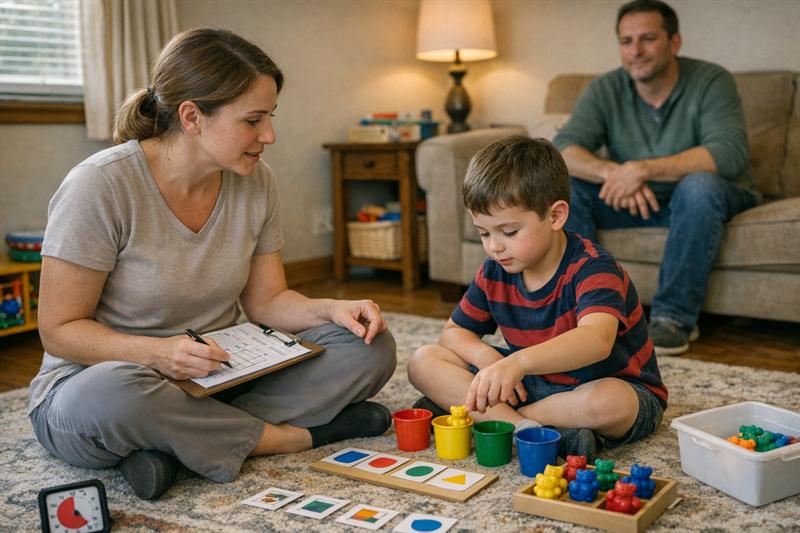
Quick Answer: An ABA session follows a structured but flexible routine where therapists teach skills, support behavior, and track progress in real time. Most sessions include a warm-up, targeted activities, behavior support, and a parent update, all adjusted to the child and setting.
Why Parents Ask This Question (And What They Really Want to Know)
Most parents are not looking for a definition of ABA. They are trying to picture what their child will actually experience. Will it feel strict? Will it feel like school? Will their child be comfortable?
This is where confusion often starts. Many providers explain goals and outcomes but do not walk through what a session actually looks like. Without that clarity, it becomes harder to feel confident moving forward.
In practice, ABA sessions are structured but rarely rigid. Much of the work happens through play, routines, and interaction. If you want to see how those small moments build into larger progress, this guide on how ABA builds communication skills step by step breaks that down clearly.
The Basic Structure of an ABA Session
Most ABA sessions follow a predictable flow. The structure stays consistent so the child knows what to expect, but the activities shift based on how the child responds.
Arrival and Warm-Up
Sessions usually begin with a transition period. The therapist focuses on building comfort and motivation, often through preferred activities.
Early sessions can look like simple play, but this is often where cooperation starts. When this step is rushed, engagement can drop and the rest of the session may be harder to run.
Skill Building Activities
This is where targeted learning happens. Activities often focus on communication, social interaction, and daily living skills.
These activities are not limited to sitting at a table. Many skills are taught through play and movement so the child can stay engaged while learning.
Behavior Support and Redirection
When challenging behaviors happen, the session does not simply stop. The therapist uses that moment to teach a more appropriate replacement skill when possible.
Consistency matters here. When behavior is handled very differently across home, school, and therapy, it can make learning harder and slow progress.
Data Collection and Adjustments
Therapists track what happens during the session. They record responses, progress, and patterns.
This helps keep the program accurate and responsive. Without consistent tracking, it becomes harder to tell what is working and what needs to change. You can see how this connects to outcomes in what makes an ABA program effective.
Wrap-Up and Parent Communication
At the end of the session, parents should receive a clear summary of what worked, what was difficult, and what to continue practicing at home.
This is where follow-through begins. When strategies are not carried over into daily routines, progress is less likely to extend beyond session time.
What Happens in an In-Home ABA Session
In-home sessions are built around daily life. The therapist works within the child’s natural environment, using real routines as teaching opportunities.
For some children, home can make it easier to get comfortable and engaged more quickly. It also means parents usually have a more active role in the session.
How the Home Environment Shapes the Session
Therapy is integrated into everyday activities like meals, play, and routines.
This is where practical skills develop. If learning only happens in highly structured settings, children may have more difficulty using those skills in real situations.
Common Activities at Home
- Practicing communication during play
- Following directions during routines
- Building independence with daily tasks
These activities may look simple, but each one is tied to a specific goal.
Parent Involvement in Home-Based Therapy
Parents are part of the process. They observe, practice strategies, and apply them outside of sessions.
This often strengthens long-term progress. When strategies are only used during therapy, skills may not carry over as effectively into everyday life.
What Happens in a Center-Based ABA Session
Center-based sessions take place in a structured setting designed for learning. The environment is more controlled, which can help with consistency.
Children who benefit from routine and repetition may respond well in this setting. Fewer distractions can make it easier to focus on skill development.
Structured Learning and Play
Sessions include both structured tasks and play-based learning.
That balance matters. When sessions are too rigid, children may disengage. When they are too unstructured, goals can become harder to target clearly.
Peer Interaction Opportunities
Children may interact with peers during parts of the session.
This gives them opportunities to practice social skills in a more natural way, which can support carryover outside of therapy.
Supervision and Team Collaboration
Center-based programs often involve multiple therapists and oversight from a BCBA.
This can support more consistent implementation. When communication between team members breaks down, strategies may become inconsistent and progress can stall.
What Happens in a School-Based ABA Session
School-based ABA focuses on helping children function in a classroom setting.
Demands are different in school than in one-on-one therapy. A child who does well in a quieter setting may still need support with group instruction, transitions, and classroom routines.
Supporting Classroom Participation
Therapists support skills like following instructions, transitioning between activities, and participating in group work.
Without support in these areas, some children may struggle with the classroom environment even when they can learn the material.
Working with Teachers and Staff
Therapists coordinate with teachers to keep strategies as consistent as possible.
Alignment matters. When expectations differ across adults, behavior challenges can increase and progress may become uneven.
Balancing Academic and Behavioral Goals
Behavioral skills support academic learning.
When a child has difficulty staying engaged, transitioning, or following classroom routines, it can become harder to fully benefit from instruction.
How ABA Sessions Change Over Time
ABA sessions evolve as the child develops new skills.
Early sessions often focus on engagement, rapport, and basic learning. This stage can feel slow because the foundation is still being built.
As therapy continues, sessions may become more structured and goal-focused. Later stages often shift toward independence and using skills across different settings. This is where consistency across environments becomes especially important, as outlined in how to generalize ABA skills across home, school, and community.
What Might Surprise Parents About ABA Sessions
- Sessions often look like play rather than traditional therapy
- Progress usually builds gradually before it becomes obvious
- Sessions adjust based on the child’s energy, attention, and behavior
- Transitions at the beginning and end can be some of the more challenging moments
These patterns are common. Expecting therapy to look highly structured from the start can create unnecessary concern when sessions appear more flexible.
How to Know If an ABA Session Is Effective
Effectiveness is measured by progress over time, not by how busy a session looks.
Useful indicators include stronger engagement, improved communication, and less frustration in daily situations. These changes should be supported by consistent data tracking and regular review.
If you are seeing any of the following, the plan may need to be adjusted:
- Skills are not showing up outside of sessions
- Behavior improves in one setting but not others
- Your child is consistently disengaged
- You are not receiving clear updates or understandable data
When these patterns continue, progress can slow. Programs often need refinement to stay effective.
Key Takeaways
- ABA sessions follow a structured but flexible routine
- Activities change based on the child and environment
- Consistency across settings supports stronger carryover
- Parent involvement can strengthen long-term progress
Conclusion
The biggest barrier for many families is not understanding what actually happens during a session. Without that clarity, it is harder to evaluate whether therapy is working or what may need to change.
When sessions lack consistency, clear structure, or follow-through, progress can slow and skills may not carry over into daily life. Over time, that can create more frustration for both the child and the family.
Strive ABA Consultants LLC focuses on making each session structured, practical, and connected across home, school, and everyday routines. With services that may include evaluations, re-evaluations, and support that helps families access care more consistently, the goal is to reduce the gaps that often slow progress.
If you are unsure what your child’s sessions should look like or whether the current approach is working, starting with a clear evaluation and updated plan can be a practical next step.
Frequently Asked Questions
What happens during an ABA therapy session?
An ABA session often includes rapport building, structured activities, behavior support, and data tracking. Each part is adjusted based on how the child responds, which helps keep the session focused and useful.
How long is a typical ABA session?
Sessions often range from a couple of hours to longer blocks depending on the treatment plan. The schedule is based on the child’s needs, attention span, and goals.
Is ABA therapy play-based or structured?
It is both. Sessions follow a structured plan, but many skills are taught through play and interaction to maintain engagement while building progress.
What does an RBT do during a session?
An RBT works directly with the child to teach skills, support behavior, and collect data. They follow a plan developed by a BCBA and make in-the-moment adjustments within that plan during the session.
What’s the difference between in-home and center-based ABA?
In-home ABA focuses on daily routines and real-life situations, while center-based ABA provides a structured environment that may include peer interaction. The right setting depends on the child’s needs and how they respond in each environment.
How do you know ABA therapy is working?
Progress is often seen through improved communication, stronger engagement, and increased independence over time. These changes are tracked with data and reviewed regularly to guide next steps.