

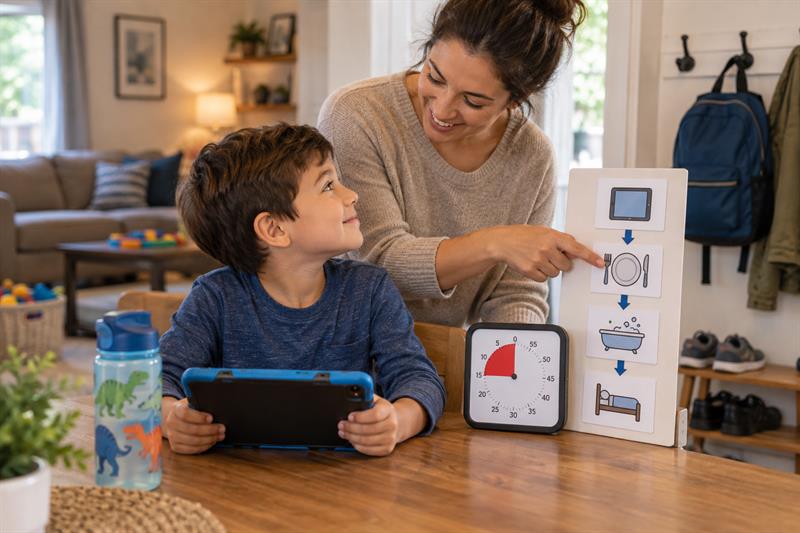
At Strive ABA Consultants LLC, this pattern comes up in family routines again and again. The hardest part of the day usually is not the entire routine. It is the moment when one activity ends and another begins.
Families looking for ABA transition support at home are usually not asking for a clinical explanation. They want to know how to help a child move from screen time to dinner, from the car into the house, from play into bath time, or from one caregiver to another with less conflict and confusion.
Why transitions at home can feel harder than they look
Transitions can become difficult when a child is asked to stop something preferred, start something less preferred, or switch too quickly without enough preparation. At home, those moments happen throughout the day. They also tend to show up when adults are tired, schedules shift, and routines do not unfold the same way every time.
That is one reason home transitions can feel different from school transitions. School settings often have more structure, more visual routine support, and fewer variations in who is leading the moment. At home, one caregiver may give extra time, another may rush the switch, and a third may change the plan midstream. That inconsistency is often where problems begin.
Common transition pressure points in daily routines
- After-school arrival: the child may already be carrying fatigue, sensory load, or frustration from earlier in the day.
- Screen-time ending: a highly preferred activity stops and the next step may not feel appealing.
- Mealtime shifts: hunger, waiting, and multiple directions at once can add frustration.
- Bath and bedtime sequences: the routine has several steps, and resistance may build when the first step is unclear.
- Leaving preferred activities: something enjoyable is ending, and the child may not feel prepared for what comes next.
Why preferred activities often make transitions tougher
A common pattern is that families focus on the visible behavior at the end of the preferred activity, but the real problem may have started earlier. The child may not know when the activity will end, may not know what is coming next, or may not have enough time to shift.
This can get harder when the next step feels less rewarding and more demanding. Fatigue, hunger, and sensory overload can also make transitions tougher. What looks like refusal is often a transition that was set up too abruptly to work well.
What helps most: cues, warnings, and handoffs
Cues, warnings, and handoffs are not interchangeable. Each one supports a different part of the transition process. Families often get better results when they match the support to what is actually breaking down.
If the child does not know what is next, that is usually a cue problem. If the child knows what is next but the change still feels abrupt, that is often a warning problem. If one adult handles the transition one way and another adult handles it differently, that is often a handoff problem.
Cues: helping a child know what is coming next
A cue helps the child understand what is happening next. It gives the transition more structure instead of making it feel sudden.
- Visual schedules
- First-then language
- Routine phrases used the same way each time
- Showing the next item, room, or activity
For example, “First shoes, then car” is a cue. So is showing a picture of bath time after play. This tends to work especially well in routines that happen often, because repetition can make the transition easier to predict.
Warnings: giving time to shift before the change happens
A warning tells the child when the transition is approaching. It does not replace the transition. It prepares for it.
- Brief notices before a transition
- Timers
- Short countdowns
- One calm verbal reminder before the change
A common way warnings stop working is when families give repeated warnings, then keep extending the activity when the child protests. That can teach the child that the warning does not mean the transition is actually starting. Once that pattern is in place, warnings often stop helping.
Warnings tend to work best when they are brief, predictable, and followed through. Not harsher. Just clearer.
Handoffs: keeping adults consistent during the transition
A handoff is the way adults pass a routine, expectation, or support from one person to another. At home, this can matter more than many families expect.
One caregiver may say, “A little more time, then cleanup.” Another may allow much more time. A grandparent may skip the cue entirely and move straight to the demand. This can leave a child unsure which version of the transition to trust.
If different adults are involved across the day, consistency becomes part of the transition support itself. A short shared plan can help. Families who need a simple way to organize that information can use a one-page ABA support plan for home, school, and caregivers so the same cues, warnings, and next steps are easier to carry across settings.
Transition routines families can use at home
The most practical transition routines are simple enough to repeat on hard days, not just smooth days. If the routine only works when everything is calm, it may not hold up when the day gets busy or stressful.
A useful pattern is to preview what is next, give a warning if needed, use one clear cue, then move into the next action without adding extra negotiation. This can keep the transition from turning into a long back-and-forth.
Coming home from school or therapy
After-school transitions can break down because the child may already be carrying the weight of the day. This is one of the most common times families expect too much too fast.
- Preview what happens next before entering the home
- Keep the first demand low and clear
- Use the same arrival sequence each day when possible
- Give one next step instead of several at once
For example, “Shoes off, snack, then break” is often easier to follow than walking into the house and hearing several instructions in a row. For families working on the full evening flow, after-school-to-evening routine support can help connect this transition to the rest of the night.
Moving from screen time to the next activity
Screen transitions usually need an endpoint the child can see and a next activity the adult has already decided. If the next step is vague, the protest may start there.
- Pair a warning with a visible timer or clear stopping point
- Name the next activity before the screen ends
- Use one phrase consistently
- Avoid renegotiating after the transition point
If the screen turns off but nothing clear replaces it, the transition may feel like a loss with no structure. That is why “a short warning, then snack” often works better than “time to turn it off” by itself.
Mealtime and cleanup transitions
Mealtime transitions often go more smoothly when the sequence is obvious: finish, clear, next activity. When the child is hungry or already frustrated, too much language can make the transition harder, not easier.
- Use a cue before the meal starts
- Use a separate cue before cleanup starts
- Keep directions short
- Make the next step visible when possible
A common mistake is giving multiple directions while the child is still trying to process the first one. That can lead to delay, frustration, and conflict that seems sudden but may start with overload.
Bath time and bedtime
Bedtime transitions often work best when the sequence stays consistent even if the exact timing changes. This is another place where families often wait until the child resists to start supporting the transition, and by then the routine is usually harder to recover.
The transition starts before bath time. A cue about what comes next, then a clear first step, can keep the routine from feeling abrupt.
For example, “Bath, pajamas, story, bed” creates a known path. Without that path, each part of bedtime may become a separate negotiation.
Leaving a preferred activity or outing
Leaving something enjoyable often needs a two-step plan: first, a warning; second, a clear next action.
For example, “One more turn, then car” works because it tells the child both when the change is happening and what happens next. If the adult only says, “It’s time to go,” the child still has to process the loss and the next step at the same time.
If you are seeing the same transition problem every day, the routine probably needs a clearer plan.
- The child handles the activity itself but breaks down at the switch
- Different caregivers get very different results with the same routine
- Warnings turn into repeated bargaining instead of preparation
- One part of the day, like after school or bedtime, is predictably harder than the rest
Those signs often mean the setup is not doing enough work, and the routine needs more structure.
What to say during a transition
The best transition language is short, predictable, and easy to repeat. Long explanations often do not help in the moment. They add more information when the child is already trying to shift.
This is something many families understandably try first. Adults keep talking because they are trying to calm the situation, but too much language can raise pressure instead of lowering it.
Simple phrases that support predictability
- First ___, then ___.
- A short warning, then we are going to ___.
- It is time for ___, then you can ___.
- When this is done, next is ___.
These phrases work because they are clear and repeatable. They reduce guesswork. They also help different caregivers use the same wording, which can strengthen consistency.
When fewer words work better
When a child is already frustrated, tired, or overloaded, short prompts are often easier to process than extended explanations. This does not mean being cold or abrupt. It means saying less so the transition stays clear.
If one phrase works, repeat the same phrase. Changing the wording each time may sound helpful to adults, but it often makes the transition harder for the child to track.
When transition support is not working yet
If a transition strategy is not helping, the first question is not whether the child is refusing to cooperate. The first question is what part of the setup is failing.
This is where families usually need to get more specific. Is the warning too late? Is the next step unclear? Is the routine too long? Is one adult following the plan while another changes it? Problems are usually easier to solve when the breakdown point is identified clearly.
Routine disruptions can make these issues more obvious. During schedule shifts, travel, school breaks, or changes in the week, the same child who usually manages transitions can start struggling much more. Families navigating those disruptions may also benefit from guidance on planning for school breaks and routine changes while ABA support continues.
Signs the transition is moving too fast
- The child did not have enough preparation
- The next step is unclear
- The warning came too late
- The child is already tired, hungry, or overloaded
If those signs are present, pushing harder often makes the transition worse. The plan usually needs more structure, not more repetition.
When to change the routine instead of repeating the same prompt
If the same transition becomes difficult every day, the prompt is usually not the real problem. The routine may need to change.
- Adjust the timing
- Simplify the number of steps
- Add a visual cue
- Move the warning earlier
- Change the order of activities if the current sequence keeps failing
If you are seeing the same struggle in the same place every day, that usually means the routine is predictable in the wrong way. The child has learned where the breakdown happens. That is the point that may need redesign, not just more reminders.
Building consistency across caregivers
Different adult responses can create transition problems faster than families realize. When one person gives several warnings, another skips them, and another adds extra choices, the child is not getting one routine. The child is getting multiple versions of the same routine.
This can result in more testing, more delay, and more confusion. The solution is not making every caregiver identical. It is getting everyone close enough that the transition still feels predictable.
Using one plan across parents, relatives, and other caregivers
- Agree on one warning style
- Agree on one cueing phrase
- Agree on what happens next when the transition starts
This is where problems often start to settle down. The child begins to learn the pattern instead of learning each adult.
A simple one-page transition note for handoffs
A simple handoff note can include the hardest transitions, preferred cues, warning timing, calming supports, and the exact next-step language that works best. This can help co-parents, relatives, sitters, and therapy teams respond in a more consistent way.
Families working on daily carryover across multiple adults may also find it useful to review how to share ABA routine supports with grandparents, sitters, and other caregivers. The point is not paperwork for its own sake. The point is making the transition plan easy to use when real life gets busy.
When families may want added support
Some transition problems improve once the routine becomes clearer and more consistent. Others keep showing up across the day, across caregivers, and across settings. When that happens, the issue is usually broader than one hard moment.
At Strive ABA Consultants LLC, families often notice this before they have language for it. They are not dealing with one difficult bedtime or one rough car transition. They are seeing the same pattern at meals, outings, after school, screen time, and handoffs between adults.
How evaluations can help clarify support needs
Evaluations and re-evaluations can help clarify the bigger pattern when transition difficulty is affecting daily routines. The value is not just in naming a challenge. It is in understanding how communication, routine support, regulation, and caregiver consistency fit together.
That gives families a clearer starting point for planning support at home, in school, and across everyday routines. Without that clarity, families often keep trying different tactics without knowing which part of the problem needs attention.
When repeated transition difficulties affect daily functioning
- Frequent conflict around multiple daily transitions
- Significant stress across caregivers
- Difficulty participating in ordinary routines or community outings
If those patterns are showing up regularly, the issue is no longer just inconvenience. It is affecting how the day works. That usually means more structured support may help.
Key Takeaways
- Transitions often improve when families focus on predictability, timing, and consistency.
- Cues tell a child what comes next.
- Warnings tell a child when the change is coming.
- Handoffs help adults stay consistent so the child is not managing different expectations from person to person.
- If the same transition keeps breaking down, the routine usually needs to change.
- The goal is not a perfect routine. The goal is a routine that works reliably enough to reduce daily stress.
Conclusion
The real problem with home transitions is not that families are missing one perfect phrase or one perfect tool. The problem is that unclear cues, weak warnings, and inconsistent handoffs can turn ordinary parts of the day into predictable stress points.
If that pattern is not addressed, it can spread. One hard screen-time ending can become a harder mealtime, then a rough bedtime, then tension between caregivers who are all trying different things. Once the same breakdown starts showing up across routines, families often need more than trial and error.
Strive ABA Consultants LLC is a practical next step for families who need clearer support around home routines, evaluations, or re-evaluations that help explain the bigger pattern behind repeated transition difficulty. When the same problems keep showing up in the same moments, a more structured plan is often what moves things forward.
Company Approach
At Strive ABA Consultants LLC, the focus is not on making transitions look perfect on paper. The focus is on helping families identify what is actually failing in the moment: the cue, the warning, the handoff, or the routine itself.
That matters because transition problems often get mislabeled as behavior problems first. In real family routines, they are often predictability problems, timing problems, or consistency problems between adults. Once that is clear, support becomes more specific and more useful.
For families in Oak Forest, Chicago, and Merrillville who are trying to understand what type of support makes sense next, this practical approach fits the way home life actually works. It also helps families connect everyday routine concerns to broader planning around evaluations and service access when needed.
FAQ
Can ABA transition support at home help with screen-time struggles?
Yes. Screen-time struggles are usually transition struggles, not just device struggles. The hard part is the shift away from a highly preferred activity, especially when the ending feels sudden and the next step is unclear.
A more effective setup is a short warning paired with a clear next activity, such as “a short warning, then snack.” That often works better than repeated reminders or ending the screen without showing what comes next. The key difference is that the child is prepared for both the ending and the next step.
How many warnings should a child get before a transition?
Enough to prepare for the change, but not so many that the warning loses meaning. A common pattern is an earlier warning and a final warning.
For example, one warning followed by a final reminder gives structure without turning the transition into bargaining. What matters most is that the transition starts when the warning says it will. If warnings keep stretching, the child learns that the real transition starts later than the adult says.
What if transitions go well with one caregiver but not another?
That usually points to a consistency problem, not two completely different transition abilities. One caregiver may use shorter language, clearer timing, or steadier follow-through.
If one adult gives a warning and moves into the next step while another negotiates, changes the wording, or delays the transition, the child is learning different rules for the same moment. The important distinction is that the routine itself may be workable. The handoff between adults is what needs to be tightened.
Why are after-school transitions often harder at home?
Because the child may already be arriving with fatigue, sensory load, social effort, or frustration from the day. That can lower tolerance for unclear or high-demand transitions.
A child who can usually shift between tasks may still struggle the moment they get home if the first few minutes are overloaded with instructions. This does not necessarily mean the child cannot handle the routine. It usually means the first step after arrival needs to be simpler and more predictable.
What is the difference between a cue and a warning during transitions?
A cue explains what comes next. A warning explains when the change is about to happen.
“First bath, then story” is a cue because it shows the sequence. “A short warning, then bath” is a warning because it signals timing. This distinction matters because some transitions fail from lack of predictability, while others fail because the change comes too abruptly. The support has to match the breakdown.
When should families seek more support for transition difficulties at home?
When transition difficulties are showing up across multiple parts of the day, creating regular conflict, or making ordinary routines and outings harder to manage. The issue becomes more important when it affects daily functioning, not just one isolated moment.
If meals, bedtime, arrival home, and community outings are all becoming difficult in the same way, that usually points to a broader need for structured support. The deciding factor is the pattern across routines, caregivers, and settings.