
Quick Answer: Self-advocacy skills can be harder for autistic children to use during routines when they have a need but do not have a clear, reliable way to communicate it. In daily life, self-advocacy is often built by teaching children how to ask for help, make choices, and request breaks in ways that work across home, school, and community settings.
At Strive ABA Consultants LLC, this is a practical issue, not an abstract one. Families are usually not asking whether self-advocacy matters. They are trying to understand why dressing, homework, meals, errands, and transitions keep becoming stressful when a child needs support but does not have a dependable way to show it.
What self-advocacy means in everyday life
Self-advocacy means communicating wants, needs, limits, preferences, and support needs in a way other people can recognize and respond to. For autistic children, that does not start with a speech-only standard. It starts with functional communication that works in real situations.
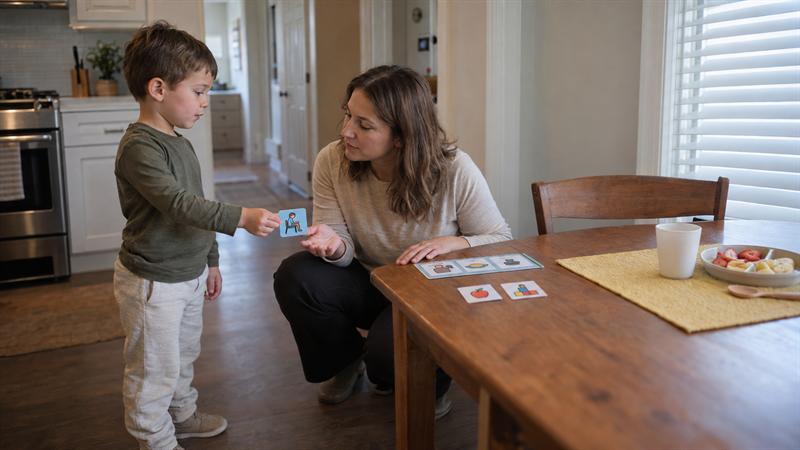
Self-advocacy is not limited to talking. It can include AAC, gestures, visuals, pointing, single words, consistent signs, or handing over a cue card. As explained in AAC and ABA: Supporting Communication Across Home and School, the goal is not to force one communication style. The goal is to make sure the child has a reliable way to express a need before the routine becomes more difficult.
Self-advocacy is more than speaking up
A common mistake is treating self-advocacy as something that begins only when a child can explain a need in full sentences. That is where problems can start. When adults wait for more developed verbal language, they may miss earlier communication attempts, and the child can end up with fewer successful ways to get help, ask for space, or make a choice.
This can show up clearly in daily routines. A child pauses, reaches, turns away, looks toward a support, or becomes visibly stuck, and the moment may be treated as noncompliance instead of communication. That can lead to more prompting, more frustration, and less independence.
What self-advocacy can look like across communication styles
- Handing over a break card during a hard task
- Pointing to a help symbol when a zipper is stuck
- Using an AAC device to choose between two options
- Reaching toward a visual choice board during snack or play
- Saying “all done” or “help” during a transition
- Using a consistent gesture to indicate discomfort or overload
The key distinction is function over form. If the child is clearly communicating a need in a way others can recognize and support, that is self-advocacy.
Why self-advocacy matters in daily routines
Self-advocacy matters in daily routines because that is where communication pressure shows up again and again. Routines are predictable, repeated, and full of small moments where a child needs something, wants something different, or needs a pause. If those moments are missed, the same stress points can keep repeating.
Self-advocacy supports participation and independence because it reduces the need for adults to guess. It also changes what independence really means. Independence is not just doing a task alone. It includes being able to communicate when help is needed, when a different option is preferred, or when the task needs to pause before frustration takes over.
Routines create repeatable practice opportunities
Morning routines, meals, homework, chores, cleanup, and outings all create natural chances to practice communication. This is one reason routine-based teaching can be so useful compared with isolated drills. The child gets repeated chances to use the same skill in the same kinds of moments.
A common pattern is that families work hard on communication during structured support time, but the real breakdown happens later during faster parts of the day. That is why predictable home routines can matter so much. Related strategies for those windows are covered in Life Skills Goals for Children: Easing the After-School-to-Evening Routine.
How self-advocacy supports independence and participation
When a child can ask for help, choose between options, or request a break, routines often become more workable. Adults may spend less time reacting after a problem has escalated and more time responding to communication earlier. That can support smoother participation at home, better carryover into school expectations, and fewer routine points that break down for the same reason every day.
If this is ignored, the child may become more dependent on adults reading subtle signs, stepping in early, or preventing frustration at every turn. That may keep routines moving in the short term, but it does not build the same level of usable independence.
Three core self-advocacy skills to teach first
The most practical place to start is with asking for help, making choices, and requesting breaks. These skills are strong starting points because they come up frequently, they are observable, and they matter across settings.
These are also the areas where adults can accidentally block progress. A child cannot practice asking for help if someone always jumps in first. A child cannot learn to make choices if the choices are not meaningful. A child cannot use a break request if the only time it is introduced is after the routine has already become highly stressful.
Asking for help
Asking for help is one of the clearest early forms of self-advocacy. It shows that the child can identify a point of difficulty and communicate the need for support before giving up, shutting down, or becoming overwhelmed.
- Needing help with dressing or fasteners
- Not understanding a direction during homework
- Needing assistance opening a container
- Not finding materials during a task
This can become harder when adults solve the problem before the child has any chance to communicate. That may keep the routine moving, but it can teach dependence on rescue rather than help-seeking.
Making choices
Choice-making helps a child express preferences and participate more actively in a routine. This is not about offering endless options. It is about giving clear, workable choices that let the child communicate something meaningful.
Good examples include choosing a snack, picking the order of two tasks, selecting between two shirts, choosing where to sit, or choosing a short break activity. What often gets misunderstood is that token choices do not teach much. If both options are confusing, unrealistic, or not truly available, the skill may not carry over well.
Requesting a break
Requesting a break is a communication skill, not simply a way out of expectations. It gives a child a way to signal overload, effort, confusion, or the need for a pause before frustration turns into refusal, distress, or shutdown.
This can come up most clearly in routines with high demand or rapid transitions. A child starts showing signs of strain, but no break support is available until the situation is already too intense. That is why visual tools can matter. In Visual Supports in ABA: Schedules, Communication Cues, and Break Supports for Everyday Routines, the focus is on making those supports visible and usable before the moment becomes more difficult.
If break requests are taught too late, the child may learn that communication comes after escalation instead of before it. That can lead to harder routines and fewer workable ways to pause and rejoin.
What these skills can look like at home, at school, and in the community
Self-advocacy should not stay limited to one setting. If a child can ask for help only at home, or request a break only with one adult, the skill is still fragile. The goal is for the child to use the same basic communication function across different people and routines.
This is where many plans lose traction. A common pattern is that the support works in one place because everyone knows the child well, but the same support is missing or handled differently somewhere else. That can lead to uneven expectations and unreliable communication.
Morning and after-school routines
At home, self-advocacy often shows up during dressing, packing up, snack time, homework, chores, and the transition from school demands to evening routines. A child might request help with shoes, choose which task happens first, or ask for a short break before homework begins.
These are strong practice windows because they happen frequently and expose the same sticking points again and again. If a child struggles most during these routine transitions, that may mean the communication demand is outpacing the support available.
Meals, tasks, and transitions
Meals and task transitions are common pressure points because they combine effort, waiting, and changes in expectation. A child may need help opening food, want to choose between foods, need a pause from a hard task, or need a clearer way to say “not yet.”
- Requesting help when a task is confusing
- Choosing between two acceptable next steps
- Requesting a brief pause before rejoining an activity
- Using a support instead of escalating during transitions
If these moments are handled as behavior problems first and communication opportunities second, routines may stay tense and repetitive.
Outings and public settings
In the community, self-advocacy may look like requesting a break in a store, asking for help during an errand, choosing between two activities, or using AAC or visuals while waiting. These settings matter because they are often less predictable and more demanding.
If supports only exist at home, community participation may become harder. That is one reason cross-setting planning matters, especially for older children and adolescents. Related examples appear in Community Participation in ABA: Structured Support for Outings, Errands, and Everyday Social Settings.
Supports that can make self-advocacy easier
Self-advocacy often improves when the child has accessible tools, clear routines, and adults who respond consistently. It can become harder when the communication method changes from place to place or only appears during formal teaching.
A common pattern is that the child technically has a support, but it is not available when the need shows up. That is where problems can start. A break card in a binder across the room is not very useful during a fast transition. A choice board that only comes out during table work may not help much during snack, errands, or dressing.
AAC, visuals, and choice boards
AAC systems, visual supports, and choice boards can make self-advocacy more available across the day. They help children request help, choose between options, and ask for breaks without having to rely on speech alone.
What matters most is access. If the child uses a device, picture, or visual cue to communicate at one time of day but not during the routine that actually breaks down, the support may not be solving the real problem.
Break supports and environmental setup
Break cards, calm spaces, visual prompts, and predictable break routines help a child understand what a break means and how to ask for one. These supports often work best when they are introduced before the child is overwhelmed.
This is often mishandled when the environment treats breaks as an emergency tool only. When that happens, the child may not learn a usable communication pattern. The child may learn that support arrives only after distress is obvious.
Prompting without taking over
Adults should pause before stepping in, offer an accessible prompt, and fade support as the child begins using the communication more independently. The point is to support the request, not replace it.
This shows up often with help requests. An adult notices the struggle, solves the problem, and then says the child should have asked. By that point, the learning opportunity is already gone. If the goal is self-advocacy, the support has to create room for the child to communicate first.
Common barriers families and teams run into
Most self-advocacy problems are not about whether the skill matters. They are about where the support breaks down. The same few issues tend to show up across routines, settings, and teams.
When adults anticipate needs too quickly
Helpful adults often remove the communication opportunity without realizing it. They hand over the item, solve the task, move the child along, or change the activity before the child has any chance to express a need.
That can create a pattern where the child looks dependent even when the bigger issue is lack of opportunity. If this continues, adults may end up doing more and the child communicating less.
When self-advocacy is mistaken for refusal or avoidance
Not every difficult moment is simple noncompliance. Sometimes a child is trying to communicate confusion, overload, or a need for support, but the signal is being read as refusal.
This does not mean every demand should be removed. It means the team has to separate “I need help” from “I am done for now.” That distinction changes what happens next. Without it, routines may become more adversarial and the child may lose trust that communication will work.
When a skill only works in one setting
A skill that works with one adult but nowhere else is not fully established yet. This usually means the cue, support, or adult response is inconsistent across settings.
If you are seeing a help request at home but not at school, or a break request during therapy but not during errands, it usually means the communication system is too context-dependent. The next step is not more explanation alone. The next step is tighter consistency across people, materials, and routines.
If you are seeing these signs, the support setup likely needs a closer look:
- The same routine breaks down at the same point every day
- The child communicates needs in one setting but loses the skill in another
- Adults are guessing what the child needs instead of recognizing a clear request
- Breaks only happen after frustration has already escalated
When those patterns are present, the issue is rarely just behavior in the moment. It usually means the routine, support system, or communication setup needs a closer review.
How ABA-related support can help build self-advocacy
ABA-related support can help when it identifies where the routine is actually breaking down and what communication function is missing. That might be help-seeking, choice-making, break requesting, or a combination of all three.
At Strive ABA Consultants LLC, the useful question is not just whether a child has a goal related to communication. The useful question is where the day consistently stalls, what the child is trying to communicate in that moment, and what support is needed to make the response more usable across settings.
Identifying communication opportunities in routines
Adults can look closely at transitions, unclear directions, hard tasks, waiting periods, crowded settings, and moments where expectations shift quickly. Those are the routine points where self-advocacy usually matters most.
This is where many families and teams benefit from mapping the routine instead of reacting one moment at a time. A structure like the one described in ABA Routines Map: How to Identify Where Support Breaks Down at Home, School, and in the Community can help clarify whether the breakdown is happening because of the task, the transition, the communication method, or the adult response.
Building consistent responses across caregivers and settings
Consistency matters because communication can weaken when one adult honors the request, another misses it, and a third expects a completely different response. This is a common reason a skill looks present in one place and absent in another.
If the same help request, break support, or choice structure is used across settings, the child has a better chance of recognizing when and how to use it. When families are also trying to understand whether current support recommendations still fit, re-evaluation of goals and day-to-day routines can help clarify what the child needs now and where adjustments may be useful.
Key Takeaways
- Self-advocacy skills can be harder to use when a child needs support during a routine but does not have a clear way to communicate it.
- Asking for help, making choices, and requesting breaks are practical starting points because they come up every day.
- Self-advocacy does not depend on spoken language. AAC, visuals, gestures, and other consistent signals can all serve the same function.
- Routines are one of the best teaching environments because they create repeatable communication opportunities.
- What adults do matters. Stepping in too fast, offering unclear choices, or waiting until distress is high can make the problem worse.
- If the same breakdown keeps happening across home, school, or community settings, the support system usually needs to be reviewed more directly.
Conclusion
The real problem is not that self-advocacy is too advanced or too abstract for daily life. The real problem is that many children are expected to move through routines without a clear, reliable way to ask for help, make a choice, or request a break before stress builds. When that is not addressed, the same routines can keep breaking down, adults keep guessing, and the child may stay more dependent than necessary.
Strive ABA Consultants LLC can be a practical next step when families or teams need help identifying where support breaks down and what communication needs to be built into the routine. That can be especially useful when the same patterns show up across settings, when support is inconsistent, or when a child’s needs have changed and current plans no longer fit.
Company Approach
Strive ABA Consultants LLC approaches self-advocacy as part of everyday functioning, not as a separate skill that sits outside the routine. That means looking at where the child gets stuck, what communication is missing in that moment, and how support can be made more usable across the people and settings involved.
This approach matters because self-advocacy usually does not fail in theory. It becomes harder in rushed transitions, unclear expectations, inaccessible supports, and inconsistent adult responses. When those patterns are addressed more directly, routines can become easier to understand and communication can become more functional.
FAQ
Can self-advocacy be taught to autistic children who do not use spoken language?
Yes. Self-advocacy does not depend on speech. It depends on whether the child has a reliable way to communicate a need, preference, or limit that other people can recognize and respond to.
That might look like pointing to a visual, using AAC to say “help,” handing over a break card, or using a consistent gesture for “all done.” The important point is that the communication works in the moment it is needed. When adults treat speech as the only valid form, they may miss earlier opportunities to build real independence.
What is the difference between self-advocacy and functional communication?
Functional communication is the broader category. It includes any communication that helps a child get needs met or participate more effectively. Self-advocacy is a specific kind of functional communication focused on expressing preferences, support needs, limits, and choices.
For example, asking for a toy is functional communication. Asking for help with a task, choosing between two options, or requesting a break during a hard routine is functional communication that also serves a self-advocacy role. That distinction matters because self-advocacy is closely tied to independence during real daily demands.
How can parents teach a child to ask for help without creating prompt dependence?
A strong approach is to pause before stepping in, provide a clear support for the help request, and then respond once the child uses it. The goal is to make communication possible, not to solve the problem before communication happens.
For example, if a child cannot open a container, immediately opening it removes the reason to ask for help. A more useful pattern is to wait briefly, show the help cue or model the word, and respond when the child attempts the request. Prompt dependence usually builds when adults move too fast and the child never gets a real turn to communicate.
Are break requests the same as avoiding a task?
No. A break request is a communication tool. Task avoidance is a pattern where the demand stops without a clear, supported communication response.
The difference shows up in what happens next. If a child uses a break card, takes a short pause, and then returns to the activity, that is self-advocacy supporting participation. If every sign of effort immediately ends the task with no structure for rejoining, the child is not learning how to communicate a manageable pause. This is why break routines need to be taught before frustration peaks, not only after the routine has already gone off track.
What are good examples of self-advocacy during home routines?
Good examples are everyday moments where the child communicates a need or preference during a familiar activity. That might include asking for help with a zipper, choosing a snack, requesting a short break before homework, or signaling “not yet” during cleanup with an accessible support.
These examples matter because they happen repeatedly and give the child many chances to practice. Home routines are often the best starting point because they are predictable. If the same routine keeps becoming stressful, that usually means it is also the best place to look for missing self-advocacy supports.
How do you help a child use self-advocacy skills in more than one setting?
Skills carry over better when the communication method, adult response, and expectations stay reasonably consistent across settings. If the child can request help at home but not at school or during errands, the issue is usually not motivation alone. It is usually inconsistency in how the support is presented or recognized.
For example, a break card that works after school will not help during a community outing if it is not available there or if adults respond differently. Generalization depends on shared tools, shared cues, and shared understanding. When those pieces are missing, the skill tends to stay tied to one person or one place.