

ABA therapy delivered at home is usually chosen before anyone has worked out how it will sit inside a real week. The evaluation is finished, the service model is decided, and the questions that remain are practical: which hour the session takes, what has to be cleared away first, who is home at that hour, and how information travels from one visit to the next. Families in Oak Forest, Chicago, and Merrillville tend to meet the same set of decisions in the first month. What follows is that practical layer, roughly in the order it arrives.
Planning for Home-Based ABA Starts With the Household Week
The planning unit is not the goal list. It is the week. A schedule can offer an opening on Tuesday afternoon, and that opening can be useless if Tuesday afternoon is the hour when the household is least able to hold anything extra. So the first document worth writing is plain: school start and end times, pickup and drop-off, work shifts, meal times, bedtime, which adult is home at each point, and the two or three places where the day already comes apart.
Most of planning for home-based ABA is that mapping step. It turns a conversation about availability into a decision about which existing hour a session can live in. Households that skip it tend to accept the first slot offered and then rebuild the schedule two weeks later, once the mismatch has already cost a few visits.
The Fixed Hour and the Movable Hour
Most weeks are held together by four or five fixed points: the school bell, a shift start, a bus, bedtime. Around them sit hours that can move, such as homework, bath, screen time, and the margin on either side of dinner. A session placed on top of a fixed point tends to fail, because nothing in the day gives way for it. A home-based ABA session placed beside a fixed point borrows that structure instead: the school day ends, the child comes in, and the session becomes the next thing that happens.
The hour after school is the one that looks open and often is not. Decompression, hunger, and the ride home use up more of a child than a calendar suggests. The narrower question is the useful one: at which hour is this child usually regulated, and which adult is usually present then? Protect that hour for a month before judging whether the arrangement works.
What the Session Slot Holds: Before, During, and After
The ten minutes before a session do more work than they get credit for. The table gets cleared, the previous activity ends with one warning rather than an abrupt stop, the materials come out of wherever they live, and the caregiver mentions anything that changed that day. A child pulled away from a preferred activity with no notice begins in a harder place than one who was told once and given a few minutes.
During the session, the technician runs the teaching and the caregiver holds whatever role the plan assigns that week. The close is the part households most often leave out: a few sentences on what went well, what was hard, one thing to repeat before the next visit, and when the analyst will read the data. Those sentences are what let the next session start warm rather than from scratch.
Setting Up a Room Without Turning the House Into a Clinic
A dedicated therapy room is not a requirement, and rebuilding the living room around sessions is a common overcorrection. A session needs a surface, a patch of floor, a place where materials live, and a household that is not pretending to be quieter than it is. Siblings walking through and a dog barking are part of the environment the plan is written for.
- A clear table with two chairs
- Floor space wide enough to sit on without moving furniture
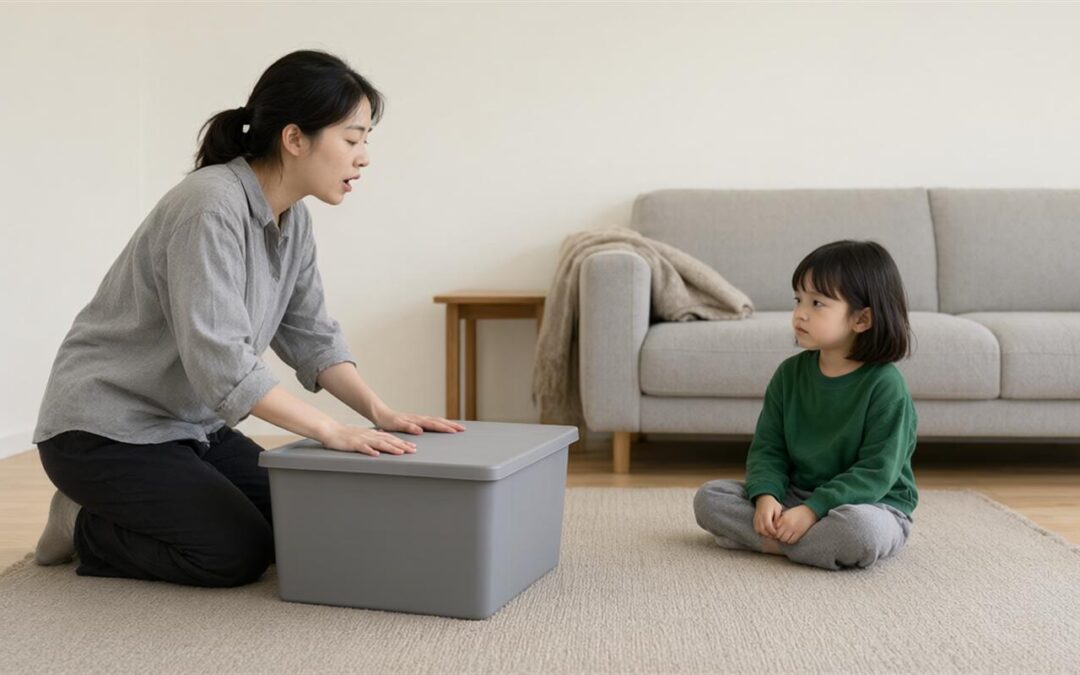
- One bin for session materials, closed at the end
- A shelf or closet where that bin goes between visits
- Preferred items that stay out of reach while a session runs
The room does not need to stay set up. Packing the bin away is often what keeps a household from resenting the space the therapy takes up, especially in a small apartment where every surface usually has a job.
Who Is in the Room: Caregiver Roles During a Session
Caregiver involvement is easier to hold when it is described as a role rather than a level of commitment. Three cover most weeks. An observer watches what a prompt looks like and how the technician responds to a hard moment. A practice partner runs one step the plan names, with the technician close enough to adjust how much help is offered. A caregiver who stays nearby but out of the room is available without hovering, which is often what a child needs in order to try something independently.
The role follows the goal, not how involved a caregiver would like to be. A goal about asking for help needs an adult who can wait through the pause; a goal about bedtime needs the adult who runs bedtime. The role can also change from week to week without any loss, and saying it out loud at the start of a session keeps two adults from prompting at once. The practice-partner role is where parent training usually lands, and how parent training fits around home routines sets out what that coaching includes.
Home ABA Logistics for Families: What the Week Has to Absorb
Every session displaces something. Sometimes it is homework help, sometimes a sibling’s bedtime, sometimes the caregiver’s own hour after work, and sometimes dinner. Home ABA logistics for families tend to break down in that displaced slot rather than at the front door: the session runs, the routine it moved has no new home, and by the third week the household is carrying two schedules that only one of them agreed to.
Naming the displaced part before the first visit settles most of it. Whoever is not in the room during the session takes the part that moved, and if nobody is free at that hour, the session time is the thing to change rather than the routine. It also helps to agree in advance what gives way when a visit runs long, because a plan with no slack tends to be dropped whole. Families still weighing whether home is the right format can read how the service models compare across home, center, and school before settling the schedule.
Between-Session Communication Without a Second Job
One channel is enough. Pick it during intake, whether that is a shared note, a messaging thread, or a paper log that travels in the bin, and resist adding a second one as the weeks go on. Between sessions, three items are worth sending: a change to the week that affects timing, one thing the caregiver noticed with the situation around it, and a question that would change what happens at the next visit. Everything else can wait for the session itself.
The stop rule matters as much as the channel. A between-session note is not an incident report, not a progress report, and not a funding document, and a caregiver writing more than a few lines a week has usually been handed the wrong format for that reader. What a weekly caregiver log is for covers the version that survives past the second week.
What Gets Displaced, and the Conversation That Keeps It Fair
Siblings are the usual first casualty. Their bedtime moves, their homework help gets shorter, and the adult who used to be free at that hour is now behind a closed door. A caregiver’s own work hours come second, and privacy comes third, since a shared home means a session in the middle of everything. None of that is a reason to avoid home-based services, but all of it is easier to carry once it has been said out loud.
One conversation before the first week covers the ground: who is where during that hour, who answers the sibling, what the household will let slide for a month, and what will not be allowed to slide at all. Twenty minutes spent on that is usually worth more than a second round of scheduling.
Key Takeaways
- The household week, not the goal list, is the planning unit.
- Place the session beside a fixed point in the day rather than in the only hour that looks empty.
- A usable setup needs less than a dedicated room: table space, floor space, and one bin.
- Each caregiver’s role in a session follows the goal and can change week to week.
- One channel and three kinds of note keep communication useful; anything more becomes unpaid work.
Conclusion: Getting Support in Place
Strive ABA Consultants LLC provides ABA therapy to families in Oak Forest, Illinois; Chicago, Illinois; and Merrillville, Indiana. Alongside direct therapy, the practice offers parent training and family support, consultation, counseling services, life skills training, social skills groups, and diagnostic evaluations for families who suspect a child may be on the autism spectrum. Insurance and financial assistance pathways exist, with eligibility reviewed for each family, and transportation support is confirmed for each family rather than assumed.
A household that has mapped its week, chosen an hour, cleared a table, and agreed who covers the displaced routine is in a stronger position to start than one still comparing options on paper. To take the next step in any of the three service areas, request a callback, make an appointment, or send a message.