

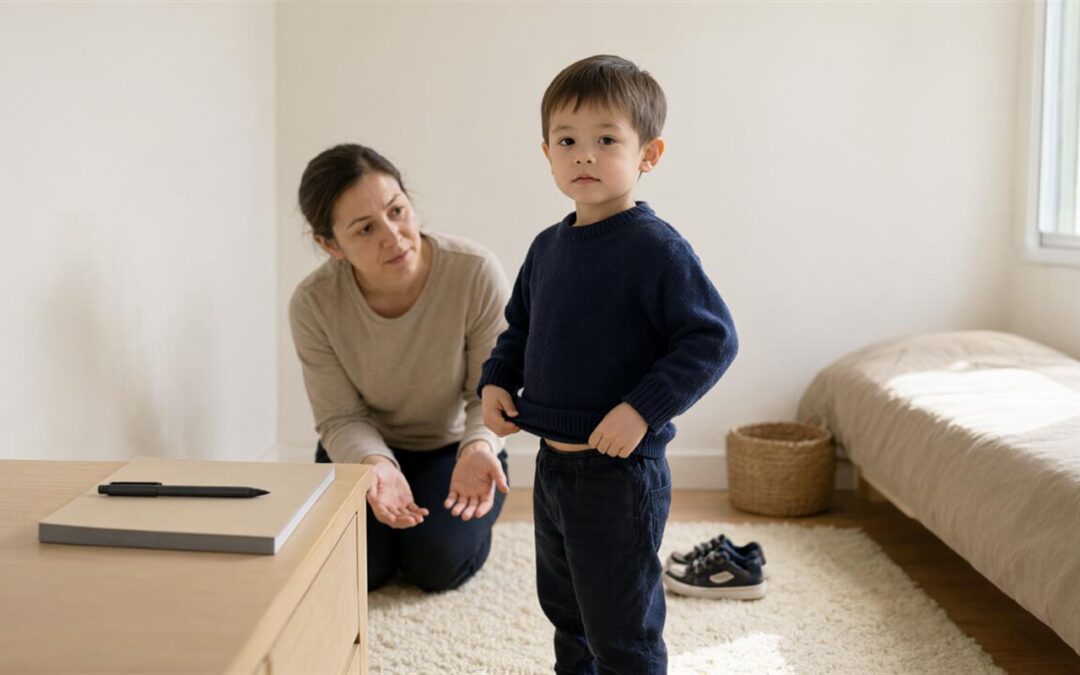
A note about how the morning went is easy to start and easy to abandon. Most families who are asked to keep track of routines between ABA sessions begin with good intentions: a notebook on the counter, a note on the phone, a plan to remember. Two weeks later the pages stop.
The problem is rarely effort. It is that nobody explained what a useful note contains, how often it needs to be written, or what happens to it afterward. A log that supports a child’s program looks different from a diary, and once the shape is clear it takes about a minute a day.
What an ABA caregiver log is meant to do
An ABA caregiver log records what happened at home between therapy sessions, written by the person who was there. It follows the routines that carry a goal — getting dressed, eating dinner, stepping away from a screen, asking for help — and it captures the parts of those routines that a session note cannot show.
The purpose is carryover, not proof. Nothing about the log is meant to demonstrate that a caregiver is doing enough, and it is not a substitute for what the team records during sessions. Its job is to move a small amount of accurate information from the kitchen table to the next conversation with the BCBA.
That distinction matters more than the format. A log kept to satisfy a requirement gets filled in on Sunday night from memory, and memory smooths over exactly the details that make a pattern visible. A note written right after the routine holds those details. A log kept to answer a question stays short and stays current.
Where a Home ABA Tracking Sheet Fits Next to Therapy Data
A home ABA tracking sheet is a separate record from the session data, which belongs to the clinical record: it is written by the RBT or BCBA, tied to the way a goal is measured, and used to decide whether a plan is working. The family’s sheet describes the same skills in another setting, with different adults, distractions, and time.
Keeping the two apart heads off a common problem. When a caregiver tries to reproduce the team’s measurement exactly, the notes grow long and the accuracy drops. What the team cannot see is the shape of the home routine — how much help a child needed at 7 a.m. on a school day compared with a Saturday, and whether the same prompt worked for both parents.
Read together, the two records answer different questions. Session data shows whether a skill is being learned; the home sheet shows whether it is being used. A plain-language guide to how ABC data and progress data differ covers the gap between an incident note and a progress measure without the clinical shorthand.
Four Columns a Weekly ABA Routine Log for Parents Needs
A weekly ABA routine log for parents does not need many fields. Four columns cover most of what a team can act on, and a fifth short line handles the days that were not ordinary.
- Routine and time. Name the routine and when it happened — “dressed for school, 7:10 a.m.” is enough.
- What was asked. The task or request in plain words, such as “put on your shoes” or “come to the table.”
- Help given. The most help the child needed in order to finish, described the way the team describes it.
- What happened next. Whether the routine finished, roughly how long it took, and what the child did afterward.
- What changed that day. A late night, a substitute caregiver, a missed bus — one line, and only when it applies.
A page with a row for each day and these five headings takes a few minutes to draw by hand, and it fits a phone note or the margin of a calendar just as well. The format matters far less than using the same one for a full week.
Recording Prompt Levels in Plain Language
Teams usually describe help on a scale that runs from most support to least: full physical help, partial physical help, modeling the step, a gesture or point, a verbal reminder, and independent. The wording varies between providers; the order does not, and the order is what makes the column readable across a month of entries.
Write the level in the words a caregiver would use out loud, then keep those words consistent. A row for shoes might read: “shoes on, 7:20 — full help with the second shoe, finished the first alone.” That single line tells the team which step was hard, how much support it took, and that the skill is not yet independent.
Two habits keep the column honest. Record the most help used during the routine rather than the average, because a routine that needed hand-over-hand once still needed it. And describe the moment instead of the child: “walked away twice, then finished with a verbal reminder” gives the team more to work with than a label like “uncooperative” does.
How to Keep a Week of Notes From Becoming a Second Job
The weekly ABA routine log for parents that survives is almost always the smallest version. Three decisions do most of the work: one routine, one time slot, one place.
Choose a single routine for the week instead of the whole day. A routine that already has a goal attached is the obvious candidate, and one is enough — a page of notes about mornings is more useful than a paragraph about everything. Write the entry in the minute after the routine ends, while the details are still specific. Keep the sheet where the routine happens: on the fridge, in the bathroom drawer, or in a note that opens with one tap.
Three or four days of entries are enough to read a pattern, and a week with a gap in it is still a week of information. Missing Tuesday does not ruin the record, and treating a missed day as a failure is how most logs end up abandoned.
Reading a Week for Patterns
Patterns appear when the same routine is recorded across several days, which is the reason for keeping the columns identical. Four kinds of pattern are worth naming when the week is reviewed.
The first is timing: when the hard version of a routine lands at the same hour daily, the schedule or the transition before it is part of the picture. The second is drift in the help column, where a skill that started at a verbal reminder now needs modeling — a direction the team will want to know about, even when the child’s day looks unchanged.
The third is the person or the place. A routine that goes smoothly with one caregiver and not another often points at prompt wording or mismatched expectations rather than at the child. The fourth is the week itself — a holiday, an illness, a new sitter — which can explain a rough stretch that would otherwise read as a setback.
Before the next meeting, write two sentences about what the week seems to show. A summary already written is easier to check against the team’s view, and easier to revise.
Turning the Notes Into a Carryover Conversation
A parent training session or a supervision visit is the natural place to review a log, and it is worth asking whether the team already has a preferred format before building one from scratch. Arriving with a week of entries changes the conversation from a general update into a specific question.
Three questions make the review concrete. Which part of the routine should stay the same this week? Which prompt level should the adults at home aim for, and when should it step down? And what would the team want to see in the log to know that a change is working? Those answers turn the following week’s notes into a test of something rather than a record of everything.
The mechanics of that handoff — who prompts, how prompts fade, and how the same skill is worded in different places — sit alongside a guide to planning skill carryover from ABA sessions into home and school.
What the Log Should Not Be Asked to Do
Jobs get attached to a log because it is the document at hand, and each one makes the log less likely to be kept.
It is not an incident report. A behavior that needs a formal record needs the team’s own process, and a caregiver note is not that document. It is not an evaluation or a behavior plan. It is not a test of the caregiver either: a week of entries showing a routine falling apart is a useful week, not a failing one. And it is not a funding document — insurance and authorization questions are answered through the records the provider keeps, not through a family’s notes.
Kept to its four columns, the log stays a small thing that gets done. Loaded with the other jobs, it becomes a report nobody has time to write.
When to Change the Log
The log needs revision when a goal changes, when the routine itself changes, or when keeping it has quietly stopped. A new goal usually means a new routine and a different help column, and recording the old one produces entries nobody reads. A change of routine is the most common trigger: a new school start time, a different caregiver on Tuesdays, a shift in the household schedule.
The third signal is the log going quiet. If two weeks pass without an entry, the format is too large for the week it is meant to fit. Ask the team which routine matters most right now, cut the rest, and restart with one row a day rather than setting the whole idea aside.
Conclusion: Getting Support in Place
Strive ABA Consultants LLC provides ABA therapy for families in Oak Forest, Illinois; Chicago, Illinois; and Merrillville, Indiana. Service options include ABA therapy, diagnostic evaluation for families who suspect a child may be on the autism spectrum, parent training and family support, consultation, counseling, life skills training, and social skills groups. A log kept at home is one small part of that picture, and it works when the team has agreed on what the entries should contain.
Families can make an appointment, send a message, or request a callback to talk through what a weekly record should look like for a specific routine. Transportation support and insurance or financial assistance pathways are confirmed for each family before they are relied on, so both are worth asking about at the start rather than assuming. For the documents that sit around a plan, a caregiver communication toolkit that covers one-page plans and weekly updates shows how the pieces fit together.
Key Takeaways
- A weekly log exists for carryover: it carries specific detail from a home routine into the next conversation with the team.
- Five short fields — routine, request, help given, outcome, anything unusual that day — hold nearly everything a team can use from a week.
- Session notes and a family’s entries answer different questions, and the entries work better when they are not a copy of the clinical record.
- Help is easiest to compare when it is written in everyday words and recorded at the point of greatest support, not averaged across a routine.
- Access questions — transportation help, insurance coverage, financial assistance — are settled with the practice family by family rather than assumed.