

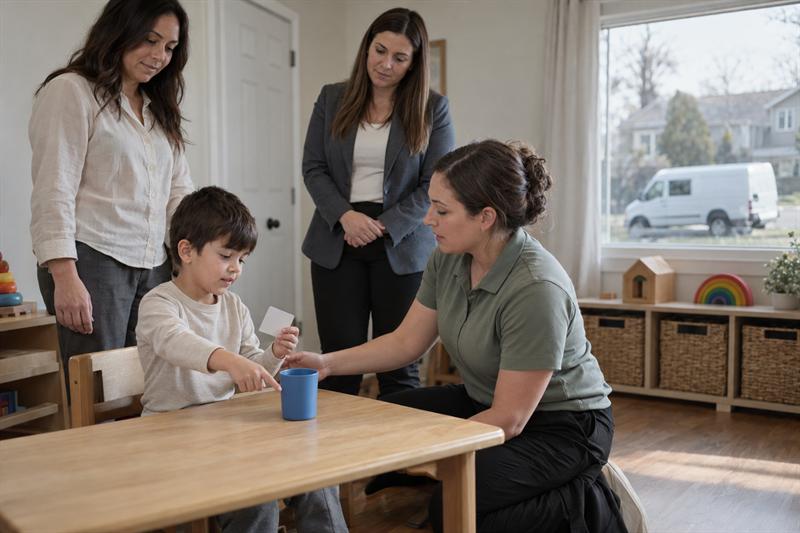
ABA stands for Applied Behavior Analysis. In plain language, it is a therapy approach that looks at how a child learns, what gets in the way, and how to teach important skills in a more consistent way. At Strive ABA Consultants LLC, this is often where families start when they have heard the term from a provider, school, or evaluator but still do not know what ABA actually involves day to day.
That gap matters. When ABA is explained too vaguely, families may picture one narrow version of therapy or assume it is only about reducing difficult behavior. In practice, ABA is often used to build communication, support routines, improve participation in daily life, and address patterns that interfere with learning or safety.
What Is ABA Therapy?
ABA therapy is a structured method for teaching useful skills and supporting behavior in everyday settings. It focuses on what a child needs to learn, what is making that skill hard right now, and how to create repeated, meaningful opportunities for progress.
That means ABA is not just about telling a child what not to do. A strong ABA plan also teaches what to do instead. This is where families often start to see the difference between general behavior advice and a therapy model built around assessment, goals, practice, and progress tracking.
- Communication: asking for help, making choices, or expressing needs more clearly
- Daily routines: participating in dressing, hygiene, meals, transitions, and home routines
- Social skills: waiting, taking turns, joining activities, and responding to others
- Safety and functional behavior: building replacement skills when unsafe or disruptive patterns interfere with daily life
What “Applied Behavior Analysis” Means in Simple Terms
“Applied” means it is focused on real-life situations, not abstract theory. “Behavior” means observable actions like asking, waiting, following a routine, leaving an activity, or refusing a task. “Analysis” means looking closely at what happens before and after a behavior so the team can understand what may be maintaining it and what may help change it.
Families sometimes hear the word “behavior” and assume ABA only applies when there are major meltdowns or aggression. That is one reason confusion starts early. ABA can also address communication gaps, inconsistent routines, difficulty with transitions, school readiness, independence, and daily participation. When those areas are not addressed, frustration, avoidance, and dependence on constant adult support can become bigger concerns over time.
What Does ABA Therapy Involve?
ABA therapy involves assessment, goal-setting, direct teaching, progress tracking, and caregiver input. It is individualized from the start. A child is not placed into a fixed set of goals just because of age or diagnosis. The plan is built around what is actually happening in daily life.
This is where many generic explanations fall short. ABA is not simply “therapy sessions each week.” A strong program identifies which skills matter most right now, teaches them in a structured way, and adjusts based on what the child is actually showing over time.
How Goals Are Chosen
Goals are chosen based on strengths, needs, routines, safety concerns, and what is getting in the way of daily functioning. Family input matters because the most useful goals are not random milestones. They are the skills that may make everyday life smoother, safer, and more manageable.
For one child, that might mean learning to request a break before becoming overwhelmed. For another, it might mean following a short after-school routine with fewer prompts. Families often notice that when goals are too generic, therapy can feel disconnected. When goals match real routines, progress may be easier to recognize.
If a family wants a better sense of how that process works, what happens during an ABA assessment explains why those early decisions shape everything that follows.
What Skills ABA May Focus On
- Communication: requesting help, answering simple questions, or using another communication method more consistently
- Social skills: sharing space, waiting, responding to peers, and participating in play
- Daily living routines: hygiene, dressing, clean-up, meals, and transition routines
- Play skills: engaging with toys, activities, or other children in a more flexible way
- Following directions: completing simple tasks or moving from one activity to the next with less resistance
- Safety-related skills: stopping, waiting, staying nearby, or using safer alternatives when frustrated
How Therapists Track Progress
Progress is tracked by observing specific behaviors and skills over time, not by relying on a general feeling that things seem better or worse. Data helps the team see what is improving, what is staying stuck, and what may need to change.
This matters more than many families expect. A skill may look better in one setting but not carry over at home, school, or in the community. If that is missed, therapy can appear successful on paper while daily life still feels hard. That is why consistent tracking and real-world feedback matter.
What Happens During an ABA Session?
An ABA session typically includes a mix of teaching, practice, prompting, feedback, reinforcement, and breaks. Some sessions look play-based. Others are built around routines, communication tasks, or step-by-step practice with daily skills. The format depends on the child’s goals.
Families often expect either a highly rigid session or a completely casual one. In reality, strong ABA sessions are structured with a purpose but flexible enough to respond to the child. If that balance is missing, sessions may become hard to follow or too loose to support meaningful progress.
Learning Through Routines, Play, Prompts, and Reinforcement
Children learn in ABA through repeated opportunities tied to daily life. A therapist might use play to teach requesting, a routine to teach transitions, or prompts to help a child complete a task successfully before fading that support over time.
For example, a child may practice asking for a favorite item instead of crying, or learn to move from one activity to another with fewer struggles. Reinforcement means something helpful happens when the child uses the skill successfully, which can increase the chances that the skill will happen again. Families who want to understand this part more clearly can explore what happens during a typical ABA therapy session for a more detailed breakdown.
Why Sessions Do Not Look the Same for Every Child
No two children have the same communication profile, tolerance for demands, routine challenges, or learning pace. That means sessions should not look identical. A toddler working on early communication will need something different from a school-age child working on independence or transition routines.
This is where problems start when families are given oversimplified explanations. If ABA is described like a standard package, it becomes harder to judge quality. The better question is whether the session structure matches the child’s actual needs and whether the goals connect to real daily life.
If you are noticing these patterns, a more structured next step may be needed:
- Your child struggles with communication, transitions, or daily routines in ways that keep repeating
- You are hearing recommendations for ABA but still do not know what the therapy would target
- Behavior concerns are affecting safety, participation, or learning across more than one setting
- Current support feels reactive instead of organized around clear goals
When those signs keep showing up, the issue may be more than uncertainty. It may mean a more formal assessment or therapy planning process is worth exploring.
Who Is on an ABA Team?
An ABA team usually includes a BCBA, an RBT, and the child’s caregivers. Each role is different, and understanding that difference helps families know what to expect and what questions to ask.
Confusion here is common. Families often meet one person most often and assume that person is handling every part of the plan. In reality, quality ABA depends on clear supervision, coordinated teaching, and ongoing caregiver involvement. For a closer look, BCBA, RBT, and the roles on your child’s ABA team explains how those responsibilities work together.
What a BCBA Does
A BCBA assesses the child, identifies treatment priorities, creates goals, oversees the plan, and reviews progress. The BCBA is also responsible for adjusting strategies when something is not working.
This becomes especially important when progress stalls. If goals are unclear or sessions stay the same even when the child is struggling, the treatment plan can lose effectiveness. Strong BCBA oversight helps keep the program responsive instead of repetitive.
What an RBT Does
An RBT provides direct therapy based on the treatment plan developed and supervised by the BCBA. That includes practicing target skills, using prompts and reinforcement, and collecting information about how the child responds.
The key distinction is that the RBT is typically the person carrying out much of the day-to-day teaching, while the BCBA guides the larger clinical direction. When families understand that difference, they are better able to recognize whether support is consistent and well supervised.
How Parents and Caregivers Are Involved
Parents and caregivers are not separate from the therapy process. They help identify priorities, share what happens between sessions, and support carryover in routines that matter most.
Progress may slow when skills stay inside therapy and do not transfer into real life. When caregivers understand the goal and the strategy, the child may get more consistent learning opportunities. That can support stronger generalization and less confusion across settings.
Where ABA Therapy Can Happen
ABA therapy can happen at home, in a clinic, at school, or in community settings. The best setting depends on what the child is working on and where the biggest barriers are showing up.
For example, home-based work may make the most sense when routines, meals, self-care, or family transitions are the main concern. School-based support may matter more when classroom participation or peer interaction is the issue. Families comparing those environments often benefit from reading in-home vs center-based ABA therapy before deciding what setup matches their needs.
Families sometimes focus only on convenience at first. Convenience matters, but if the setting does not match the actual goals, progress tends to stay narrow. The right setting is the one that gives the child repeated practice in the situations where the problem is actually happening.
What ABA Therapy Can Help With
ABA therapy can help with communication, routines, independence, transitions, social participation, and behavior patterns that interfere with daily life. The most useful way to think about it is not “what diagnosis does ABA treat,” but “what functional barriers are getting in the way right now.”
That shift matters because families are rarely looking for abstract progress. They are trying to solve real problems: getting through the morning with less stress, helping a child ask for what they need, improving safety, or reducing the daily cycle of refusal and frustration. If a family is still trying to figure out whether these concerns point toward ABA, early signs parents should know can help connect those patterns to the bigger picture.
Communication and Functional Skills
ABA often targets the practical skills that make daily life work better. That includes asking for help, making choices, tolerating waiting, following directions, and completing basic routines with less support.
When these skills are missing, frustration may rise quickly. Children may rely on crying, leaving, resisting, or shutting down because they do not have a more effective way to communicate or cope. This is where meaningful ABA goals often make the biggest difference.
Social Interaction and Daily Routines
Social and routine-based goals can include turn-taking, joining shared activities, waiting briefly, following familiar steps, and transitioning with less conflict. These are not minor details. They shape how the child functions at home, in care settings, and at school.
These challenges can become harder when support is inconsistent across adults or environments. A child who can follow a routine with one person but not another is showing a skill that has not generalized yet. That often means the plan needs more consistency, not just more repetition.
Safety-Related and Challenging Behaviors
ABA can also address behaviors that create safety risks or disrupt learning and daily routines. The goal is not to punish behavior. The goal is to understand what may be driving it, reduce triggers where possible, and teach a safer, more functional replacement skill.
For example, if a child runs from adults during transitions or hits when demands increase, the team looks at what is happening before that behavior, what the child may be trying to communicate, and what replacement behavior needs to be taught. When that work is delayed, unsafe patterns can become more established and harder to interrupt across settings.
Is ABA Therapy the Same for Every Child?
No. ABA therapy should not be the same for every child because the reasons for support are not the same. Children differ in age, communication, coping skills, learning history, environment, and family priorities.
This is one of the biggest differences between high-quality ABA and a weak program. A weak program may repeat standard goals without enough connection to real life. A strong program reflects the child’s actual barriers and builds skills that matter in the settings the child moves through every day.
Why Assessment and Individual Needs Matter
Assessment matters because it shows what the child can already do, where routines break down, what triggers difficulty, and which goals are likely to improve daily functioning first. Without that foundation, therapy often becomes too broad or poorly prioritized.
Families sometimes start with a vague understanding of ABA and expect therapy to cover everything at once. Strong planning works differently. It starts by identifying what matters most right now. That often leads to clearer goals, better carryover, and a more useful therapy plan.
Questions Families Can Ask When Evaluating Fit
- How are goals chosen, and how do they connect to daily routines?
- How are parents and caregivers involved in the process?
- How is progress tracked and reviewed over time?
- Who supervises therapy, and how are changes made when progress slows?
These questions matter because families often focus on credentials alone. Credentials are important, but they do not tell the whole story. Fit also depends on whether the program is clear, responsive, and connected to real life.
What Happens Before ABA Therapy Starts?
Before ABA therapy starts, families usually move through some combination of referral, evaluation, assessment, planning, and scheduling. Not every family starts from the same place. Some already have a diagnosis. Others are still trying to understand whether an autism evaluation or re-evaluation is the next step.
At Strive ABA Consultants LLC, this is often where families need the most clarity. The process can feel like one long step, but it is actually several distinct stages. When those stages are misunderstood, families can lose time, ask the wrong questions, or assume therapy begins before the right information is in place.
Screening, Diagnosis, or Referral
Some families first hear about ABA from a pediatrician, school, therapist, or caregiver who has noticed repeated concerns. Others come in after a formal diagnosis and want to know what happens next.
The key point is that a recommendation for ABA is not the same thing as the full therapy process. It is often the start of a larger path that includes evaluation, clinical review, and treatment planning. Families who want a step-by-step view of that sequence can review the complete guide to starting ABA therapy.
Assessment and Treatment Planning
Assessment identifies strengths, challenges, patterns, and priorities. Treatment planning uses that information to create a structured set of goals and strategies. This is where the therapy plan becomes specific.
If this stage is rushed, the rest of the process can become harder. Goals may be too broad, important routine issues may be missed, and progress may feel uneven from the start. Families who want to understand the assessment step more clearly can review what happens during an ABA assessment.
What to Do if a Family Is Still Waiting for Answers
If a family is still waiting for clearer answers, the priority is figuring out which step is actually missing. In some cases, that is an autism evaluation. In others, it is a re-evaluation or a more complete assessment of what support is needed now.
When families stay stuck in uncertainty for too long, daily routines can grow more stressful, school concerns may build, and behavior patterns may become more established. Strive ABA Consultants LLC can help families clarify whether evaluation or re-evaluation is the more practical next step before therapy planning moves forward.
Key Takeaways
- ABA therapy is a structured, individualized approach that teaches useful skills and supports daily functioning.
- It commonly focuses on communication, routines, social participation, independence, and safety-related concerns.
- Strong ABA starts with assessment, clear goals, and progress tracking tied to real life.
- A BCBA, an RBT, and caregivers each play different roles in the therapy process.
- When families understand what ABA actually involves, they are better able to decide what needs to happen next.
Next Steps for Families Exploring ABA
If ABA has been recommended but still feels vague, the most practical next step is to stop treating it like a single yes-or-no decision. The real question is whether the current challenges point to a need for evaluation, assessment, or active therapy planning. When that remains unclear, delays can grow and daily routines may get harder, not easier.
Strive ABA Consultants LLC can be a helpful next step for families who need that process explained clearly and mapped to what is actually happening at home, school, or in care settings. For families in Oak Forest, Chicago, or Merrillville who are trying to sort out evaluations, re-evaluations, or what should happen before therapy starts, Strive ABA Consultants LLC offers a practical way forward grounded in the patterns discussed throughout this guide.
Conclusion
The real problem is usually not just hearing the term “ABA therapy.” It is hearing it without a clear explanation of what it means, what it involves, and what should happen next. When that confusion is not addressed, families can lose time, daily challenges may continue to build, and important support decisions can get delayed.
That is why a clear next step matters. Strive ABA Consultants LLC helps families make sense of where they are in the process, whether that means clarifying the need for an autism evaluation, a re-evaluation, or a more defined path toward ABA support. When the same communication, routine, transition, or behavior concerns keep repeating, taking action can be a practical move because those patterns may become harder to manage when they are left unaddressed.
FAQ
What is ABA therapy in simple terms?
ABA therapy is a structured way of teaching useful skills and supporting behavior in everyday life. It focuses on what a child is trying to do, what is getting in the way, and how to teach that skill more clearly and consistently.
For example, a child may need help asking for a break instead of crying, following a short routine instead of refusing, or moving between activities with less frustration. The important distinction is that ABA is not just about stopping a behavior. It is about teaching a more functional way to communicate, participate, or cope.
What does ABA therapy actually look like day to day?
Day to day, ABA therapy usually includes a mix of teaching, prompting, reinforcement, practice, and breaks built around the child’s goals. Sessions may look play-based, routine-based, or more structured depending on the skill being targeted.
One child may be working on requesting help during play. Another may be practicing transitions, self-care steps, or waiting briefly during routines. What matters most is that the session has a clear purpose and that the skill connects to daily life, not just to the therapy setting.
Who works with my child during ABA therapy?
Most ABA programs involve a BCBA, an RBT, and caregiver participation. The BCBA usually handles assessment, treatment planning, supervision, and progress review. The RBT typically provides direct teaching during sessions and follows the plan under supervision.
This distinction matters because families often hear several acronyms at once and assume everyone is doing the same job. In practice, the BCBA directs the program and the RBT carries out much of the day-to-day teaching. That structure helps keep the therapy plan organized and responsive.
How do ABA therapists decide what goals to work on?
Goals are usually chosen through assessment, observation, caregiver input, and a review of what is breaking down in daily routines. Strong goals are functional. They solve real problems instead of filling space on a treatment plan.
For example, a goal may focus on tolerating transitions, asking for help, joining a routine, or using a safer replacement behavior. What changes the decision is not just what a child struggles with, but which skill would reduce stress, improve participation, or increase independence in daily life.
Does my child need an autism diagnosis before starting ABA therapy?
Families do not always start the process from the same point. Some first learn about ABA before they have a complete diagnosis or before they understand whether an evaluation or re-evaluation is still needed.
The key issue is separating the idea of learning about ABA from the formal steps required to begin services. A family can understand the therapy model before every clinical or administrative step is complete. What matters most is identifying whether the current barrier is a missing diagnosis, a pending evaluation, or the need for a more specific assessment of support needs.
How can parents and caregivers be involved in ABA therapy?
Parents and caregivers are involved by helping shape priorities, describing what happens across daily routines, and supporting consistency outside therapy sessions. Their input helps make goals more relevant and helps the team see whether skills are carrying over beyond direct therapy time.
For example, if a child handles transitions in session but not at home, caregiver feedback shows where the plan still needs work. What is often misunderstood is that involvement does not mean doing therapy alone. It usually means helping the team connect therapy strategies to the child’s real environment so progress does not stay limited to one setting.