

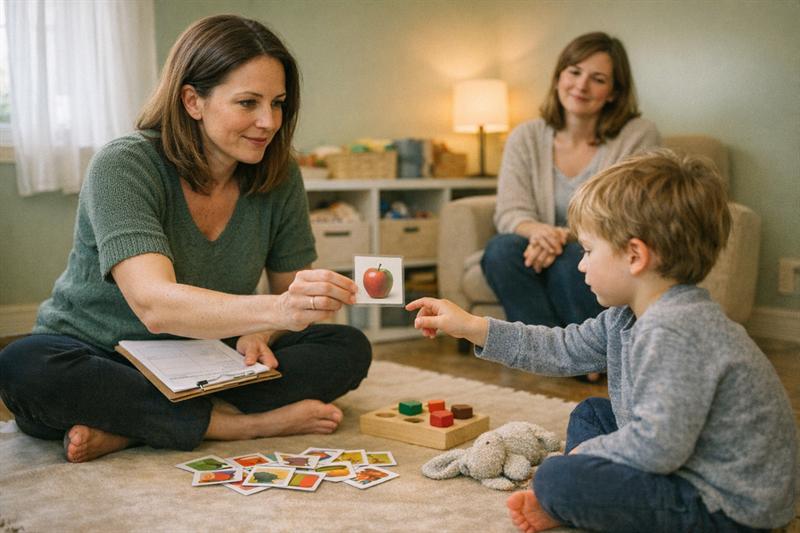
Quick Answer: An ABA assessment is a structured evaluation in which a BCBA observes your child, gathers parent input, and reviews behavior and skill patterns to develop a personalized therapy plan. Much of the stress around this step comes from not knowing what to expect during the visit or how the information will be used afterward.
Why the ABA Assessment Matters Before Therapy Begins
An ABA assessment is more than a first step. It helps shape what therapy may look like, how often services are recommended, and which skills are prioritized.
If an assessment is rushed or treated like a checklist, the resulting plan may not reflect how your child learns, communicates, or responds in daily life. That can lead to goals that need adjustment once therapy begins.
A thorough assessment provides a clearer starting point. It looks at how your child communicates, responds to others, and handles everyday situations so therapy can be built around those patterns.
Who Conducts an ABA Assessment?
Role of the BCBA
A Board Certified Behavior Analyst (BCBA) typically leads the assessment. Their role is to evaluate behavior, identify patterns, and use that information to build a structured treatment plan.
The BCBA is not simply watching what your child does. They are looking at how skills show up across situations, what may be getting in the way, and how behavior connects to the environment. That analysis helps guide the next steps.
How Parents Are Involved
Parents are a central part of the assessment, not just observers.
Children may behave differently during an evaluation than they do at home or school. Parent input helps fill in that gap and gives the BCBA a more complete picture of your child’s routines, communication, and behavior across settings.
When that input is limited, the initial plan may need more revision once services begin.
Step-by-Step: The ABA Assessment Process
The process usually follows a clear structure, even if the session feels flexible in the moment.
Initial Parent Interview
This step focuses on understanding your child’s background and current needs.
- Developmental history
- Communication abilities
- Behavior concerns
- Daily routines
This conversation helps the BCBA understand what matters most to your family and where support may be most useful.
Direct Observation of Your Child
Your child is typically observed during play and interaction. Some activities may be guided, while others are more natural.
This is not a pass-or-fail test. The goal is to see how your child responds, communicates, and engages, not to judge performance.
Skill and Development Assessments
The BCBA may introduce activities that look like play but are meant to evaluate specific skills.
- Communication, such as requesting, responding, or labeling
- Social interaction
- Learning readiness
- Daily living skills
Many assessments are interactive rather than formal or highly structured, which can help the child engage more naturally.
Behavior Analysis and Triggers
This part of the process focuses on behavior patterns.
The BCBA may look at:
- What happens before a behavior
- The behavior itself
- What happens after
This helps clarify what may be maintaining the behavior and what the child may be communicating through it. When that context is missing, strategies can focus too narrowly on the behavior itself instead of the conditions around it.
For a clearer explanation of behavior patterns, see the 4 functions of behavior in ABA.
Data Review and Clinical Interpretation
After observation, the BCBA reviews and organizes the information collected.
This includes parent input, observed behaviors, and skill performance. The focus is on patterns across situations, not isolated moments.
Families may not see this part directly, but it is where the assessment findings are pulled together into practical recommendations.
What Evaluators Are Looking For
Communication Skills
This includes how your child expresses needs and understands others.
When communication is limited or inconsistent, frustration can build. Understanding that pattern helps shape goals that are more functional and meaningful.
Social Interaction
This includes engagement, play, and interaction with others.
The BCBA is looking at how your child connects with people, responds to social cues, and participates in shared activities.
Daily Living Skills
This includes independence with routines and following directions.
These skills affect everyday functioning at home, in the community, and in other settings where more independence may be expected over time.
Challenging Behaviors
Evaluators look at factors such as frequency, intensity, and what tends to happen around the behavior.
Surface behavior can be misleading without context. Understanding the pattern behind it helps support strategies that are more relevant to your child’s needs.
How to Prepare Your Child for an ABA Assessment
- Keep routines as consistent as possible before the visit
- Bring preferred toys or comfort items
- Prepare any requested documents ahead of time
- Use simple language to explain the visit
- Expect behavior to look different than usual
- Understand that perfect cooperation is not required for a useful assessment
Many parents worry that a child who is hesitant, upset, or less cooperative will make the appointment less useful. In reality, those responses can still help the evaluator understand how your child handles new situations and support needs in the moment.
Common Concerns Parents Have (And What to Expect)
“What if my child doesn’t cooperate?”
The assessment can still provide useful information. Hesitation, refusal, or difficulty transitioning can all help the evaluator understand where support may be needed.
“What if they act differently than at home?”
That is common. Evaluators expect some differences across settings and rely on your input to understand the bigger picture.
“Will this affect eligibility for services?”
The assessment is used to understand your child’s needs and guide service recommendations. It helps determine what type and level of support may be appropriate.
Many parents expect the assessment to feel very controlled and predictable. In practice, some variability is normal and can still provide meaningful information.
What Happens After the Assessment?
After the assessment, the BCBA develops a treatment plan based on what was observed and discussed.
This may include recommended hours, initial goals, and focus areas. Depending on the provider and funding source, the next steps may also include authorization, scheduling, and caregiver follow-up.
For a full breakdown of next steps, see what happens after an ABA assessment.
How ABA Assessments Connect to Long-Term Therapy
The assessment helps set the direction for ongoing therapy.
It influences how often services are recommended, what goals are prioritized, and how progress is measured over time. If the starting point is unclear, the plan may need more adjustment later.
That is why this stage matters. To see how everything connects, review starting ABA therapy step-by-step.
Key Takeaways
- The ABA assessment process is structured but flexible
- It focuses on understanding behavior and skills, not testing performance
- Parents play a critical role in providing context
- Patterns matter more than isolated moments
- Preparation helps, but perfection is not required
Conclusion
The biggest challenge with the ABA assessment process is often not the process itself, but the lack of clarity around what actually happens. That uncertainty can create stress and make it harder for families to know what to expect.
When the assessment is not well understood or not done thoroughly, the initial plan may need more adjustment later. That can slow momentum and create unnecessary frustration.
At Strive ABA Consultants LLC, the assessment is treated as the foundation for care planning. The focus is on identifying meaningful behavior patterns, understanding how your child learns, and building a plan that reflects those findings from the start.
If you are preparing for an assessment or unsure what comes next, getting clear on the process early can help reduce delays and confusion. A well-structured evaluation gives the next steps a stronger starting point.
FAQ
How long does an ABA assessment take?
An ABA assessment often takes several hours and may be completed over one or multiple sessions. This allows time for interviews, observation, and skill review across different areas. Your provider can outline the expected timeline so you can plan ahead.
What should I bring to an ABA assessment?
Bring any requested documents along with comfort items or preferred toys. Familiar items can help your child feel more at ease and support more natural interaction. Checking in advance can help ensure nothing is missed.
Does my child need to behave a certain way during the evaluation?
No. There is no expectation for perfect behavior. Evaluators focus on patterns across interactions, not isolated moments. Sharing what you typically see at home helps complete the picture.
Who performs an ABA assessment?
A Board Certified Behavior Analyst (BCBA) typically leads the assessment. They are trained to evaluate behavior and develop treatment recommendations based on observed patterns and collected information.
What happens if my child refuses to participate?
The assessment can still move forward. Refusal or hesitation can give insight into how your child responds to new, difficult, or unfamiliar situations. Letting the provider know your concerns ahead of time can help them adjust the approach.
How soon does therapy start after the assessment?
Therapy usually begins after the treatment plan is completed and any needed approvals are in place. Timing depends on factors such as scheduling, authorizations, and provider availability. Understanding the next steps early can help reduce delays.