

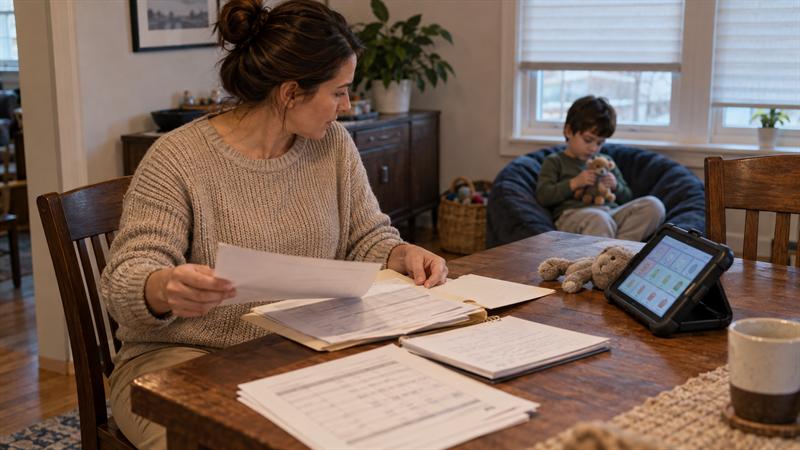
Start by confirming what is being reviewed. An ABA treatment reassessment, an autism diagnostic reevaluation, and a school reevaluation answer different questions. When contacting Strive ABA Consultants LLC about evaluation services, clarify whether your concern involves a diagnosis or your child’s current ABA goals.
For a treatment reassessment, useful preparation shows what your child does independently, where help is needed, and which goals matter in daily life. Your child does not need to produce a perfect version of those routines.
Key Takeaways
- Confirm whether the appointment concerns ABA treatment, diagnosis, or school eligibility.
- Bring available reports and specific examples of strengths and difficulties.
- Prepare your child for the visit without practicing assessment answers.
- Discuss communication supports, sensory needs, and breaks beforehand.
- Ask how recommendations connect to meaningful daily skills, not just assessment scores.
What Is an ABA Reevaluation?
An ABA reevaluation is a reassessment of a child’s current skills, support needs, and treatment goals in applied behavior analysis. It commonly combines caregiver input, treatment information, observation, and selected assessment activities to guide treatment planning. The process depends on the purpose of the review and the provider’s procedures.
How Reevaluation Differs From an Initial Assessment or Progress Review
The main differences are the information available and the depth of the review.
- Initial assessment: Establishes starting information about skills, needs, and potential treatment priorities.
- Progress review: Discusses ongoing work, recent changes, and questions about current goals.
- Reevaluation: May involve broader reassessment and updates to the treatment plan.
Providers sometimes use these terms differently. Understanding what happens during an initial ABA assessment provides background, but a reevaluation also draws on what has happened since treatment began.
ABA Reevaluation Versus Autism Diagnostic and School Reevaluation
These appointments are not interchangeable, even when some records overlap.
- ABA reevaluation: Addresses behavioral treatment needs and goals.
- Autism diagnostic reevaluation: Addresses diagnostic questions through an appropriately qualified professional; a Board Certified Behavior Analyst (BCBA) credential alone does not by itself qualify a practitioner to provide an autism diagnosis.
- School reevaluation: Addresses educational eligibility and support needs through the school’s process.
An Individualized Education Program (IEP) or school report can provide useful context for ABA planning, but it does not replace a provider’s reassessment. Identify the appointment type before gathering paperwork so preparation matches the question being addressed.
When Should ABA Goals Be Reevaluated?
ABA goals deserve review when current information suggests they no longer reflect the child’s skills, needs, or priorities. Scheduled reassessment is one opportunity, but families do not need to wait for it to raise a concern.
- A skill appears established, and you want to know whether the focus should shift to maintaining it or using it elsewhere.
- A goal remains difficult without a clear explanation of the barriers.
- A skill appears in therapy but not in everyday routines.
- Your child shows distress during activities connected to a goal.
- New routines or family priorities change what support is useful.
One important distinction is completing a task with help versus completing it independently. If your child needs reminders, those reminders belong in the progress discussion. Leaving them out gives an incomplete picture of the support your child needs.
Reevaluation needs and insurance requirements are separate; no single reassessment schedule applies to every situation. Urgent health or safety concerns should be addressed promptly with the appropriate provider rather than held for the next review.
Bring a goal mismatch into the conversation now. Request a focused discussion when:
- The same goal remains difficult without a clear adjustment plan.
- Reported progress does not match what happens in daily routines.
- A previously useful goal no longer addresses an important need.
These patterns call for clarification rather than continuing without discussion. Start with a goal review; the treatment team can then determine whether a broader reassessment is needed.
What to Gather Before an ABA Reevaluation
Gather information that explains your child’s current daily functioning. Available records, a few routine examples, and your main questions are more useful than a large collection of unrelated paperwork. Informal notes are enough to start the conversation; you do not need to create clinical charts.
Current Goals, Available Reports, and Important Changes
Start with documents you already have, then identify what the team specifically requests.
- Current ABA goals or the most recent treatment summary.
- Relevant school, speech, occupational therapy, or other reports.
- Notes about changes in communication, sleep, health, or routines.
- Your child’s interests, preferences, and successful activities.
- Questions about goals that feel unclear or less useful.
Share sensitive records through the provider’s approved process and arrange appropriate permission for information exchanged between professionals. Share health changes as context, not as evidence of a behavioral cause. Missing paperwork should not prevent you from raising an important concern.
Everyday Examples That Explain Skills and Support Needs
Describe what happened and what help was involved. A short note using these five details gives the team something concrete to discuss:
- Routine: Where and when did it happen?
- Skill: What was your child doing?
- Support: What reminder, demonstration, or other help was provided?
- Result: What happened next?
- Importance: Why does this matter to your child or family?
For example, in a hypothetical snack routine, “asked for help after an adult said, ‘What do you need?’” tells a different story from “asked for help independently.” A prompt is assistance that helps a response occur; noting it makes the description more precise.
A skill working in one setting but not another is also useful information. A child might request help during a quiet therapy activity but not during a busy evening routine. This raises a question about generalization, or using skills across situations, rather than proving that either observation is wrong.
How to Prepare Your Child Without Rehearsing Answers
Prepare for predictability and comfort, not assessment performance. Explain the visit in a way your child understands, preserve usual communication supports, and discuss accommodations with the team.
Explain the Visit in a Familiar, Accessible Way
Use details the team has confirmed rather than promising activities or a schedule that might change.
- Explain who your child will meet and where the visit will happen.
- Use familiar words, pictures, or a short visual schedule if helpful.
- Describe how your child can request help or a break.
Help your child understand the visit rather than practice specific assessment responses. Rehearsing answers can make it harder to distinguish practiced responses from the skills the clinician is trying to understand.
Plan for Communication, Comfort, and Breaks
Tell the team what helps your child communicate and remain comfortable before the appointment begins.
- Usual communication devices, pictures, or other aids.
- Sensitivities to noise, lighting, touch, or crowded spaces.
- Comfort items and familiar calming routines.
- How your child requests breaks or expresses refusal.
- Signs that your child is becoming overwhelmed.
Your child’s assent, meaning their willingness to participate, and signs of distress belong in the plan. Do not withhold communication supports or push through distress to obtain a more complete performance. The team needs an accurate understanding of support needs.
What Commonly Happens During an ABA Reevaluation?
A reevaluation commonly combines existing information with updated caregiver input and observation. Components and timing vary, and not everything necessarily happens during one appointment.
- Record review: The clinician examines relevant goals, treatment information, and available reports.
- Caregiver discussion: Families describe strengths, changes, concerns, and priorities.
- Observation: The clinician observes skills and support needs during relevant activities.
- Assessment activities: Selected activities or tools help answer the review’s specific questions.
- Recommendations: Findings inform discussion of current needs and treatment planning.
A single difficult or unusually successful visit does not explain every setting. Sleep, unfamiliar surroundings, and the support provided are relevant context. Ask how appointment observations will be considered alongside treatment information and daily-life examples.
Questions to Ask About Updated Goals and Recommendations
Ask questions that connect recommendations to everyday functioning. A useful goal has a clear purpose and a way to measure progress, including how much help the child needs.
- What changed since the previous assessment?
- Which skills happen independently, and which still require help?
- Where is the skill being used outside therapy?
- How does this goal support communication, participation, safety, or daily living?
- What changes are recommended, and what information supports them?
- How will progress, comfort, and possible distress be monitored?
- When will the recommendations be reviewed?
A score without context does not tell you how a skill works in daily life. For more discussion prompts, review these questions to ask about ABA progress during a progress review.
Before the discussion ends, clarify how you will receive the recommendations, who is responsible for the next steps, and how the team will evaluate changes. Therapy hours and assessment scores are not substitutes for meaningful outcomes.
Confirm Scheduling, Transportation, and Paperwork
Raise practical barriers before the appointment so the team has time to discuss arrangements. Confirm these details:
- Expected duration, location, and who should attend.
- Requested documents and how to submit them securely.
- Communication supports and accommodation arrangements.
- Authorization requirements and anticipated costs.
- Transportation needs or scheduling difficulties.
Repeated travel or scheduling problems can interrupt consistent participation. They also provide context when reviewing treatment information. Describe interruptions accurately rather than treating them as a family failure or assuming they explain every difficulty.
Strive ABA Consultants LLC offers transportation support and can discuss financial assistance options to help address access barriers. Families in Oak Forest, Chicago, or Merrillville should raise these needs alongside appointment planning. Availability and eligibility depend on the particular service and location.
Because autism diagnostic reevaluations and ABA treatment reassessments serve different purposes, first identify which service addresses your concern. Then clarify the relevant paperwork and access arrangements; do not assume that one appointment covers both.
Frequently Asked Questions About ABA Reevaluation
Does an ABA Reevaluation Mean My Child’s Therapy Is Not Working?
No. Reevaluation can be part of ongoing care, including when a child has gained skills or priorities have changed. For example, an established skill may prompt discussion of a new goal or using that skill elsewhere. The appointment itself does not establish treatment success or failure.
What if My Child Is Tired, Anxious, or Does Not Participate?
Those conditions can affect what the clinician observes that day. Explain how your child’s behavior compares with their usual behavior and identify helpful supports. Breaks, accommodations, or additional observation may be considered. A difficult visit needs to be interpreted alongside other available information, not treated as the entire picture.
Can I Request a Goal Review Before the Next Scheduled Reevaluation?
Yes. You can raise a goal concern before the scheduled reevaluation, and that discussion may not require a full reassessment. For example, a changed daily routine might make a different skill more important. Requesting a goal discussion is separate from any insurance authorization needed for a formal reassessment.
Will an ABA Reevaluation Change My Child’s Therapy Hours?
Not necessarily. Recommendations may change or remain similar depending on current needs and assessment findings. Recommendations and insurance authorization are separate, so a recommended service level does not guarantee coverage. Reevaluation does not automatically mean more or fewer hours.
What if Home Observations Differ From Therapy Data?
Both observations can be accurate because settings, demands, and support differ. For example, a child might request help after a prompt in therapy but not independently during a busy home routine. The difference helps identify the conditions under which the skill occurs; it does not automatically make either account incorrect.
Conclusion: Prepare for a Useful Conversation, Not a Perfect Performance
Contact Strive ABA Consultants LLC to clarify which evaluation service fits your concern and discuss preparation and access needs. When prompts, setting differences, or participation barriers are left out, important questions about goals can remain unresolved. Addressing those details before the visit helps keep the discussion focused on your child’s everyday needs.
Write down three routine examples and your most important goal questions, then confirm requested records and accommodations. For help organizing your observations, review what to share from daily routines during a progress review. Prepare to explain what your child needs, not to produce a perfect performance.