

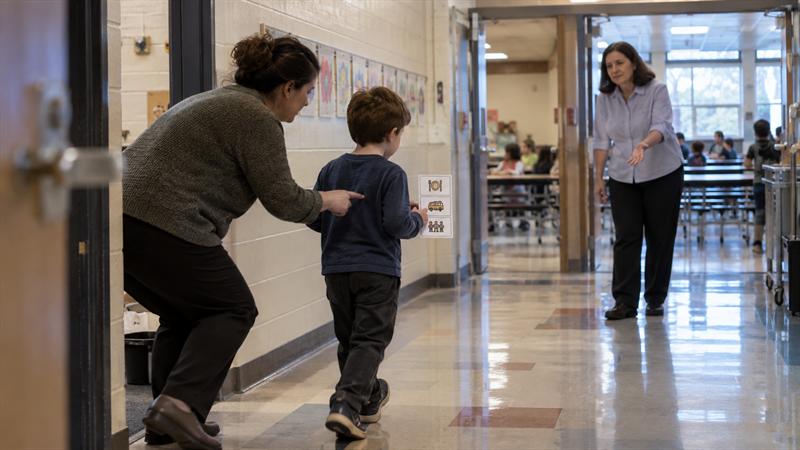
Why Daily Transitions Are a Common Break Point for Behavior Support
Transitions break not simply because the student is moving from one task to another, but because the shift also brings a new audience, new noise level, new adult cues, and the loss of the previous activity at the same time.
A common pattern is that a student can complete a worksheet but shut down when the bell rings for lunch. Problems often start when the team treats the next adult as a backup instead of a required part of the switch. If the bell is the only warning, the student gets little processing time. The result can be escalation in the hallway, the lunch line, or the pickup area.
A Simple Model for Consistent Transition Support
Consistent transition support typically depends on six practical components:
- Shared expectations across all adults in the setting
- Predictable cues and visual or written supports
- Staff handoffs and information passing
- A low-pressure response approach when the student begins to dysregulate
- A role for caregiver and provider input
- A simple review cycle after each week
A school can buy tools all year, but if the next adult does not know the cue, the routine breaks. The problem often grows when staff treat the plan as a teacher plan instead of a building plan.
Shared Expectations Across Staff
Every adult who touches the transition should give the same signal, not the same speech. If Ms. Rivera says, “A few more minutes,” and Mr. Chen says, “Let’s go now,” the student receives two competing instructions. The fix is not better discipline. It is one shared meaning, one clear instruction, and one non-negotiable expectation. A short written cue can be easier to follow than a long binder.
Predictable Cues and Visual Supports
A visual cue works best when the student can use it without asking an adult to translate it. A timer added one day and dropped the next creates a new variable, not a support. The support must match the student’s comprehension level, and the symbols must make sense to the student. It is a tool, not a one-day intervention.
Staff Handoffs and Information Passing
A transition can fail at the handoff if information does not move with the student. The paraprofessional hands the student to the classroom teacher, and the teacher hands the student to the cafeteria aide. A brief update can carry the details that matter: what worked, what comes next, and what to watch for. A sticky note or a short shared log entry can be enough. If the handoff is implicit, the student inherits the gap.
Low-Pressure Response Approach
When a student begins to dysregulate during a transition, adding more words can add pressure. The adult response can lower the demands in the moment: fewer words, a calm body position, and a pause. This is a consistency posture, not a clinical protocol. If every adult uses the same low-pressure response, the environment is less likely to amplify the escalation.
Transition-Specific Behavior Support Across the School Day
Transition-specific support is often more effective when each setting gets a short routine built around its own sensory load, adult count, and timing risk.
Arrival and Entry
Arrival support starts before the student reaches the door. The team can use a designated entry point, a named adult, and a short visual or verbal sequence such as drop the bag, walk to the classroom, sit, and start morning work. If the entry point shifts randomly, the student may have more difficulty building a predictability anchor. Fluorescent lighting, bell noise, and crowded drop-off can be variables to watch. A predictable first minute can help reduce immediate strain.
Dismissal and Pickup
Dismissal support can be more reliable when the final part of the day is planned, not when the team waits for the pickup call. Waiting lines, a late parent, a different pickup location, and conflicting instructions all add variables. A visual card with a few steps and one assigned adult can reduce immediate strain. If the student has left the pickup area or become highly upset before, the final block should preview steps rather than surprise the student with “line up and go.”
Classroom and Activity Changes
The real transition can be the gap between a signal and the student being ready for the next setting. The bell is a signal, not the transition. A warning before the change with specific content can give the student a processing window. The phrase, “We are putting away the worksheet and walking to music class next,” is easier to follow than “it’s almost time.” The first activity after movement should be low-demand. Complex instruction too early after a move can create a second challenge.
Meals and Special Areas
Lunch and special areas need a short script because the environment, staff, noise, and group size all change in the same trip. A student regulated in a small classroom can become overwhelmed in a larger cafeteria. A behavior that looks like defiance may be a regulation-related response to noise and the loss of one-to-one support. A short script for the early part of the period can help. A handoff that says the student settles slowly can help the adult in the new room avoid misreading the early moments.
How Staff Keep the Routine Consistent
Consistency is a maintenance system, not a one-time staff meeting. A frequent failure point is the substitute day, a coverage gap, or a hallway handoff.
Role Clarity Before the Transition
Staff consistency starts when every adult knows what they are responsible for and when they hand the student off. Ambiguity creates a negotiation in the moment that the student can feel. Two adults reaching for the same student, or no adult taking responsibility, can create friction. The fix is a short assignment: one adult walks to the door, and one adult supervises the line from inside.
Brief Planning and Team Huddles
A brief check can be enough when the goal is logistics, not blame. Ask what changed today, whether a substitute is present, and whether the lunch routine needs a small change. A shared digital note can carry the plan. If the huddle becomes a vent session, it stops working as a readiness tool.
Consistent Language and Cues
Cue consistency matters more than wording. If the warning changes from a time warning to “get ready,” to “we are leaving soon,” the student receives different signals. Write the cue where a substitute can see it. A small card on the desk with the timer and phrase can be easier to follow than a policy that no one checks on a high-stress morning.
Observing Patterns Without Jumping to Conclusions
Pattern observation helps the team choose where to change before adding a new behavior plan. Record when it happens, where it happens, the activity in progress, the adults present, and what happened immediately before. A lunch-line pattern at one regular time is different data from a pattern that follows one adult. If the pattern points to the environment, change the environment. If it points to a skill gap, teach the skill. If it points to a communication or developmental variable, move the conversation to a professional review.
When Behavior Support for School Transitions Becomes a Systems Issue
A routine that has been used consistently but has not stabilized is a signal, not a verdict on the student. It can mean the school team has narrowed the problem but not solved it.
Signs That School-Based Support May Need Professional Input
If the pattern is stable, the team may benefit from a professional behavior support review rather than another set of random fixes. Watch for these indicators:
- The same transition difficulty persists over time despite consistent routines.
- The behavior occurs across different settings and with different staff.
- The behavior is escalating in intensity or frequency rather than stabilizing.
- Safety is a recurring concern during specific transition points.
When several of these signs are present, a consultation is often the next practical step. This is where teams often spend time managing the moment instead of changing the conditions behind it. See When a School or Care Program May Benefit From Behavior Consultation for more on the signs and process.
When Autism Evaluation or Reevaluation May Be Relevant
An evaluation or reevaluation can be a useful next step when the transition pattern is broad, persistent, and not addressed by routine changes. Not every hard transition needs a formal evaluation. Many transition issues respond to environment, skill, and consistency work. But when communication, sensory, or social differences remain unclear, a clearer picture can help the team build a more useful plan.
A reevaluation is especially relevant when the student’s age, grade level, or support needs have shifted. The decision usually involves the family, with input from the school team and relevant providers. The school can support the process by sharing the observed pattern clearly. This is less about a label than about getting the support picture right.
How Families, Schools, and Providers Can Work Together
A transition plan that lives in one office can struggle to hold. The family, classroom team, and provider can run different routines in the same week. Alignment does not require everyone involved to attend every meeting. It helps when each person involved knows the shared goal and the daily cue.
A short written summary can reduce drift. For students receiving ABA services, coordination matters even more. How Schools and ABA Providers Can Work Together More Effectively outlines practical structures for keeping both teams aligned.
Local Access and Barriers That Affect Consistency
Access matters as much as the routine because a support plan can only be as consistent as the family’s ability to reach the people, schedule, and funding that make it happen.
Transportation, Scheduling, and Coordination
Transportation and scheduling consistency matter because they can determine whether the student reaches the support at all. If the student cannot reliably reach a consultation, ABA session, or evaluation, the plan loses consistency. An access gap can look like the support is not working, but access conditions can be part of the barrier.
Schools and care programs can reduce the burden by giving information in writing, keeping scheduling flexible, and not assuming the family has solved logistics alone.
Financial and Access Pathways
Financial clarity matters because unclear funding or assistance pathways can delay an evaluation once a school pattern is clear. Lack of information is a barrier as real as transportation. A family may not see the next step as possible because they do not understand the cost structure, funding route, or scheduling pathway.
Transparent access information can reduce friction and support the family in making a decision.
Strive ABA Consultants LLC’s approach to transition consistency: A practical approach is to review the setting patterns, staff handoffs, family access, and support-level clarity together. At Strive ABA Consultants LLC, behavior support consultation, autism evaluations and reevaluations, and access support can be part of that review.
Common Questions About Behavior Support for School Transitions
These are common questions from school teams and families.
Are transitions just a behavior problem?
Not in most cases. A transition can look like a behavior problem when it is actually a sensory, communication, skill, or consistency issue. A student who shuts down at the lunch bell may not be defying the team. They may not have had a preview, a visual cue, or a low-demand start.
The label can narrow staff attention to managing behavior; the variable can guide what to fix. That shift often changes the response.
What tools are most practical for transition support?
A transition support plan is easier to follow when every adult can run it without being reminded. A brief verbal warning, a visual step card, a designated adult role, and a short review can be more reliable than a complex intervention that only one person knows.
A common mistake is adding more tools instead of making one tool reliable. The real question is whether the front office, paraprofessional, and classroom adult can run the same sequence at different transition points.
When should a school consider an evaluation or reevaluation?
Consider an evaluation when consistent school supports have been in place and the pattern still spans settings, staff, and time. An initial evaluation asks what is going on. A reevaluation asks whether the current picture is still accurate.
A student evaluated earlier may need an updated view as demands shift. The school can share the pattern data, and the family usually participates in the decision with input from the school team and providers. This can turn a vague worry into a structured next step.
How do you get staff on the same page during transitions?
Start with a short routine sheet that lists the cue, the steps, the roles, and the non-negotiables. Walk it through once, check in before the first few transitions, and review it after the first pattern emerges. Low-friction communication can be easier to sustain than a single staff meeting.
Families and providers also need the same page when they are part of the student’s day. A Parent Guide to ABA Home-School Communication for Shared Goals offers a practical structure for keeping that information moving reliably.
What if the student works well at home but struggles at school?
That difference is information, not a contradiction. It can point to environmental variables, differing adult expectations, a missing preview at school, or one-to-one support at home.
A common read is that the student is choosing more difficult behavior at school. Often, the home environment has fewer variables in play. The practical implication is to compare the two settings as data, not as a loyalty test. The team can then target the specific variable that appears only at school.
Key Takeaways
If you are building or reviewing transition supports for a student, the core points are:
- Behavior support for school transitions is often best treated as a systems issue rather than a single student issue. It depends on consistency in the environment, the routine, and the adult response.
- The transition points that often create friction are arrival, dismissal, classroom or activity changes, and meals or special-area movements.
- Shared expectations, predictable cues, staff handoffs, and a low-pressure response approach can give the team a starting structure.
- Staff consistency is a maintenance function. It takes role clarity, brief planning, and a pattern-observation habit rather than one-time training.
- When the pattern persists despite consistent school supports, or when the team is unsure of the underlying variable, a behavior consultation or autism evaluation/reevaluation is often the next step.
- Access, transportation, and financial navigation are part of the support equation. A plan that the family cannot access is less likely to stay consistent.
Conclusion
The real problem is a school day that shifts audience, location, noise, and adult cues faster than the student can process the change. If the team treats it only as a behavior label, arrival, dismissal, lunch, and pickup can keep producing the same escalation.
School teams may spend more time containing the moment and less time changing the conditions behind it. The family also carries the gap between home and school.
The next step is to work with Strive ABA Consultants LLC on a behavior support review, evaluation, or reevaluation discussion. This is practical when the team already has pattern data but needs a structured read of the variables, access barriers, and next support level. Start by bringing the transition map, observation notes, and staff handoff schedule to a consultation so the team can move from reaction to a plan.