

Quick Answer: ABA independence skills focus on daily routines that become difficult when a child needs repeated prompting, has trouble communicating needs, or uses a skill in one setting but not another. ABA-based strategies can support these skills by identifying the part of a routine causing difficulty, teaching manageable steps, and practicing them in everyday situations.
Families exploring autism evaluations or reevaluations may be looking for more than a broad definition of independence. They may want to understand why getting dressed, leaving for school, washing hands, packing a backpack, or asking for help remains difficult. Independence is not doing every task alone. It is taking part in daily life with supports that fit the child’s needs and building skills that make routines more manageable.
What Are ABA Independence Skills?
ABA independence skills are practical abilities that help a child participate in routines at home, school, and in the community. They may include self-care, communication, organization, transitions, choice-making, and self-advocacy.
- Communicating a need, preference, or concern
- Following part or all of a daily routine
- Participating in dressing, hygiene, meals, and cleanup
- Using a visual schedule, checklist, timer, or communication device
- Managing belongings at home or school
- Recognizing when help is needed and asking for it
Independence does not mean removing support before a child is ready. A child who uses pictures, gestures, sign language, AAC, or a visual routine to complete a task is still building functional independence. The goal is not unsupported task completion. The goal is greater participation in routines that matter.
Many independence goals overlap with daily living skills, including hygiene, dressing, meals, and caring for personal belongings. Independence connects these skills to a larger question: what would help the child take part more fully in everyday life?
How ABA Can Help Build Independence in Everyday Routines
Start With a Meaningful Daily Challenge
The most useful goals usually begin with a routine that is already affecting the child or family. “Mornings are hard” is a real concern, but it is too broad to teach directly. The next step is identifying where the routine breaks down.
For one child, getting ready for school may involve choosing clothes, moving from one task to the next, packing materials, and communicating when something is missing. For another, the difficulty may begin before the routine because transitions, sensory demands, or unclear expectations create frustration. Looking at the specific point of difficulty can make the routine easier to support.
Break Complex Tasks Into Smaller, Teachable Steps
ABA commonly uses task analysis, which means breaking a larger activity into smaller actions. Adults may see “wash your hands” as one instruction. A child may need to approach the sink, turn on the water, wet hands, get soap, rub hands, rinse, dry, and return to the next activity.
Breaking a routine into steps helps identify what the child already does, where help is needed, and what should come next. This keeps goals from becoming too broad and gives families a clearer way to notice progress.
Use Prompts and Supports With a Plan to Build Participation
Prompts are supports that help a child begin or complete a task. They may include a verbal reminder, gesture, model, visual cue, or physical guidance when appropriate. The important point is not simply adding prompts. It is using them with a plan and reducing them when the child is ready to do more independently.
A child may appear unable to complete a routine when the routine has changed too quickly or when repeated directions are not paired with a clear support. Visual schedules, first-then supports, timers, and communication tools can make the next step easier to understand. Without a plan for prompts, a child may become more reliant on adults repeating the same instruction.
Practice Skills Across People, Places, and Routines
A skill is not fully useful just because it happens once in one setting. Generalization means practicing a skill with different people, in different places, and during realistic routine changes.
- Washing hands in more than one bathroom
- Following a visual routine with more than one caregiver
- Requesting help at home and at school
- Using a checklist during weekday and weekend routines
Families may notice that a child uses a skill in a structured setting but not at home. This does not necessarily mean the skill has been lost; the child may need more practice using it across settings. For more guidance, review the ABA generalization checklist for parents.
Examples of Independence Skills by Developmental Stage
Chronological age does not determine readiness. A useful goal depends on the child’s communication, sensory, motor, learning, and daily support needs. These are possible areas of focus, not a checklist every child should meet.
Early Childhood Independence Skills
For younger children, independence often starts with participation and communication. A child does not need to complete an entire routine alone for that routine to become more functional.
- Choosing between two clothing items, foods, or activities
- Requesting a preferred item, a break, or help through speech, sign, gestures, pictures, or AAC
- Pushing arms through sleeves or choosing clothes during dressing
- Putting toys away with a visual or verbal cue
- Completing part of a handwashing routine
- Participating in snack and mealtime routines
- Moving between activities with a predictable transition support
- Practicing simple safety responses, such as staying near a caregiver in public
Families may feel pressure to focus only on what a child cannot yet do. A more practical starting point is identifying the part of a routine the child can already join. Participation provides a foundation for the next step.
Elementary-Age Independence Skills
As school and home routines become more complex, children may need support with organization, self-care, transitions, and responsibilities. The goal is to make everyday expectations clearer and more manageable.
- Following a morning, bedtime, or after-school routine
- Using a visual checklist to gather school items
- Taking part in hygiene and grooming routines
- Sorting laundry, putting away belongings, or helping with simple household tasks
- Preparing a simple snack with appropriate supervision
- Following classroom routines and moving between activities
- Recognizing when help is needed and asking for it
- Managing small responsibilities, such as clearing a place after meals
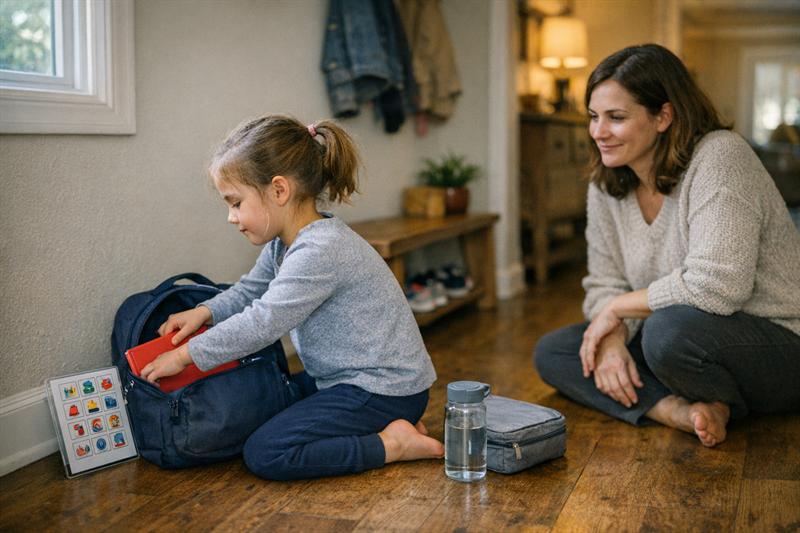
“Pack a backpack” is a useful example. It may involve checking a list, finding materials, placing them in the bag, noticing what is missing, and asking for help. When adults treat this as one task, a child can get stuck at any point. Breaking it down makes the next skill clearer.
Preteen and Teen Independence Skills
For preteens and teens, independence increasingly involves planning, self-advocacy, personal care, and managing more complex routines. These goals should support autonomy, not remove supports that are still useful.
- Managing more detailed hygiene and self-care routines
- Using calendars, reminders, checklists, and visual planning tools
- Beginning tasks without repeated adult reminders
- Managing school materials and personal belongings
- Participating in meal planning or simple food preparation with appropriate safety supports
- Completing household responsibilities
- Practicing community safety and navigation with appropriate supervision
- Communicating needs, preferences, and accommodations
- Handling schedule changes and transitions with a plan
Many of these routines involve executive function skills, such as starting a task, organizing materials, remembering steps, and adjusting when plans change. A teen who uses a phone reminder or checklist effectively is using a practical system to manage a real demand.
From “Do It for Me” to “Help Me Try”: What Progress Can Look Like
Participation Comes Before Full Task Completion
Progress usually happens in steps. A child may first tolerate a routine, then complete one part, then complete more steps with fewer prompts. This progression is more realistic and useful than expecting immediate full independence.
- Holding a toothbrush before brushing with support
- Selecting clothing before receiving help with dressing
- Using a visual schedule before following it with fewer reminders
- Putting one item away before cleaning up an entire activity
Families can lose momentum when they only count the final outcome. When partial participation is overlooked, adults may take over too quickly. That can reduce opportunities to practice and keep the routine dependent on constant assistance.
Asking for Help Is an Independence Skill
Requesting help is not the opposite of independence. It is a functional self-advocacy skill. A child who can communicate “help,” “break,” “I do not understand,” or “too loud” has a more reliable way to participate before frustration turns into avoidance or distress.
Communication does not have to be spoken to be effective. The key is that the child has a clear and consistent way to express what they need during real routines.
Meaningful Progress Should Show Up Beyond One Setting
When a child performs a skill in therapy but not at home, it is useful to look at what changes between settings rather than assuming the child is refusing or has failed. The people, materials, pace, and expectations may be different. Those differences can show where additional practice or support is needed.
When routines keep breaking down across settings, it may be time to look more closely. Families may notice:
- A child completes a task with one adult but not another
- A skill works in a structured setting but is difficult to use during busy home routines
- Repeated prompts are increasing instead of decreasing
- Frustration rises whenever a routine changes or becomes more demanding
These patterns may mean the goal needs adjustment, more intentional generalization, or a clearer support system. Addressing them can help reduce stress around daily routines and create more opportunities for participation.
How Families Can Support Independence Skills Outside of Sessions
Make the Routine Clear and Predictable
Clear routines reduce guesswork. Visual schedules, labeled storage, simple checklists, and predictable transition cues can help children understand what needs to happen without relying only on repeated verbal reminders.
Predictability should not become rigidity. Once a child understands a routine, small changes can be introduced gradually so the skill remains useful when real life does not go exactly as planned.
Offer Choices and Enough Time to Respond
Limited choices give children a practical way to participate. Choosing between two shirts, deciding which task to complete first, or selecting a preferred visual support can reduce conflict and build decision-making skills.
A common mistake is repeating directions quickly or completing the task for the child before they have time to respond. This can lead to more prompting rather than less. A brief pause gives the child a genuine opportunity to use the skill being taught.
Coordinate With the Child’s Support Team
Families can share which routines are working, which ones are difficult, and what matters most at home. School and home priorities do not always look the same, but strategies should support rather than work against each other.
- What exact steps are being taught within this routine?
- What prompt or visual support is being used?
- How will support be reduced when the child is ready?
- How will the skill be practiced with different people and settings?
Consistency can make routines easier to understand when multiple adults are involved. Families coordinating supports across settings can use guidance from coordinating a child’s therapy team across ABA, school, and caregivers.
When an Autism Evaluation or Reevaluation May Help Clarify Support Needs
Daily Demands Can Change Over Time
Support needs can become more noticeable when expectations change. Starting school, moving into a new classroom, handling more complex routines, or taking on additional self-care and organizational demands can reveal strengths and challenges that were less visible before.
Strive ABA Consultants LLC offers autism evaluations and reevaluations for families seeking clearer information about current developmental needs. A reevaluation does not guarantee a particular diagnosis, service, or outcome. It can help families organize current concerns and guide the next conversation about support.
Questions Families Can Bring to an Evaluation or Reevaluation
- Which daily routines currently require the most support?
- What strengths can be built into a plan for greater participation?
- Are communication, sensory, motor, learning, or planning demands affecting the routine?
- What supports help the child participate more independently?
- Have the child’s needs changed as home, school, or community expectations have changed?
When routine challenges become more frequent or disruptive, an evaluation or reevaluation may help a family move from a broad concern to clearer questions about next steps.
Key Takeaways
- ABA independence skills include self-care, communication, routines, organization, self-advocacy, and asking for help.
- Meaningful goals focus on routines that matter to the child and family, not a one-size-fits-all checklist.
- Progress often starts with participating in part of a routine or completing steps with fewer prompts.
- Skills need practice across people, places, and routine changes before they become reliably useful in daily life.
- Autism evaluations and reevaluations can help clarify changing needs when daily demands become harder to manage.
Conclusion: Independence Is Built Through Meaningful, Individual Steps
The issue is not that a child needs help. Daily routines can become more stressful when they repeatedly break down, adults need to take over every step, or the child has limited ways to communicate needs and use supports effectively. Identifying the specific barriers within a routine can create more opportunities for participation and reduce reliance on repeated prompting over time.
Strive ABA Consultants LLC can be a practical next step for families seeking greater clarity about autism-related developmental needs and the routines creating the most concern. An autism evaluation or reevaluation can help identify current strengths, organize the questions that matter most, and provide useful information for discussing the support a child may need now.
How Strive ABA Consultants LLC Approaches Independence Questions
Strive ABA Consultants LLC approaches independence by looking beyond whether a child completes a task alone. The more useful question is what is making the routine difficult and what support may help the child participate more successfully.
Routine challenges can involve more than one factor. Communication barriers, unclear steps, sensory needs, difficulty shifting attention, limited planning skills, and inconsistent expectations can all affect the same task. Identifying the pattern gives families a more practical next step than simply asking a child to try harder.
Frequently Asked Questions About ABA Independence Skills
What are independence skills in ABA therapy?
ABA independence skills are practical abilities that help a child participate in daily routines with the level of support that fits their needs.
These skills may include communication, self-care, routines, choice-making, organization, visual supports, and requesting help. Independence does not require a child to complete every task without assistance.
One useful starting point is identifying a daily routine that would be easier if the child could take part in one additional step.
Can ABA therapy help with daily living skills?
ABA-based strategies can be used to teach and practice daily living routines such as dressing, hygiene, meals, belongings, and household participation.
The process often involves breaking the routine into smaller steps, using clear supports, and practicing in more than one setting so the skill is more likely to be useful outside a structured environment.
Start by identifying where the routine breaks down instead of treating the entire task as one problem.
What are examples of ABA goals for independence?
Independence goals may include following a visual morning routine, requesting help, completing handwashing steps, packing belongings with a checklist, participating in household tasks, or using reminders to begin a task.
Each goal should be based on the child’s current skills and the routines that have the greatest impact on daily life.
Bring one difficult routine to the child’s support team and ask which specific step could be addressed first.
How does ABA help a child become more independent?
ABA can support independence by identifying a meaningful routine, breaking it into teachable steps, using individualized supports, reducing prompts when appropriate, and practicing the skill in everyday settings.
This approach may use task analysis, prompts, prompt fading, and generalization. A skill that works with one person or in one location may need additional practice before it becomes reliable elsewhere.
Ask how the child’s current goals are being practiced beyond one setting, person, or routine.
At what age should ABA work on independence skills?
Independence skills can be addressed across childhood and adolescence, but the right goal depends on the child’s current needs rather than age alone.
Early goals may involve communication, choices, and participation. Later goals may involve routines, planning tools, self-advocacy, and managing more complex responsibilities.
Focus on the next useful skill for the child’s current routine instead of comparing progress to a fixed checklist.
Is asking for help considered an independence skill?
Yes. Asking for help is an important independence and self-advocacy skill.
A child may communicate “help,” “break,” “I do not understand,” or “too loud” through speech, gestures, sign language, pictures, or AAC. This can reduce frustration and make participation more possible.
Consider whether the child has a clear, reliable way to communicate when a routine becomes difficult.