
Quick Answer: ABA school readiness is not just about sitting still or following rules. It also includes whether a child can communicate, transition between activities, and function with more independence in a classroom.
As school gets closer, many families start asking the same question: what does “ready” actually mean? At Strive ABA Consultants LLC, this comes up regularly. A child may be making progress in therapy, but that progress does not always carry over into a classroom.
That is where school readiness can get oversimplified. It is often reduced to behavior, when it also depends on how a child handles group expectations, changing routines, and less one-on-one support.
What “School Readiness” Really Means
School readiness refers to a child’s ability to communicate, follow routines, engage with others, and function with increasing independence in a classroom. It is not just about behavior or academics. It is about whether a child can participate in the structure of a school day.
In practical terms, this includes listening to group instructions, transitioning between activities, interacting with peers, and completing tasks without constant prompting. When these skills are still developing, the classroom can feel unpredictable and harder to navigate.
A child may do well in structured, familiar settings but struggle when expectations shift or support is reduced. That gap is often part of what ABA therapy addresses when school readiness is the focus.
Why Readiness Is More Than Behavior
A common assumption is that if a child can sit still and follow directions, they are ready for school. That is only one part of the picture.
In a classroom, children are expected to ask for help, wait, transition between tasks, and adjust when routines change. When those skills are not yet consistent, behavior challenges can follow because the environment becomes harder to manage.
This often becomes more noticeable as expectations increase. Small difficulties with communication or transitions can build into frustration and disengagement during the school day.
Common Misconceptions About Being “Ready”
- Readiness means no challenging behaviors
- Academic skills matter more than functional skills
- Children will naturally adjust once school starts
- Following directions in one setting means it will happen everywhere
These assumptions can delay the right kind of support. When readiness gaps are overlooked early, they often become clearer once a child is in a classroom.
Core School Readiness Skills ABA Therapy Builds
School readiness is built across multiple skill areas. These skills work together, and when one area is still developing, it can affect how a child functions throughout the day.
Communication Skills in a Classroom Setting
Children need to express needs, understand instructions, and participate in group learning. This includes asking for help, responding to questions, and following directions given to a group.
Some children communicate well in familiar settings but struggle in busier environments. This can lead to missed instructions and increased frustration.
Social Interaction and Peer Engagement
Classrooms require ongoing interaction with peers. This includes sharing, taking turns, and participating in group activities.
Unstructured times like recess or group work are often where difficulties show up first. Children who struggle here may withdraw or have trouble staying engaged with peers.
For a deeper look at how these skills develop, see how communication skills are built step-by-step in ABA therapy.
Independence and Daily Living Skills
- Following routines with less prompting over time
- Managing personal belongings
- Completing simple tasks independently
- Handling basic self-care needs during the school day
This is often where readiness gaps become clear. A child who depends heavily on adult support at home may have a harder time when that same level of support is not available at school.
Executive Functioning and Following Routines
Executive functioning includes starting tasks, staying focused, and completing activities. It also involves handling multi-step instructions and organizing actions.
This area is easy to underestimate. A child may understand what to do but still struggle to follow through consistently. That gap can lead to incomplete work and difficulty keeping up with classroom routines.
More detail on this can be found in how ABA therapy supports executive function skills in children.
Transitions and Flexibility
Classrooms involve frequent transitions. Moving between activities, adjusting to schedule changes, and shifting attention are part of the daily routine.
Difficulty with transitions is a common challenge. It may show up as resistance, delays, or emotional reactions, which can interrupt participation and make the school day harder to manage.
How ABA Therapy Teaches These Skills in Real-Life Contexts
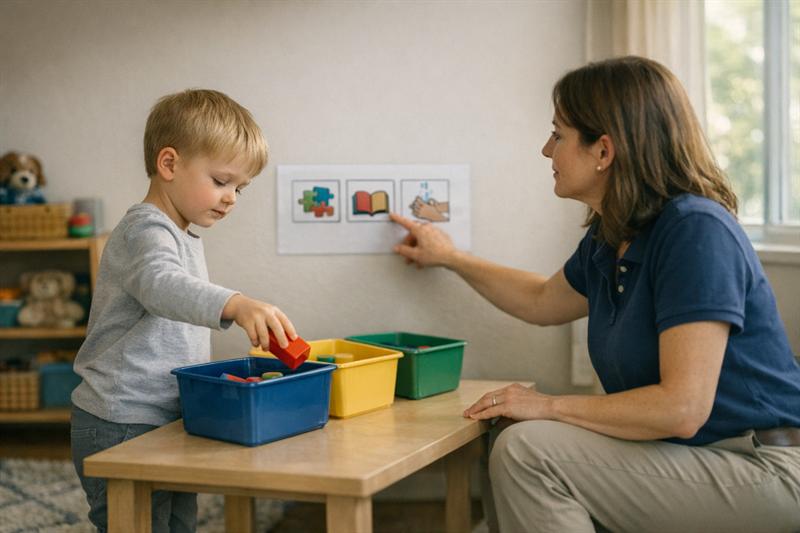
ABA therapy builds readiness by combining structured teaching with practice in real-life situations. The goal is not just learning a skill, but being able to use it across different environments.
Structured Learning vs Natural Environments
Structured sessions break skills down into clear, manageable steps. Natural environments introduce variability, distractions, and real-world expectations.
Both matter. Without practice outside of structured settings, skills may stay limited to therapy and not carry over as well into school.
Generalization Across Settings
Generalization means a child can use a skill across different environments, people, and situations.
This is a common challenge. A child may follow instructions during therapy but not in a classroom. Often, that reflects a need for more practice across settings rather than a lack of understanding.
When generalization is not addressed, progress can look strong in therapy but inconsistent in school. For more detail, see why ABA skills don’t carry over and how to support generalization.
Signs a Child May Need Additional School Readiness Support
- Difficulty following group instructions
- Struggles with transitions between activities
- Limited communication in busy environments
- Heavy reliance on adult prompts
- Challenges interacting with peers
- Skills that show up in one setting but not others
- Resistance or delays during routine changes
- Communication breakdowns in group situations
If several of these patterns are present, it may be a sign that more targeted support would help before or during a school transition.
When these challenges are consistent, focused support can help build the skills a child needs to participate more successfully in a classroom.
How Parents Can Support School Readiness at Home
What happens at home can affect how well skills carry over into school.
- Practice simple routines daily
- Build independence in small, repeatable tasks
- Create predictable transitions between activities
- Encourage communication during everyday situations
Consistency matters. When home routines and therapy goals are aligned, children usually have more opportunities to practice the same skills across settings.
How Evaluations Help Identify School Readiness Needs
An evaluation helps identify which skills are in place and where support may be needed. This creates a clearer starting point for building readiness.
At Strive ABA Consultants LLC, evaluations and re-evaluations are used to break down skills into specific areas, making it easier to target what may have the most impact in a classroom.
Sometimes readiness challenges are not fully recognized until school begins and participation becomes harder. Evaluating earlier can help bring those gaps into focus sooner.
Conclusion
School readiness is not about behavior alone. It also comes down to whether a child can manage communication, transitions, and independence in a structured environment.
When these skills are still developing, challenges may show up quickly once school starts. What begins as a small gap can affect participation, routines, and peer interaction over time.
Strive ABA Consultants LLC focuses on identifying these gaps early and building the skills that matter in real classroom settings. Starting with a clear evaluation can provide direction and help families prepare more effectively.
Key Takeaways
- School readiness includes communication, independence, and flexibility
- Behavior alone does not determine readiness
- Executive functioning and transitions play a major role in classroom success
- Generalization is a common reason skills do not carry over to school
- Early evaluation can help identify and address readiness gaps
FAQ
What is school readiness in ABA therapy?
School readiness in ABA therapy refers to the ability to communicate, follow routines, interact socially, and function independently in a classroom. These are the skills children use throughout the school day. An evaluation can help identify which areas may need support.
How does ABA help prepare a child for school?
ABA can help build skills like communication, routines, and social interaction, then practice them across different environments. This supports better consistency in school settings. Therapy is often adjusted to focus on the skills most relevant for classroom participation.
What skills should a child have before starting school?
Helpful school-readiness skills include following instructions, communicating needs, managing simple routines, and handling transitions. These are common classroom expectations. Identifying gaps early can help guide preparation.
Can ABA therapy improve classroom behavior and learning?
ABA can support classroom participation by building foundational skills like attention, communication, and task completion. These skills affect how a child engages in learning and daily routines at school. A structured plan can help align therapy with classroom demands.
How do I know if my child is ready for school with autism?
Readiness depends on functional skills, not just age. If a child struggles with communication, transitions, or independence, it may mean more support is needed. A formal evaluation can provide a clearer picture of current strengths and needs.
What is the difference between behavior and school readiness?
Behavior refers to observable actions, while school readiness includes the broader ability to function in a classroom. A child can show improved behavior but still struggle with independence or communication. Understanding the difference can help guide the next steps.