

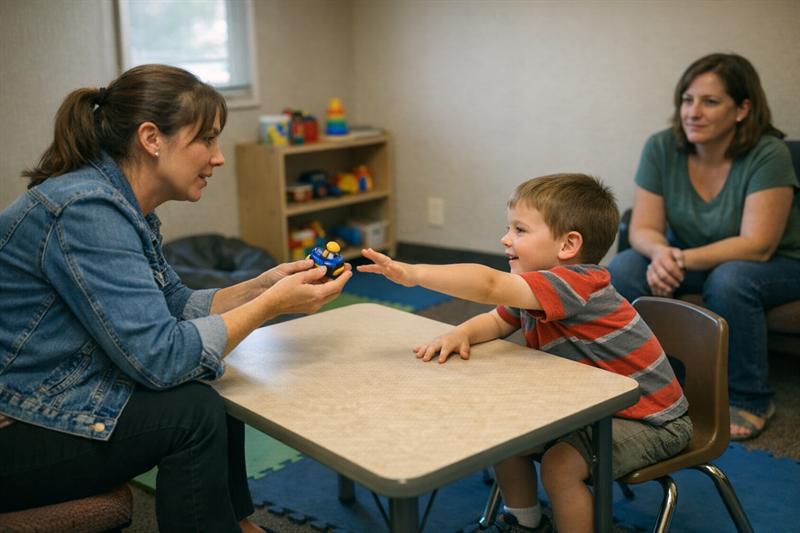
Quick Answer: In ABA therapy, the first skills often focus on safety, communication, and basic learning readiness because these foundations can reduce frustration, support participation, and make later goals more achievable.
Introduction
Most parents are not short on effort. They are short on clarity about where to start.
After a diagnosis or the start of therapy, it is common to receive a long list of goals without a clear explanation of what should come first. Many goals sound important, but they do not all have the same impact early on.
This is often where progress either builds or stalls. When early priorities are off, therapy can feel harder, behaviors may increase, and learning can slow down. When the right foundations come first, other areas usually develop more smoothly.
If you are just starting out, reviewing early signs that lead to ABA therapy can help you understand how these priorities begin.
Why “First Skills” Matter More Than Most Parents Realize
The first skills in ABA therapy shape much of what follows.
A common issue is starting with skills that look like progress in a session but do not make daily life easier. For example, labeling colors or matching shapes may show early success, but they do not always help a child communicate needs or handle frustration.
When foundational skills are missed, children may struggle to engage, follow instruction, or stay regulated enough to learn. That can lead to slower progress and more frequent behavior challenges.
When early priorities are selected well, learning becomes more accessible and consistent. That is what creates real momentum.
Understanding how ABA therapy goals are created and measured helps clarify why certain skills are introduced first.
The Problem With Generic ABA Skill Lists
Many ABA resources list skills without explaining order. That is usually the bigger issue.
Not all skills serve the same purpose. Some unlock learning, while others depend on foundational abilities already being in place.
A common mistake is focusing on compliance or labeling before communication. When a child cannot effectively express needs, frustration can build, and behavior challenges may increase instead of improving.
Without a clear sequence, therapy becomes reactive instead of intentional. That is often where progress starts to slow.
The 4-Level ABA Skill Priority Framework (Core Section)
Effective ABA programs usually follow a progression. Skills are selected based on what supports learning first, not simply what appears most advanced.
This four-level framework is a practical way to think about how early priorities are often organized.
Level 1: Safety and Regulation Skills
Safety usually comes first because it affects everything else.
- Reducing dangerous behaviors such as elopement or self-injury
- Building tolerance for transitions
- Supporting basic self-regulation
When safety needs are not addressed, sessions can become inconsistent and hard to sustain. Learning opportunities are interrupted, and progress may become uneven.
If these areas are not more stable, behavior can start to interfere with routines at home and in the community.
Level 2: Communication Foundations (Requesting Often Comes First)
Communication is one of the most important early priorities.
Requesting, also called manding, is often introduced early because it gives a child a direct way to express needs.
- Requesting items or activities
- Asking for help
- Requesting breaks
When communication improves, frustration often decreases because the child no longer has to rely only on behavior to be understood.
When communication is limited, behavior challenges can become more frequent or more intense. This is one reason it is commonly prioritized early.
Level 3: Learning Readiness Skills
These skills support a child’s ability to learn from instruction.
- Imitation
- Attention and joint attention
- Following simple instructions
- Engagement with tasks
Progress often slows when these skills are missing. Without imitation, it is harder to model new behaviors. Without attention, instruction is less likely to stick.
In those cases, families may see repeated teaching without much carryover. The issue is often not effort. It is that the foundation is still incomplete.
Level 4: Social and Independence Skills
These are the long-term goals many families are working toward.
- Play and peer interaction
- Self-care routines
- Early academic readiness
When these skills are introduced before earlier levels are in place, progress may be inconsistent. When they are built on a stronger foundation, they are more likely to carry over into daily life.
How Skills Build on Each Other (The Hidden Sequence)
ABA skills are connected. Each one supports what comes next.
A common sequence looks like this:
- Requesting improves communication
- Communication can reduce frustration
- Reduced frustration can support attention
- Improved attention can increase learning
This is why order matters. Teaching higher-level skills without these foundations often leads to slow or inconsistent progress.
As skills develop, they also need to transfer across settings. Without that step, progress may stay limited to therapy sessions. Generalizing ABA skills across environments is what helps skills become part of everyday life.
What Determines Priority for Each Child?
While the general framework stays consistent, the starting point should be individualized.
- Current communication ability
- Behavior patterns and triggers
- Developmental level
- Family routines and priorities
- Learning environment
Two children with similar diagnoses may still need very different starting points. When plans are not adjusted to the child, progress can slow and frustration can increase.
If a child shows frequent behavior challenges, limited communication, or low engagement, those are strong signs that foundational skills may need to come first.
How ABA Evaluations Identify First Skills
Skill prioritization usually begins with a structured evaluation.
Assessments review communication, behavior, adaptive skills, and readiness for learning. Observations and parent input add context for how the child functions day to day.
This process helps identify where breakdowns are happening. A child may have strengths in one area but gaps in another that block progress.
Understanding what happens during an ABA assessment helps clarify how these decisions are made.
If you are noticing these signs, priorities may need to be adjusted:
- Frequent frustration or behavior when needs are not met
- Limited ability to request help or preferred items
- Difficulty staying engaged during simple tasks
- Skills learned in therapy not carrying over at home
When these patterns show up, it may mean foundational skills need more attention and the plan should be reviewed.
Signs Your Child Is Working on the Right First Skills
- More attempts to communicate, even if those skills are still developing
- Less frustration-driven behavior
- Improved engagement during sessions
- Faster response to new learning
- Progress showing up in daily routines
These are useful early signs that priorities are aligned. Progress becomes easier to notice both inside and outside of therapy.
Key Takeaways
- First skills should focus on access to learning, not complexity
- Communication is often a turning point for progress
- Skills usually build in a sequence that should not be rushed
- Missing early foundations can slow progress across other areas
- Evaluations help determine what should come first
Conclusion
The biggest issue is not always doing too little. It is often starting in the wrong place.
When foundational skills like communication and regulation are overlooked, progress can slow, behavior challenges can increase, and therapy may become harder to maintain over time.
When the right skills are prioritized early, learning becomes more accessible and progress tends to build more consistently.
Strive ABA Consultants LLC focuses on identifying these priorities early through structured evaluations and ongoing reassessment so therapy stays centered on the skills most likely to support progress.
If you are unsure whether your child is working on the right first skills, a focused evaluation can help identify what may be getting in the way and what to adjust next.
How Strive ABA Consultants LLC Approaches Early Skill Development
Early skill selection should be thoughtful, not just a checklist.
Evaluations are used to identify the skills most likely to support progress, including communication, behavior regulation, and readiness to learn.
When these areas are addressed first, progress is often more stable and more likely to carry across settings. That is what gives early intervention practical value in everyday life.
FAQ
What are the first skills taught in ABA therapy?
The first skills often focus on safety, communication, and learning readiness. These areas can support behavior stability and make further learning more possible. A structured evaluation helps determine what should come first for each child.
Why is communication taught before other skills in ABA?
Communication gives a child a functional way to express needs. When this improves, frustration often decreases and participation often improves. That is why it is commonly prioritized early.
How do therapists decide ABA goals for a child?
Goals are based on communication level, behavior patterns, developmental needs, and family priorities. Assessments and observations guide those decisions, and plans are adjusted as progress is made.
What is manding in ABA therapy?
Manding is the ability to request needs, such as asking for help or preferred items. It is a foundational communication skill because it directly supports daily interactions.
Should behavior reduction come before communication?
Communication is often addressed alongside behavior because it can reduce the need to rely on problem behavior to get needs met. The balance depends on the child’s individual profile and safety needs.
How long does it take to see progress in early ABA therapy?
Early progress may show up as increased engagement, more communication attempts, or smoother daily routines. The timeline varies, but ongoing assessment helps keep the plan aligned with what the child needs most.