
Why this decision feels harder than it sounds
Families are often told a child needs “social skills support,” but that phrase can point to two different kinds of help. A social skills group gives a child a place to practice with peers. Individual ABA gives a child one-to-one teaching to build the skills that may make peer practice more productive.
This is where confusion often starts. The visible problem is social difficulty, but the real issue is not always lack of social opportunity. Sometimes the bigger issue is readiness. At Strive ABA Consultants LLC, that question often comes up when a child is referred to a group before they can consistently manage transitions, frustration, or communication breakdowns well enough to benefit from peer learning.
The better question is not which option sounds more social. The better question is what the child needs to learn first.
What a social skills group is meant to help with
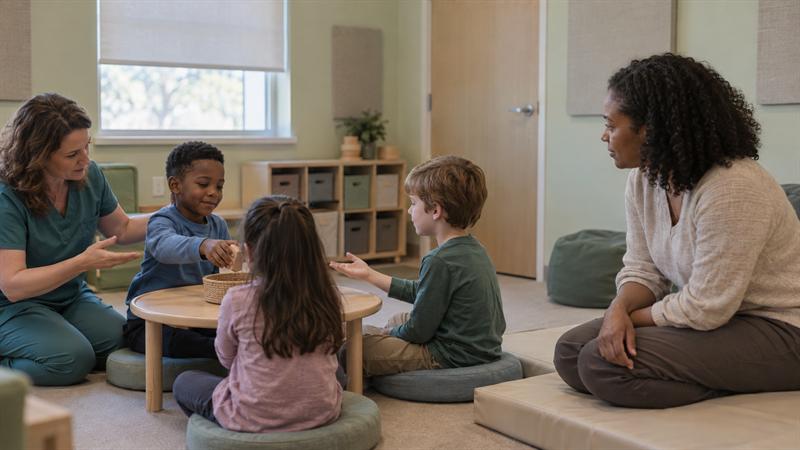
A social skills group is meant to help a child practice interaction in a structured setting with other children. That usually includes skills like turn-taking, joining play, waiting, reading simple social cues, handling small disagreements, and participating in back-and-forth conversation or shared activities.
The value of a group is that peers change the task. A child might take turns well with an adult and still struggle when another child changes the game, moves quickly, interrupts, or wants something different. That difference matters because social learning is not just about knowing a skill. It is about using that skill when the interaction becomes less predictable.
A common mistake is expecting a group to teach everything from the ground up. Groups are often strongest for practice, carryover, and feedback in a live social setting. They are not always the most efficient place to teach foundational skills from scratch.
If a group is being considered, it helps to know what a strong program should look like. This guide on how to evaluate a social skills group can help families tell the difference between structured teaching and simple group exposure.
What individual ABA is meant to help with
Individual ABA is meant to help with direct teaching in a one-to-one format. That can make it easier to break larger goals into smaller steps, adjust prompting, pace teaching carefully, and respond quickly when a child gets stuck.
For social development, that often means working on the skills that support later peer success. Those skills can include functional communication, tolerating waiting, staying with an activity, shifting between tasks, following directions, asking for help, handling changes, or learning how to recover after frustration.
This is something families commonly miss at first: a social goal does not always need a social setting first. If a child cannot yet communicate clearly in a hard moment, stay regulated long enough to participate, or tolerate another person changing the routine, peer practice may break down quickly. Individual ABA is often a practical starting point because it gives the child a place to learn those pieces directly before being asked to use them in a busy group.
Families who want a clearer picture of how ABA goals are built and tracked can also review what an ABA treatment plan should include.
Social skills group vs individual ABA: the biggest differences
The biggest difference is function. A group is usually built for practice with peers. Individual ABA is usually built for direct teaching with a higher level of support.
- Primary goal: Social skills groups focus on using skills in peer situations. Individual ABA focuses on teaching and strengthening skills step by step.
- Teaching format: Groups rely on shared activities, peer interaction, and social feedback. Individual ABA allows more repetition, prompting, and immediate adjustment.
- Level of support: Groups usually require the child to manage more at once. Individual ABA gives more direct support in the moment.
- Peer practice: Groups provide live peer interaction. Individual ABA can prepare for that, but it does not fully replace it.
- Readiness demands: Groups demand more tolerance for waiting, transitions, shared attention, and unpredictability. Individual ABA works better when those skills still need to be built.
- Progress measurement: Group progress is often seen in peer participation and generalization. Individual ABA progress is often seen first in consistency, communication, and tolerance for learning demands.
Neither format is automatically better. What matters is whether the child is ready to benefit from the demands of the setting. If the setting is too hard, learning may slow down and frustration may grow.
Signs individual ABA may be the better place to start
Individual ABA is often the better place to start when foundational skills are still limiting participation. That includes situations where communication is still emerging, routines break down quickly, or the child needs more support than a group can realistically provide.
- Communication is still inconsistent: If a child cannot reliably ask for help, express needs, or respond in a basic back-and-forth, group learning may turn into repeated breakdowns.
- Following directions is still hard: If simple instructions are often missed or resisted, the child is likely to spend more time off-task than learning in a group.
- Waiting and transitions trigger major problems: This can become more difficult in peer settings because children are expected to share space, take turns, and move with the group.
- Regulation is the main barrier: If frustration quickly leads to refusal, leaving the activity, or unsafe behavior, the social goal may be hard to reach until the participation barrier is addressed.
- The child needs smaller teaching steps: One-to-one instruction usually works better when a skill has to be shaped carefully and supported closely.
Families sometimes choose the group first because the goal sounds right, but the child is not yet ready for the demands of the setting. That can lead to limited progress, more stress, and confusion about whether the group itself is helping. In those cases, the starting point may simply be off.
If you are seeing these signs, direct support may need to come first.
- Your child does well only when an adult is closely guiding each step
- Peer settings regularly end in frustration, withdrawal, or conflict
- Waiting, transitions, or shared activities break down quickly
- Communication drops sharply when the situation becomes less predictable
When those patterns are present, starting with individual ABA is often the more effective move.
Signs a social skills group may be the better place to start
A social skills group may be the better place to start when a child already has enough communication and participation skills to learn through peer interaction. The issue is no longer just building the skill. The issue is using the skill with other children.
- Basic communication is present: The child can express wants, respond to others, and stay in a simple interaction, but struggles to do that well with peers.
- Some group tolerance is already there: The child can handle short periods of waiting, shared materials, and basic group routines without the whole activity falling apart.
- The goals are specifically peer-based: Problems like joining play, keeping a conversation going, handling losing, or adjusting to another child’s ideas are often better practiced live.
- One-to-one performance is stronger than peer performance: If the child does reasonably well with adults but not with peers, a group may be the missing step.
This is where many families get useful clarity. Readiness for a group does not mean a child already has strong social skills. It means the child can participate enough for peer practice to teach something. That distinction changes the decision.
When both can make sense
Some children need both because the two formats do different jobs. Individual ABA can teach the parts of a skill that still break down under pressure. A group can then test and strengthen that same skill with peers.
For example, a child might learn in one-to-one sessions how to ask for a turn, wait briefly, and tolerate a change in activity. In a group, that same child then has to use those skills when another child does not respond as expected. That is where generalization happens.
A common mistake is treating the two services like separate tracks with unrelated goals. That may slow progress. When the same skill is being taught directly in one setting and practiced in another, the child gets a clearer learning path. Families who want to watch for real carryover can use this guide on how to evaluate progress in a social skills group.
Questions families can ask before choosing which to use first
Families usually get better answers when they ask specific questions tied to learning and participation, not just service names. These questions help show whether the child needs more teaching, more peer practice, or both.
- What exact social or communication skill is the priority right now?
- Can the child do that skill one-to-one but not with peers?
- What usually causes the skill to break down?
- How much adult support does the child need to stay engaged and successful?
- What would early progress look like in the first few months?
- If a group is recommended first, what signs show the child is ready for it?
- If individual ABA is recommended first, what would show readiness for a group later?
This is where decisions usually become clearer. If the answer keeps coming back to participation barriers, individual ABA is often the practical first step. If the answer keeps coming back to peer use and generalization, a group usually becomes more relevant.
How evaluations and treatment planning can clarify the right next step
The right next step gets clearer when recommendations are based on observed strengths, barriers, and daily patterns instead of broad assumptions. At Strive ABA Consultants LLC, that usually means looking closely at where interaction breaks down, what support the child still needs, and whether the barrier is social use, foundational skill development, or both.
This matters because the same child can look very different across settings. A child who communicates well at home may shut down in group situations. Another child may look social during preferred play but struggle the moment flexibility or waiting is required. That is why treatment planning needs to separate surface behavior from the skill gap underneath it.
For families trying to understand what that process looks like, what happens during an ABA assessment can help explain how recommendations are formed. In some cases, reevaluations may also help clarify whether current supports still match the child’s needs.
Key Takeaways
- Social skills groups and individual ABA are not interchangeable. They address different needs.
- Individual ABA often makes more sense first when communication, regulation, waiting, transitions, or participation are still breaking down.
- Social skills groups often make more sense first when the child can already participate enough to benefit from peer interaction.
- Some children need both, with one setting focused on direct teaching and the other focused on practice and carryover.
- The most useful question is not “which is better?” It is “what does this child need to learn first?”
Conclusion
The real problem is not choosing between two good options. The real problem is starting with the wrong format and expecting it to solve a barrier it was not designed to solve. When that happens, progress may slow, frustration may build, and families can lose time trying to force peer practice before a child is ready to benefit from it.
The pattern is usually clearer once the breakdown is identified. If participation, communication, transitions, or regulation are still the main obstacles, those skills often need direct teaching first. If the child already has those foundations and the main issue is using them with peers, group work becomes much more useful.
Strive ABA Consultants LLC can be a practical next step when families need help sorting out that difference. A clear assessment and treatment-planning process can make it easier to identify what is actually getting in the way, what support should come first, and how to build a plan that matches the child’s needs more closely.
Company Approach
Strive ABA Consultants LLC approaches this decision by looking at how skills hold up across real situations, not just whether a child can show a skill once in a structured moment. That usually means asking where the breakdown happens, what support is still required, and whether the next step should focus on direct teaching, peer practice, or a coordinated mix of both.
This is especially important when families are moving from evaluation into planning or trying to decide whether current recommendations still fit. A support plan tends to work better when it matches the child’s actual learning needs and daily demands, not just the label attached to the service.
FAQ
Is a social skills group the same as ABA therapy?
No. A social skills group and individual ABA are not the same, even when both address social goals.
A social skills group is usually built around practicing interaction with peers. Individual ABA is built around direct teaching with more support and more control over the teaching steps. A child who needs help learning how to tolerate waiting or ask for help during frustration usually needs something different from a child who already has those skills but struggles to use them with peers.
The difference matters because families sometimes choose the setting that sounds most relevant instead of the one that matches the skill gap. That can lead to slow progress and confusion about what is not working.
Should a child start individual ABA before joining a social skills group?
Often yes, if foundational skills are still limiting participation. That is a common and practical sequence when communication, regulation, transitions, or following directions are still weak.
For example, if a child cannot stay engaged in a shared activity without continuous adult support, a group may expose the problem without doing much to fix it. Individual ABA is better suited to teach those pieces directly. Once those skills hold up more reliably, group participation often becomes more productive.
The deciding factor is not whether the goal is social. The deciding factor is whether the child can already access social learning in a peer setting.
How do you know if a child is ready for a social skills group?
A child is usually ready for a social skills group when the child can participate enough to learn from peers, even if the social skills themselves still need work.
That usually looks like basic communication, some ability to wait or share attention, and enough regulation to stay in the activity when another child changes the pace or direction. The child does not need to be socially polished. The child does need enough stability in participation for practice to lead to learning.
What often gets misunderstood is readiness. It does not mean “already good at socializing.” It means the setting is likely to teach more than it overwhelms.
Can individual ABA help with social skills even without a group?
Yes. Individual ABA can help teach the building blocks that support social interaction, even before peer practice is added.
That can include requesting, responding, sharing attention, taking turns in a simple format, tolerating changes, or repairing a communication breakdown. Those are social foundations. If those skills are weak, group practice usually falls apart under pressure because the child is still trying to manage the basics.
What individual ABA does not fully replace is real peer unpredictability. It can prepare a child for that challenge, but it does not create the same kind of live social demand as a peer group.
Can a child do both individual ABA and a social skills group at the same time?
Yes, and in many cases that is a useful setup once the child has enough readiness for peer work.
One setting can focus on direct teaching while the other focuses on real-world use. For example, a child might learn how to ask for a turn and handle a denied request in one-to-one sessions, then practice those same skills when another child does not respond the expected way in a group. That creates a clearer path from teaching to carryover.
The important distinction is coordination. If both settings are targeting the same breakdown from different angles, the combination often works better than two disconnected services.
What should families ask before enrolling in a social skills group?
Families should ask what the group is meant to teach, what support children receive during problems, and how progress is measured.
Those questions matter because not every group is built the same way. Some groups are structured to teach turn-taking, flexibility, and reciprocal interaction. Others provide general peer exposure without much direct teaching. If a child still needs close help to stay engaged, that difference becomes critical.
The most important issue is fit. A group works best when its demands match what the child can handle and its goals match what the child actually needs to practice.