

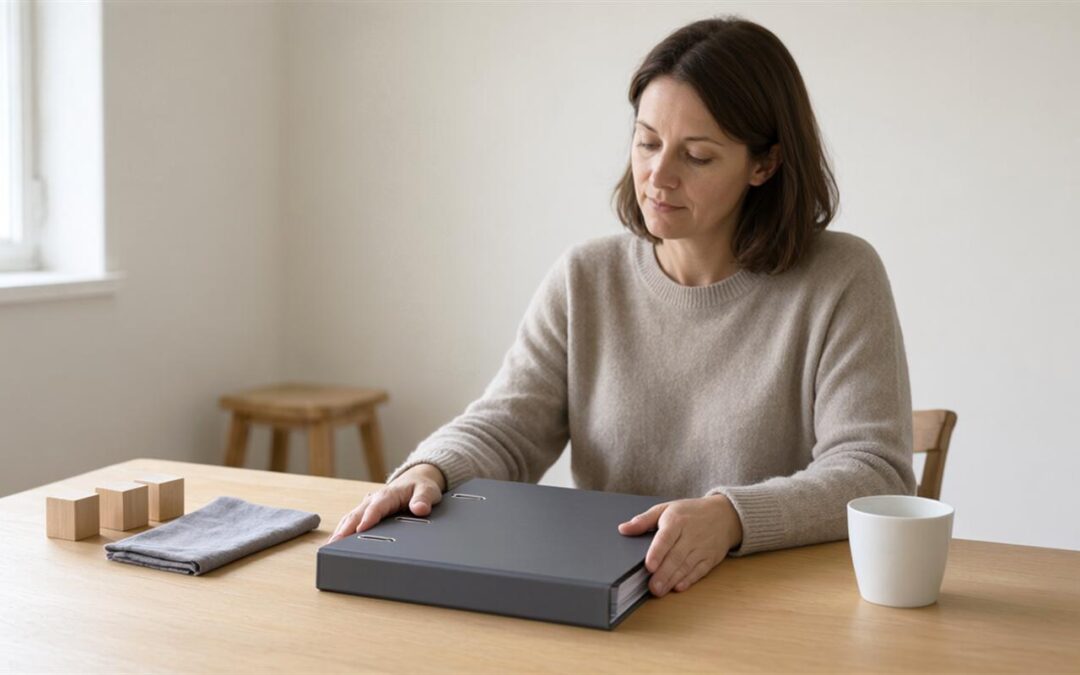
A folder usually starts on the day a family hears the words intake appointment or diagnostic evaluation. Into it go the referral, a copy of the insurance card, a school letter, and whatever the first provider hands across the desk. For a few months the folder does its job. Then a progress report arrives, then an IEP draft, then a note from a sitter asking what to do at bedtime, and the folder becomes a stack that has to be emptied onto a table before anyone can find one page inside it.
That is not a story about disorganization. It is what happens when three systems send paper on three different clocks and nothing in the folder says what exists or where it lives. What follows is a home system built for that reality: one index page, four tabs, a file naming rule, and a copy that travels to school and to other caregivers.
Why One Folder Stops Working
Clinical paperwork moves on a clinical rhythm. An evaluation report arrives once, a treatment plan arrives at the start of services and is revised at review, and progress reports land in between. School paperwork moves on a school calendar: an IEP or IFSP, district reports, letters about meetings, and notices that arrive before a break rather than after it. Caregiver paperwork has no rhythm at all. It is written at the kitchen table when a routine shifts and handed to a grandparent the same week.
An intake folder was built for the first stream, at a point when only the first stream existed. By the second year it is holding three, and the problem is not volume. It is that no page in the folder says what exists, who holds the original, or which copy is current. Each search restarts at the top of the pile, and the search usually happens in the ten minutes before a meeting.
Start With the Index Page, Not the Tabs
The first sheet in the binder is not a divider. It is an index, and it holds one line per document: what the document is, the date it was issued, who holds the original, and where the copy sits. Written by hand as paper arrives, it takes about a minute a line and replaces work that would otherwise fall to one adult’s memory.
Building the index first is what keeps the tabs honest. A family that buys a divider set and then tries to fill it ends up with empty sections marked for paperwork that never arrived, and no section for the document that did. When the index comes first, the tabs are chosen from what is actually in the house. The index also does two quieter jobs: it is the page to read before a meeting, and it is the running record of anything that was agreed and has not arrived yet.
ABA Binder for Parents: Four Tabs That Cover Most Weeks
Four tabs hold almost everything a family is asked for in a given month. The first is who your child is: names, contacts, insurance details, the current providers, and the emergency numbers a sitter would need. The second is clinical: the evaluation report, the current treatment plan, progress reports, and the most recent reevaluation. The third is school: the IEP or IFSP, district reports, and correspondence with the school team. The fourth is caregiver and handoff: the one-page summaries and notes that leave the house.
Behind all four sits the same split, current in front and archive behind. That split is what keeps a binder usable in its third year, because a superseded plan stays in the house without sitting in the way of the plan that is active. The most useful ABA binder for parents is not the thickest one; it is the one a tired adult can open at the end of a long day and find the right page quickly.
The ABA Document Checklist: What Earns a Slot
A working ABA document checklist stays short, and every line on it answers a question someone will ask again. Six items cover most requests that reach a family.
- The evaluation report, which is the reference document for what was assessed, when, and by whom.
- The current treatment plan, with its goals, its weekly hours, and its review date.
- The most recent progress report, which is the update a review meeting usually starts from.
- The current IEP or IFSP, if school services are part of the week.
- The insurance eligibility confirmation, so the funding question is answered from paper rather than from memory.
- The transportation arrangement, when transportation support is part of the plan, since availability is checked family by family rather than assumed.
What does not earn a slot is a second copy of the same plan, a stack of worksheets from a session, and the folder of handouts that comes home after every workshop. Those can live in one envelope that gets emptied at the end of a season. Most of the list above arrives during the first weeks of services, and the order in which those documents usually appear is set out in a guide to ABA intake and onboarding, which helps while the folder is still new and nothing has a home yet.
The Clinical Layer: Evaluations, Plans, and Reports
The evaluation report is the reference document. It answers what was assessed, on what date, and by whom, and it is the page other documents point back to. The treatment plan is the working document: goals, teaching procedures, weekly hours, and the date the plan is due for review. A progress report is the update, and a reevaluation either confirms the original picture or replaces it.
Families do not automatically receive every document their team holds, and what arrives depends on the provider and on the funding source. Asking what the family is entitled to receive, and in what form, is a reasonable question at intake and again at a review. If an evaluation is still ahead rather than behind, the documents to prepare for a developmental disability evaluation belong in the same clinical tab, filed under the date of the appointment rather than the date the report finally arrives.
How to Organize Child Therapy School Documents Without Rebuilding the Folder Every Year
The IEP or IFSP is the spine of the school tab. Keep the current document at the front and the one it replaced directly behind it, so a question about what changed is answered by turning one page. A separate divider for each school year keeps annual paperwork from mixing, and the move into archive happens at the end of a year rather than at the start of the next one, when the first meeting is already close.
District reports and letters from the school team follow the same date-first rule as clinical pages, which matters when two versions of one document sit in the same tab. If a copy of the school record is needed, the request goes to the district office, and the local process is worth asking about rather than assuming. The goal is not to organize child therapy school documents once and be finished; it is to keep the folder able to absorb the next envelope.
Naming a File So You Can Find It a Year Later
A naming rule is what makes the digital copy as useful as the paper one. Date first, then who issued the document, then what it is. Sorted by name, files read in the order things happened, which is the order a review meeting usually asks about and the order that makes a year-old folder legible without opening a single document.
Paper is scanned when it arrives rather than at the end of the month, because the envelope on the counter is the only dependable reminder of what is inside it. One digital home mirrors the four tabs, and a second copy exists only when a second adult genuinely needs one. The rule matters more than the tool: the same pattern on paper and on file means a family is not learning two systems.
The One Page That Travels
The binder stays home. One page goes with the child, to a sitter, a grandparent, an after-school program, or a respite worker, and it holds what an adult needs in the first hour rather than the full history. That page is dated, because the date is how a reader knows whether the routine on it is still the routine in the house.
What belongs on that page is its own piece of work, and the caregiver communication toolkit covers the formats that hold up across settings. What matters for the folder is that the page is rebuilt from the binder when the plan changes, rather than written from memory at the door.
What to Send, What to Keep, and What to Retire
Copies travel and originals stay. One clean copy of anything hard to replace, such as an evaluation report or a signed plan, is worth keeping in the archive even when the working copy is digital. When a school team or a new provider asks for documentation, sending what was asked for works better than sending the binder, because the request names the document and the rest is someone else’s reading time.
Retiring a document is the step families skip. When a new plan replaces an old one, the old one moves to archive instead of the recycling bin, because the history is often what a review asks about, and reconstructing it later means a records request. The archive section is the reason the current section stays thin.
The Quarterly Fifteen Minutes
The system holds as long as someone spends a few minutes on it four times a year. The ritual is small: file the newest report, write its date on the index, move the plan it replaced to archive, note on the index anything still outstanding, and refresh the one page if a routine has changed at home.
Putting those fifteen minutes on a calendar at a fixed point is what keeps the folder from drifting between reviews. It is also the moment to notice a gap while there is still time to ask about it, rather than in the car on the way to a meeting.
Key Takeaways
Four habits do most of the work in a home document system.
- Write the index page first, then choose tabs from what the folder actually holds.
- Keep four tabs, with current documents in front and superseded ones behind.
- Hold the checklist short, and let handouts live in one envelope.
- Name every file the same way: date, issuer, document.
- Send copies, keep originals, and move replaced documents to archive.
Conclusion: Getting Support in Place
Strive ABA Consultants LLC works with families in Oak Forest, Illinois; Chicago, Illinois; and Merrillville, Indiana. Services include ABA therapy, diagnostic evaluations for families who suspect a child may be on the autism spectrum, parent training and family support, counseling, life skills training, and social skills groups. Insurance and financial assistance pathways are available, and eligibility is confirmed with each family, as is availability for transportation support.
A folder system does not change what a plan contains, and it is not a substitute for the clinical record a provider keeps. What it changes is how quickly a family can answer a question with a page in hand. To take the next step, make an appointment, send a message, or request a callback.