

Quick Answer: The main decision problem is whether a social skills group will extend your child’s current ABA plan or simply add another setting where skills do not transfer. A social skills group can complement individual ABA therapy when it targets skills already stabilized in one-on-one work, fits the child’s regulation capacity, and connects to measurable home, school, or community outcomes. For families balancing social skills groups and ABA therapy, Strive ABA Consultants LLC approaches group fit as a sequencing and access decision, not a default upgrade.
Why the Decision Is About Fit, Not Just Adding More Therapy
Consider adding group support only when it serves a specific function in the existing ABA plan. Individual ABA gives your child focused instruction, clear expectations, and adult support in a controlled environment. A group typically adds peers, background activity, competing demands, and less individual attention. The value of those changes depends on your child’s current skills.
Group time can sound like a natural next step. Problems can begin when the group does not map to the individual plan. The child may end up attending a setting that feels like progress but does not build a measurable outcome.
The practical test is simple: Does the group extend a skill, or does it introduce a new skill under harder conditions? If it extends the skill, it can have a role. If it introduces the skill, pause and revisit one-on-one work.
What a Social Skills Group Should Look Like in an ABA Program
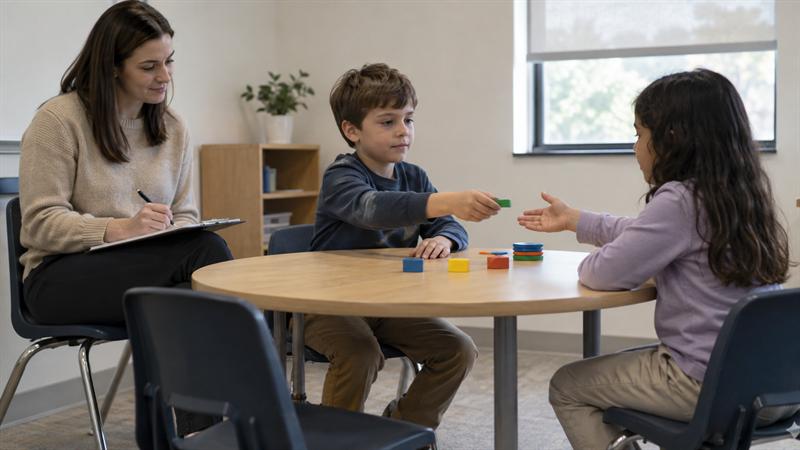
A well-run social skills group functions like a focused, data-informed ABA setting: it has clear targets, consistent adult support, and prompts that can be faded. It should not feel like casual peer time. It should look like planned instruction.
Group size matters. A small group with enough trained adult support allows each child to be observed and supported individually. A larger group can make it harder to track each child’s behavior with enough precision.
- Clear skill targets, such as turn-taking, waiting, entering play, or responding to a peer prompt
- A schedule that matches the child’s attention span and regulation limits
- Adult planning that includes prompting, modeling, and fading support
- Data collection on what the child does, not just what the child attends
The group should connect to the individualized ABA plan. If the target skill is not yet stable, individualized work generally comes before group practice. For a closer look at how structured group practice differs from casual peer time, see how social skills groups work in ABA.
Progress should be reviewed like any other ABA goal. The provider should be able to show what was measured, what changed, and what still needs work.
7 Readiness Conditions to Review Before Adding a Social Skills Group
A child is more likely to be ready for a social skills group when the child can participate without excessive distress and the group targets skills the child is close to acquiring. Readiness is a set of practical conditions, not a single label.
1. Foundational Skills Are Holding in One-on-One Settings
The child follows simple multi-step directions in one-on-one sessions and uses a basic communication method consistently enough to attempt group interaction. This includes verbal language, AAC, or another supported communication method. If the target skill has not yet stabilized in one-on-one work, group work can add pressure before it builds practice.
2. The Child Can Participate in a Structured Group for an Appropriate Duration
The child can sit or engage in a structured group for a realistic length, even if that is shorter than the full session. A shorter block with some support can be a useful starting point. The group routine should include a clear start, transition, activity, and end.
3. Regulation Supports Are Realistic and in Place
The child has a regulation plan that matches the group environment. Seat, noise, sensory input, pacing, and peer movement all affect the child’s ability to stay engaged. If the plan depends on a calm environment that the group does not provide, distress can increase.
4. Social Motivation or Peer Value Is Present
The child shows some interest in peers, or the goal is to reduce distress in settings where peers are unavoidable. Motivation does not need to be strong or obvious. A child who prefers parallel play can still benefit from structured group work when the target is manageable.
5. The Group Goals Match the Child’s Current Developmental Stage
The group targets skills that match the child’s developmental level. A preschooler often needs shorter sequences and concrete supports, while a school-age child may handle longer routines and more abstract expectations. The group should sit slightly above the child’s current level, not far ahead of it.
6. The Family Can Support Consistency at Home and in the Community
The family can keep the routine consistent for several weeks. Transportation, work schedules, and after-school demands matter as much as clinical fit. If attendance becomes patchy, the group loses its value and the child may experience repeated starts and stops.
7. The Provider Can Connect Group Skills to Measurable Goals
The provider can connect the group to specific ABA goals and share data on those goals. They should be able to say what behavior will increase, what prompt will fade, and how the skill should appear in other settings. If the explanation stays broad, the plan is not specific enough.
If several key readiness conditions are not met, adding group time can add stress before it builds skill.
- The group adds a new environment before foundational skills are stable
- Regulation needs are not built into the group plan
- Attendance will depend on transportation or scheduling that is not yet solved
- The target skills are not connected to current ABA goals
The practical next step is a goal review before enrollment. Your child may need a clearer plan, not a trial that assumes the group will fix a gap.
When Group Support Is Less Likely to Be the Right Next Step
Group support is less likely to be the right next step when it would introduce skills that are not yet stable, increase dysregulation, duplicate one-on-one work, or become inaccessible. This is a placement and sequencing decision, not a judgment about the child.
Foundational Communication or Participation Skills Are Still Fragile
If the child still needs heavy support to follow group instructions or tolerate peers, group time can increase overwhelm. The child may learn to cope with the setting rather than build the target social skill. One-on-one ABA generally remains the priority until communication and participation are stable enough for group practice.
The Child Becomes Dysregulated in Group Settings
Dysregulation in group settings is a signal to adjust the plan, not push through it. When a child feels flooded, shuts down, or escalates, adding more group time can make peer settings feel harder rather than more manageable. A useful adjustment may be a shorter format, a quieter environment, a different peer group, or a return to individualized work.
The Group Would Duplicate Skills Already Being Taught Individually
If the ABA team is already teaching turn-taking, waiting, or peer interaction in one-on-one sessions, a group should not repeat the same target at the same intensity. Duplication can consume time that could be used for progression and may not add new information. A useful group extends the skill into a more natural or less controlled setting.
Scheduling, Transportation, or Access Barriers Prevent Consistent Attendance
A group that cannot be attended consistently may not build durable skills. Distance, transportation gaps, and competing routines can weaken data, disrupt fading schedules, and reduce practice opportunities. Access becomes a clinical issue when it interrupts consistent attendance.
Evaluation or Reevaluation Needs Remain Unresolved
If the child’s communication level, sensory profile, or developmental needs are still unclear, the group decision becomes guesswork. An autism evaluation or reevaluation can help clarify what the child can handle and what the group should target. This is a planning step, not a barrier to progress.
How Individual ABA and Social Skills Groups Work Together
Individual ABA builds the skill, and group support helps test whether the skill works when the environment changes. The two formats work best when they follow the same plan.
Individual ABA Builds the Foundation
One-on-one sessions are where many new skills are introduced, shaped, and reinforced with strong adult support. The child learns the target behavior in a lower-demand environment before facing peers, noise, and less prompting. This is the base that makes group practice useful.
Group Settings Create a Practice Environment
Group settings add the variables that matter in everyday life. Peers may not respond as expected, attention splits, and adult prompts must fade. If the skill only works when the adult directs attention, the group has not yet done its job.
Skills Should Move From Taught to Maintained
The goal is not to perform the skill in the group room. The goal is for the skill to remain when prompts reduce and the setting changes. A useful marker is independence: the child waits, initiates, or recovers from a missed cue without the same level of adult support.
School and Home Carryover Is the Real Measure
Carryover is a strong signal that the plan is working. A child who takes turns in a structured group but not at recess or at home still needs the plan adjusted. This is why how ABA therapy supports school readiness matters more than in-group performance.
Questions to Ask Your ABA Team Before Starting a Social Skills Group
Ask questions that create a clear connection between the group, your child’s current goals, and the data the team will use. These questions move the conversation from enthusiasm to planning.
- Which specific skills will this group target, and how do they connect to the current ABA goals? This shows whether the group extends the plan rather than adds a separate goal.
- How was readiness determined, and what data supports that decision? This prevents a group from becoming a default next step.
- What is the group size, adult ratio, and session structure? This tells you whether the setting can support observation, prompting, and fading.
- How will progress be measured, and when will the family see that data? This turns the group into a measurable part of the treatment plan.
- What happens if the child is not making progress or is distressed? This reveals whether the team has a clear adjustment plan.
- How will group skills carry over to school and home? This keeps the focus on functional independence.
- Does the team coordinate with school, speech, or occupational therapy? This reduces overlap and conflicting routines.
- What is the plan if the group is not the right fit? This protects the child from a long trial with no clear exit.
How to Monitor Progress Without Overloading Your Child
Monitor the skill, not just the attendance, and watch for carryover into home, school, and community. Attendance proves the child was present. It does not prove the skill is working.
Look for the target skill in less controlled settings. If the child waits in the group but not at the kitchen table, the skill has not generalized yet. If the child initiates a play move with a peer in the group and later uses a similar move at school, the plan may be working.
Watch the child’s wellbeing alongside data. A child who leaves the group exhausted, withdrawn, or resistant is giving a signal. That can mean the format, length, environment, or target difficulty needs review. Families may wait until the child is visibly distressed. By that point, the group can start to feel like another source of pressure.
Review data regularly and compare it with one-on-one ABA data. If group progress stalls while individual sessions improve, the group may not be adding enough value. The team should be ready to adjust the target, the group, the prompts, or the duration.
Local Access, Scheduling, and the Practical Side of Consistent ABA Support
A group plan can fall apart when access is solved after the clinical decision, not before it. Distance, transportation, work schedules, and after-school routines are part of the planning problem.
In Oak Forest, Chicago, and Merrillville, a group that is the right target but the wrong distance can become inconsistent quickly. Consistency is what allows data to accumulate and supports to fade. A plan that looks strong on paper can break in the car, at the school drop-off, or after a long day.
Provider partnerships can reduce this friction. Transportation support, clearer scheduling, and coordination with schools or other providers can help families maintain attendance without adding stress. Financial assistance pathways can also keep the plan realistic when coverage or cost creates barriers.
An updated autism evaluation or reevaluation can sharpen the plan when the child’s level is unclear. Up-to-date data can help the team choose the right target, the right group intensity, and the right support level. A coordinated plan across providers is often the most useful support. A guide to how to coordinate your child’s therapy team can help keep ABA, school, speech, and home routines moving in the same direction.
Key Takeaways
- A social skills group is useful when it extends skills already stabilized in one-on-one ABA.
- Readiness includes skill stability, regulation capacity, developmental fit, family logistics, and provider data.
- A group should not duplicate individual ABA targets at the same intensity.
- Progress is measured by carryover to home, school, and community, not by attendance alone.
- If the group is not working, the plan can be adjusted or paused without treating that as failure.
The Strive ABA Consultants LLC Approach to Social Skills Group Fit
At Strive ABA Consultants LLC, social skills group fit is reviewed as part of the broader treatment planning conversation. That conversation looks at current ABA goals, regulation needs, communication level, attention span, and the setting where the skill must work.
When the child’s developmental picture is unclear, a clearer evaluation can guide the next step. Autism evaluations and reevaluations can help identify whether a group format matches the child’s current communication, sensory, and cognitive needs. This keeps the group decision grounded in the child’s actual level rather than in a general recommendation.
Access is also treated as part of the plan. Transportation support, scheduling, partnerships, and financial assistance pathways can help support consistent attendance. The goal is a group recommendation that can actually be kept.
The approach keeps the family centered. The team should be able to explain the target skill, the data, the support plan, and the review point. If the group adds pressure without adding measurable independence, the plan changes.
Frequently Asked Questions
Can a social skills group replace individual ABA therapy?
No. A social skills group is typically a practice and generalization setting, while individual ABA provides the focused instruction where many new skills are introduced, shaped, and reinforced. In one-on-one sessions, the adult can often control prompts, reduce demand, and track the skill closely. In a group, the child uses the skill alongside peers, background activity, attention splits, and less prompting.
For many children, both formats run at the same time. The group does not replace individualized assessment, goal setting, or targeted teaching. A group becomes most useful when it asks the child to use a skill in a more natural or less controlled way.
How do I know if my child is ready for a social skills group?
Readiness is not a single test. It is a set of conditions that the ABA team should be able to explain with data and observation. The child should have a stable foundational skill in one-on-one settings, enough regulation to participate for a realistic duration, and group targets that match the child’s developmental level.
A useful example is turn-taking. If the child can take turns in one-on-one ABA, a group can practice that skill with peers. If the child still needs heavy prompt support to wait or follow directions in one-on-one sessions, group work can add pressure before it builds practice. The key distinction is timing, not deficiency.
How is progress in a social skills group measured?
Progress should be measured with the same kind of data used in individual ABA: specific behaviors, frequency, duration, prompt levels, or independent responses. Attendance is a record of presence, not a measure of skill change. If the target is peer interaction, the team should gather data on what the child actually did, such as initiating a play move, waiting for a turn, or recovering after a missed cue.
The stronger measure is carryover. A skill that works in the group but disappears at home or school has not yet generalized. The team should compare group data with individual ABA data and observations from other settings. Fading of adult support is often a clear sign that the skill is becoming functional on its own.
What should I ask before enrolling my child in a social skills group for autism?
Ask questions that connect the group to your child’s current plan. The most useful questions are: “Which specific skills will this group target, and how do they match our current ABA goals?” “How was readiness determined, and what data supports that decision?” “How will progress be measured, and when will we see that data?” “What is your plan if the group is not working?”
The answer quality matters as much as the topic. A well-planned group has specific, observable targets and a clear data plan. A generic answer about socializing or peer connection can suggest that the group will function more like unstructured peer time. That distinction helps identify whether the group is a connected treatment component or an add-on activity.
What should I do if my child is struggling in a social skills group?
Do not assume the child simply needs to push through. The first step is to identify what may be challenging: regulation, skill level, peer fit, group length, environment, or target difficulty. Each of those has a different adjustment, and the right adjustment depends on the specific data you have.
If the child is dysregulated, the likely adjustments are a shorter session, a quieter environment, fewer peers, or a return to individualized work. If the skill is new, the group is ahead of the one-on-one plan and the individual target should be strengthened first. If the child can handle the skill but not the peers or setting, the group composition or format may need review. A reevaluation can help clarify whether the current target level still fits when the child’s profile is unclear.
Conclusion: Choose a Group That Supports Existing Goals, Not Just More Sessions
A common challenge is that families may be asked to add a social skills group before the plan explains how it connects to their child’s current ABA goals. When that connection is missing, the group can become another demand that drains family bandwidth while skills remain narrow and setting-specific.
When group support is sequenced correctly, it gives the child a place to practice in less controlled social conditions. When it is added without readiness, data, and access support, it can increase stress and weaken the child’s connection to peer settings. The difference is not enthusiasm. The difference is a plan that knows what the group is for.
If your child has been recommended for a social skills group and the current picture is unclear, a review with Strive ABA Consultants LLC is the practical next step. The team supports families in Oak Forest, Chicago, and Merrillville with autism evaluations, reevaluations, and access planning that includes transportation support and partnership pathways. The practical next step is a direct review of your child’s current ABA goals, readiness conditions, and group recommendation before enrollment begins.