

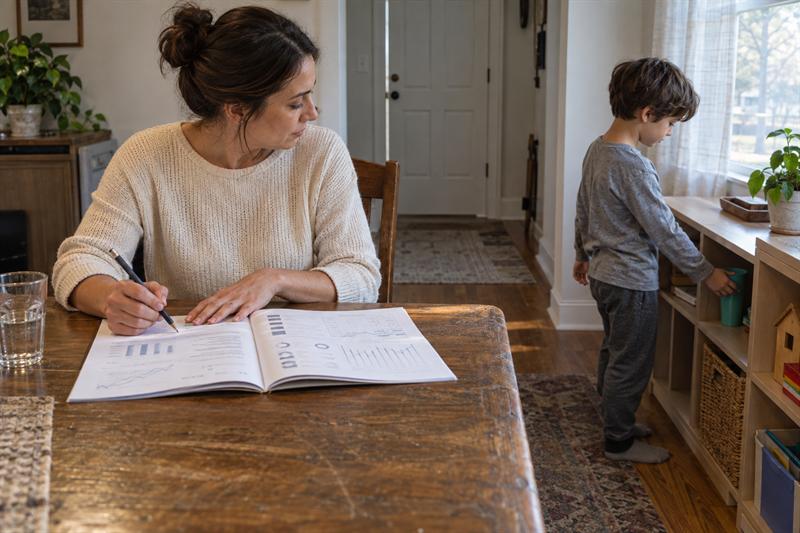
At Strive ABA Consultants LLC, this is a common source of confusion for families. A report can include percentages, graphs, and clinical terms, yet still leave a parent with the same question: what does this actually mean for my child at home, at school, and in everyday routines?
This guide explains the ABA data terms that come up most often in progress reports and review meetings. The goal is not to make parents think like analysts. It is to make the report easier to read, easier to question, and easier to connect to real progress.
Why ABA progress reports can feel hard to read
ABA progress reports are meant to summarize measurable change. That helps guide treatment decisions, but it also means the language can sound technical before it sounds useful.
Many families run into this during review meetings. They hear terms like baseline, frequency, latency, or independence, and the conversation moves on before anyone explains what those words mean in plain language.
This is where confusion starts. A number by itself does not tell a family whether a skill is becoming easier, more independent, or more useful in daily life. Without that context, a report can sound encouraging and still feel unclear.
How to read an ABA progress report before looking at the terms
Before focusing on any single ABA data term, start with the structure of the report. That usually gives a clearer picture faster than reading the numbers first.
- What goal is being measured?
- How was the skill or behavior measured?
- What was the baseline or starting point?
- What does the trend look like over time?
- Is the progress showing up across routines, people, and settings?
If a report is hard to follow, this approach usually helps. It also helps families separate a strong-looking number from meaningful progress.
Start with the goal being measured
The first question is always: what exactly is this goal targeting? A number only matters if the reader knows what skill or behavior is being measured.
For example, “80% accuracy” means very little without knowing whether the goal involves answering questions, following directions, using a communication system, or transitioning between activities. A clear report ties the data back to a clearly defined goal. That same clarity is part of what families often look for when evaluating provider fit, which is discussed in what makes an ABA provider a good fit for your family beyond credentials.
Check how the skill or behavior was measured
Different skills may call for different types of data. A behavior that happens many times in a short period is often measured by frequency. A behavior that lasts for a while is often measured by duration. A response after a direction may be measured by latency or percent correct.
Families sometimes see a number improve without being told why that measurement was chosen. Once that part is clear, the rest of the report becomes much easier to interpret.
Compare baseline to current performance
Baseline is the starting point before focused teaching begins or before a plan changes. It gives the team something to compare current performance against.
This matters because progress is not judged in isolation. If a child started with lower independent performance and is now responding more often with fewer prompts, that change can be meaningful even if the final number is not yet where the team wants it to be.
Look for consistency across time and settings
One strong session does not settle the question. The more useful question is whether the skill is becoming more stable over time and more functional in different places.
Families often notice this gap first. A child may perform well during structured therapy and still struggle during busy routines at home or less predictable school moments. That does not mean the data is wrong. It may mean the skill is still being built, generalized, or used with more support than the report first suggests.
Common ABA data terms explained in plain language
The terms below are the ones families most often ask about during progress reviews. Each one matters for a different reason, and each one makes more sense when read in context.
Baseline in ABA
Baseline is the starting point before a teaching plan begins or before a new strategy is introduced. It shows what the skill or behavior looked like at the beginning.
For example, if a child independently requests help only occasionally before direct teaching starts, that early performance may be the baseline. Later data is compared to that point to show change over time.
What baseline does not mean is that the child is stuck there. A common misunderstanding is reading baseline like a label. It is simply the reference point for measuring progress.
What does frequency data mean in ABA?
Frequency data means how often a behavior or response happens. It is a count.
For example, a team might track how many times a child asks for a break, leaves a seat, engages in aggression, or independently greets someone. Frequency is useful when the number of times something happens matters more than how long it lasts.
This is where families sometimes get misled by the number alone. Several instances in a short period means something very different than the same number across an entire day. Frequency needs context to be useful.
Duration
Duration measures how long a behavior lasts. This is different from frequency, which only counts how many times something happens.
A child could have one tantrum in a day, which sounds low by frequency, but if it lasts a long time, duration shows why support may still be needed. The reverse is also true. Several short events may look high by count but have a different impact in daily life.
This is why frequency and duration should not be treated as interchangeable. They answer different questions.
Latency
Latency is the time between an instruction or event and the start of the response. It helps the team understand how long it takes for a child to act after a cue or demand.
For example, if a child is told to put shoes on and begins within a short period, latency is shorter. If the child consistently needs much more time before starting, latency is longer.
This may matter most when the goal involves transitions, following directions, or responding to communication cues. Longer latency can slow down routines and is one of the places families may notice stress building.
Percentage or percent correct
Percent correct shows how many responses were correct out of the total number of opportunities. It is useful, but it is also one of the most misunderstood numbers in a report.
The reason is simple: correct does not always mean independent. A child can score high on accuracy while still needing frequent prompts. If that part is not explained, the data can sound stronger than it really is in day-to-day use.
This becomes harder to interpret when families focus on the percentage without asking how the response happened. Accuracy matters, but the support level matters too.
Independence in ABA data
Independence means the child completed the skill with reduced support or no prompting. In practice, this is often what families care about most.
A child who washes hands correctly after several prompts is not demonstrating the same level of independence as a child who starts and finishes the routine without help. Both are forms of progress, but they mean different things for daily life.
This is something many families find confusing in review conversations. Independence is not just about whether the answer was right. It is about whether the skill is becoming usable without someone guiding each step.
Prompt level
Prompt level refers to how much help was needed for a correct response. That help might be verbal, gestural, visual, modeled, or physical.
Prompt level matters because it changes how the data should be read. If performance is improving only with high levels of prompting, the skill is still developing. If prompting is fading and correct responding stays strong, that may show more durable progress.
Families who want a clearer explanation of how this works can also review prompting in ABA and when support is faded.
Prompt dependency
Prompt dependency means a child has learned to wait for help instead of responding on their own. This is where a report can look stronger on paper than it feels in real life.
For example, a child may answer correctly after a repeated cue, a gesture, or a model every time. The answer is technically correct, but the child is still relying on the prompt to get started.
If this pattern is missed, a skill may not transfer well to home, school, or community settings because the support is not always available in the same way.
Goal status or progress status
Goal status refers to labels such as in progress, mastered, on hold, modified, or discontinued. These labels summarize where the goal stands in the current plan.
In progress usually means the skill is still being built. Mastered usually means the child met the defined success standard. Modified usually means the original approach or target needed adjustment.
What matters is the explanation behind the label. A long period marked in progress is not automatically a problem, but it should still show movement, changes in support level, or a clear reason the goal remains active.
Mastery criteria
Mastery criteria describe what level of performance counts as mastered for that goal. This usually includes a defined level of success across a certain number of sessions, days, or conditions.
One good session is not mastery. A common pattern is short-term success that fades when the routine changes, the therapist changes, or the support level drops. That is one reason mastery criteria exist.
Without a clear mastery standard, it becomes harder to tell whether a skill is truly learned or simply going well in one narrow context.
Maintenance
Maintenance means keeping a skill over time after it has been learned. This is what shows whether the skill stays available after the teaching is less intense or less frequent.
A child may master a skill in a short phase of focused teaching, then lose it later if the skill is not maintained. This can leave families feeling like progress came and went too quickly.
Maintenance matters because it shows whether progress is holding up over time.
Generalization
Generalization means the skill carries over to other people, places, materials, or routines. For many families, this is where progress starts to feel real.
For example, asking for help during therapy is a good start. Asking for help at home, at school, and during less structured moments shows stronger generalization.
This is often the difference between a skill that works in session and a skill that improves daily life. Families who want to monitor that carryover more closely can use simple ideas from how to track ABA progress at home.
ABA terms that are often misunderstood
Some report terms sound straightforward but create the most confusion. These are the areas where a parent can leave a meeting thinking progress is clearer than it really is.
Independence is not the same as accuracy
A correct answer given after multiple prompts is still different from a correct answer given independently. That distinction matters because independence is what usually determines whether the skill is usable in real situations.
If a report shows high accuracy but low independence, the child is still learning how to perform the skill without relying on another person. That usually means the next phase of work may focus on fading prompts, not just repeating the same task.
Fewer behaviors does not always tell the full story
A drop in behavior frequency can be a good sign, but it does not explain the full picture by itself. The behavior may be happening less because supports improved, because demands changed, because the setting changed, or because a replacement skill is starting to work.
It can also look better temporarily in a controlled session and still show up during harder parts of the day. This is why behavior data needs context, not just lower numbers.
One strong session does not always mean the skill is fully learned
Families often see a strong graph point and assume the skill is ready to move on. In practice, the stronger question is whether the performance holds across days, people, and routines.
This usually becomes clearer when support changes. If performance drops as soon as prompts fade or the setting becomes less structured, the skill may not yet be stable enough to treat as fully learned.
If you are reading a report and the numbers look better than daily life feels, pay attention to these signs:
- The skill looks strong in session but is still hard at home or school
- The child is correct, but only after repeated prompts
- The goal stays “in progress” for a long time without a clear explanation
- The report shows improvement, but routines are still breaking down in the same places
When these signs are present, the issue is usually not the number itself. The data may need better interpretation, better generalization planning, or a clearer explanation of what comes next.
Questions to ask during an ABA progress review meeting
The best review questions are specific. They help families move past broad reassurance and get to the part that actually changes decisions.
- What exactly counted for this goal?
- Was this measured by frequency, duration, latency, or percentage?
- How much prompting was needed for these responses?
- Is this skill happening outside therapy sessions too?
- What does this progress look like in everyday routines?
- If progress is uneven, what changes next?
Specific questions matter because vague review meetings usually lead to vague expectations. Families who want a stronger checklist can use questions to ask about ABA progress during a progress review before the next meeting.
What meaningful progress can look like beyond the numbers
Meaningful progress is not just a cleaner graph. It often shows up as smoother routines, faster recovery from frustration, more independent communication, safer behavior, or fewer points in the day that require intensive support.
For one child, that may mean starting the bedtime routine with less prompting. For another, it may mean asking for help instead of escalating, waiting longer between reminders, or transitioning with less resistance.
This matters because families live with the practical side of progress. The report should help explain what is changing there, not just what happened during sessions. Preparing examples from home can make that conversation much more productive, which is why what to share from daily routines before an ABA progress review is often useful before a meeting.
When to ask for more clarification about an ABA report
Ask for more clarification when the report uses technical terms without explaining them in functional language. Also ask when the chart looks positive, but daily routines are still breaking down in the same way.
This usually points to one of three issues. The skill is improving in a narrow setting only, the data is being interpreted too broadly, or the next treatment step has not been explained clearly enough.
It is also worth slowing down when a goal remains active for a long time without a clear reason, or when independence stays low even though accuracy looks strong. If those details are missed, families may leave with an incomplete picture of progress.
Key Takeaways
- ABA data terms are easier to understand when read in context, not as isolated numbers.
- Baseline shows the starting point. Frequency, duration, and latency describe different kinds of measurement.
- Accuracy does not mean the same thing as independence.
- Prompt level, maintenance, and generalization often explain why a skill looks different across settings.
- A strong review conversation should connect the data to everyday routines, not just the therapy session.
Conclusion
The real problem is not that ABA reports use data. The problem is that families are sometimes expected to understand technical language without enough interpretation, and that can lead to confusion about whether progress is actually becoming more independent, more consistent, and more useful in daily life.
If this is not handled well, families can walk away from review meetings with the wrong priorities. They may focus on the biggest number instead of the most important pattern, or assume a skill is stronger than it really is because prompt level, generalization, or maintenance were never explained clearly.
At Strive ABA Consultants LLC, the goal is not just to collect data. The goal is to help families understand what the data means, where progress is truly happening, and what may need to change when it is not carrying over into real life. If a progress report has started to feel more confusing than helpful, reaching out to Strive ABA Consultants LLC can be a practical next step because clearer interpretation often supports better decisions, stronger collaboration, and more functional progress.
Company Approach
Strive ABA Consultants LLC takes a practical view of progress. Numbers matter, but they are only useful when they are tied to daily function, support level, and whether a skill is holding up across the settings that matter most to the family.
This is especially important when families are moving through consultations, assessments, reevaluations, or changes in service planning. When the language in reports is clear, it becomes easier to understand what support may be needed next and whether goals still fit the child’s current needs. For families trying to understand where they are in that process, which ABA appointment is next can help clarify the bigger picture.
FAQ
What does baseline mean in ABA?
Baseline in ABA is the starting point before a new teaching plan begins or before a change in intervention is made. It shows what a skill or behavior looked like at the beginning so future data has something to be compared against.
For example, if a child follows one-step directions independently only some of the time before focused teaching starts, that early performance may be recorded as baseline. Later progress makes more sense when viewed against that starting point.
A common misunderstanding is treating baseline like a fixed label. It is not a prediction of what the child will always be able to do. It is simply the reference point that helps the team measure change over time.
What does frequency data mean in ABA?
Frequency data means how often a behavior or response happens during a specific period or activity. It is used when the number of times something occurs is more useful than how long it lasts.
For example, frequency may be used to track how many times a child asks for help, how often they engage in a target behavior, or how many independent requests occur during a session. A count is only meaningful if the reader also understands the setting, the time period, and what counted as an occurrence.
What often gets misunderstood is that frequency by itself does not tell the whole story. The same number of occurrences can mean very different things depending on how much time passed and what was happening at the time. The context changes the meaning.
Is independence the same as getting the answer right in ABA?
No. Independence and accuracy are related, but they are not the same thing. Accuracy tells whether the response was correct. Independence tells how much help was needed to get that correct response.
For example, a child may answer all items correctly during a teaching task, but if most of those correct responses happened after verbal, gestural, or physical prompts, the performance was accurate without being fully independent.
This distinction matters because independence is often closer to what families want to understand in everyday life. A skill is generally more functional when it happens correctly with less support, across more settings, and with more consistency.
Why would an ABA report show progress if a parent is not seeing the same thing at home?
This can happen when a skill is improving in the therapy setting but has not fully generalized to home, school, community settings, or unfamiliar people. It can also happen when the report is measuring one narrow version of a skill and the parent is noticing a broader daily-life challenge.
For example, a child may show progress requesting items during structured therapy opportunities but still struggle to ask for help during fast-moving family routines. Both observations can be true at the same time.
The key issue is not whether one view is right and the other is wrong. It is whether the data reflects performance in a specific context or a skill that has become more usable across everyday situations. That difference often changes how progress should be interpreted.
What questions should parents ask during an ABA progress review meeting?
The most useful questions focus on what was measured, how it was measured, and what the change means outside therapy sessions. A parent usually gets more clarity by asking specific questions than by asking whether progress is “good.”
Examples include: What exactly counted for this goal? Was this measured by frequency, duration, or percentage? How much prompting was needed? Is this skill happening in other settings too? What has changed in daily routines because of this progress?
These questions help separate surface-level improvement from meaningful functional change. They also make it easier to understand whether the next step is more practice, prompt fading, goal adjustment, or generalization work.
What if an ABA goal stays “in progress” for a long time?
An “in progress” label usually means the skill is still being built, strengthened, or tested across conditions. It does not automatically mean something is wrong, but it does raise useful interpretation questions.
Some goals remain in progress because the child is learning the skill with prompts first, then working toward independence, consistency, maintenance, or generalization. A goal may also stay active if performance is variable across settings or if the teaching plan was adjusted along the way.
What matters most is not the label alone, but the explanation behind it. If a goal has been active for a long time, the useful distinction is whether the child is still moving forward in smaller steps or whether the data shows a plateau that may require a change in approach.