
Quick Answer: Many behavior challenges at home continue because the environment is unclear, inconsistent, or overstimulating. An effective ABA home environment setup focuses on structure, visibility, and accessibility so expectations are easier to follow without constant prompting.
Why the Home Environment Matters More Than Most Parents Realize
When strategies work in therapy but fall apart at home, the environment is often part of the reason. A child who follows directions in a structured setting may struggle in a space where expectations are not clearly built into the surroundings.
Behavior is influenced by what happens before it. In ABA, these are called antecedents. At home, that can include noise levels, layout, access to items, and how clearly expectations are shown. When those elements shift throughout the day, behavior often shifts with them.
The Link Between Environment and Behavior
Children respond to what is immediately around them. When expectations are not clear in the environment, they rely more on trial and error. This can increase frustration. Over time, repeated confusion may contribute to patterns of avoidance, resistance, or escalation.
Why Routines Alone Are Not Enough
Routines help, but they work best when the environment supports them. Parents may follow the same routine every day and still get inconsistent results. Often, the difference is the setup. If the environment does not guide behavior clearly, routines can turn into repeated reminders, and reminders can turn into constant prompting.
For a deeper look at how structure impacts behavior across settings, see how home and school ABA environments differ.
The 5 Core Principles of an ABA-Friendly Home
An effective setup is not about adding more rules. It is about making expectations visible so the child does not have to guess what to do.
- Predictability: Keep layouts consistent. When items and spaces stay the same, expectations become easier to follow.
- Accessibility: Frequently used items should be easy to find and use. When access is unclear or changes often, frustration and avoidance can increase.
- Sensory Awareness: Noise, lighting, and clutter affect how a child responds. Overstimulating spaces can increase frustration and make it harder to focus.
- Clear Expectations: Each space should have a clear purpose. When a space sends mixed signals, behavior is more likely to become inconsistent.
- Reinforcement Visibility: Motivating items should be easy to identify and clearly connected to effort. When reinforcement is inconsistent, cooperation often drops.
Many home setups break down here. If reinforcers are out of reach, unclear, or used inconsistently, the connection between effort and outcome becomes harder for the child to understand.
Room-by-Room ABA Home Setup Guide
Living Room (Shared Spaces)
- Reduce visual and noise distractions
- Create clear zones for different activities
- Limit access to overwhelming or competing items
Shared spaces often become unpredictable. When everything is available at once, attention can shift constantly. This usually leads to more redirection and less follow-through.
Bedroom (Sleep + Regulation)
- Keep the space calm and uncluttered
- Limit stimulating items near sleep areas
- Keep key items in consistent locations
This can become difficult when the bedroom is used for both high-energy play and rest. The space stops signaling when to slow down, which can make transitions to sleep harder.
Kitchen (Transitions + Demands)
- Use simple visual cues for routines like meals and cleanup
- Keep expectations consistent across similar tasks
- Prepare transitions before they happen
Transitions are a common breakdown point. When expectations are unclear or rushed, resistance can build quickly and lead to bigger behavior challenges.
Learning or Play Areas
- Separate learning from free play
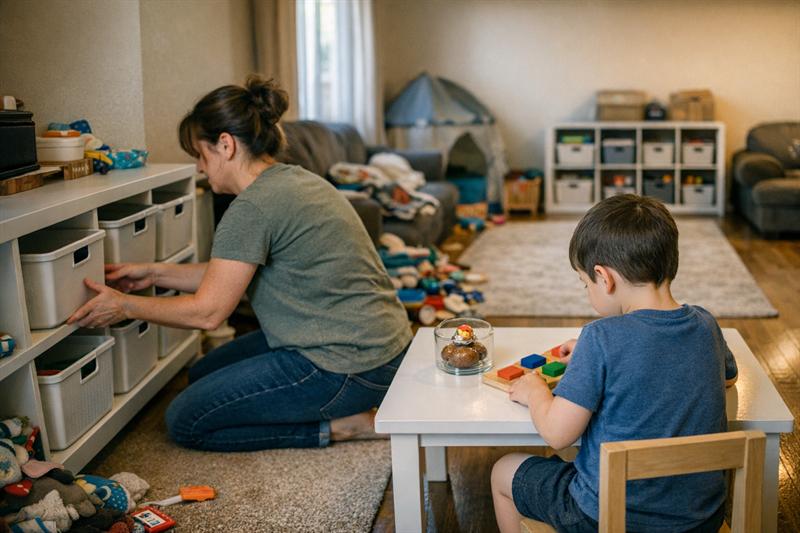
- Keep materials organized and easy to access
- Connect effort with clear, immediate reinforcement
When learning and play happen in the same space without structure, focus often drops. This can lead to incomplete tasks and increased avoidance.
Simple activities can reinforce structure. See ABA-based games that support learning at home for practical ways to build engagement into these spaces.
Common Mistakes in ABA Home Setups
- Relying on verbal instructions instead of visual structure
- Keeping spaces cluttered or overstimulating
- Changing layouts too often
- Making reinforcers hard to access or using them inconsistently
When behavior does not improve, many parents respond by giving more instructions. If the environment stays the same, the problem often continues. Over time, that can lead to more prompting, more frustration, and less independence.
How to Identify Environmental Triggers at Home
What to Look For
- Behavior increases during transitions
- The space feels noisy, crowded, or visually busy
- Needed items are hard to access or unclear
Small Changes That Reveal Big Insights
Change one element at a time. Adjust the layout, simplify a space, or change how items are presented. When behavior shifts after a small change, it can point to what was influencing the issue.
Tracking patterns helps make this clearer. Learn more about using behavior tracking at home to see what is actually influencing behavior day to day.
If you are seeing the same behavior patterns over and over, the environment may be a key factor.
- Your child does well in structured settings but struggles at home
- You are repeating the same instructions throughout the day
- Transitions quickly turn into resistance or meltdowns
- Rewards stop working or feel inconsistent
When these patterns show up together, it may be time to take a closer look at how the environment is set up and what could be missing.
When to Seek Professional Guidance
If environmental changes are not improving behavior, important variables may still be unclear. This is often where progress stalls.
One common pattern is trying multiple strategies without a clear understanding of what is driving the behavior. Without that clarity, changes often stay inconsistent and results do not last.
A structured assessment can help clarify what is influencing behavior and how the environment may be contributing. For a breakdown of this process, see what happens during an ABA assessment.
Key Takeaways
- Behavior at home is strongly shaped by the environment
- Routines are harder to maintain when the environment is unclear
- Small changes in setup can reduce ongoing challenges
- Repeated patterns often point to gaps in structure or consistency
Conclusion
When behavior feels inconsistent at home, the problem is rarely effort alone. Often, it is the setup. Without clear structure in the environment, expectations stay unclear, and behavior becomes harder to guide.
That can lead to more correction, more stress, and less independence over time. When those patterns continue, they can become part of the daily routine.
Strive ABA Consultants LLC works with families to identify what may be contributing to these challenges. Through evaluations and re-evaluations, the focus is on understanding how the home environment is influencing behavior and what changes may help.
If behavior at home is not improving despite consistent effort, the next step may be getting clearer answers and a plan that matches what is actually happening in your child’s environment.
Frequently Asked Questions
What is an ABA-friendly home environment?
An ABA-friendly home environment is structured so expectations are clear and easy to follow. It uses layout, organization, and reinforcement to support behavior. Reviewing your current setup can help identify where confusion may be happening.
How do I set up my home for ABA therapy?
Start by organizing spaces, adding visual structure, and making expectations visible. These changes can reduce the need for repeated instructions. Focusing on one room at a time keeps the process manageable.
Can changing the home environment reduce autism behaviors?
Changes to the environment can reduce some behavior challenges when triggers are tied to layout, access, transitions, or overstimulation. Adjusting structure and consistency often makes patterns easier to understand and support.
What are antecedent strategies in ABA at home?
Antecedent strategies focus on what happens before behavior. This includes how the environment is set up and how expectations are shown. When used well, they can reduce the need for correction later.
Do I need special equipment for an ABA home setup?
No. Most improvements come from organizing and simplifying what is already in the home. Clear spaces and accessible items usually have more impact than specialized tools.
Why does my child behave differently at home than in therapy?
Therapy settings are typically more structured and consistent. Home environments are often less predictable. That difference can affect how behavior shows up. Adjusting the home setup can help create more clarity and consistency.