

A parent who starts comparing formats usually has one goal in mind and three doors in front of it. The search terms alone suggest a contest: group work on one side, individual therapy on the other, and something called parent training off to the side as though it belonged to a different conversation. It is not a contest. The three formats differ in who is in the room and who delivers the practice, and that difference is what makes one of them the right next step for a particular social goal. The useful question is narrower than which option is stronger. It is what this goal is missing right now.
Three Formats, Three Different Questions
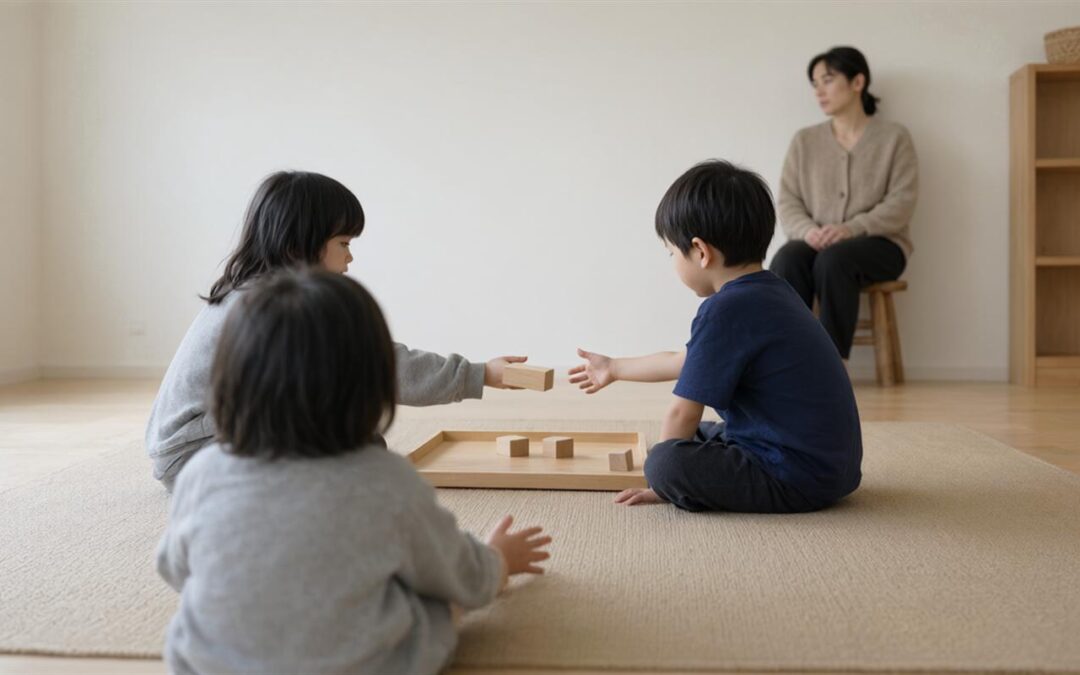
A social skills group places a child among peers with an adult at the edge of the room. One-to-one ABA puts a single clinician and a single learner together with a program written for that learner. Parent training changes the adult instead of the setting, so the caregiver learns to run the practice inside the family’s own routines.
Framed as social skills group vs one-to-one ABA, the question sounds like a choice between two rooms and two levels of intensity. Set parent training beside them and the frame loosens, because the third option does not compete for the same hour of the week. Each format asks something different of the child. One-to-one work asks for a response to an adult who is already watching for it. A group asks for a response to someone who did not plan to be a teaching partner. Parent training asks for the same response on an ordinary evening, when nobody is keeping count.
The Missing Piece Test: Skill, Partner, or Routine
Before comparing formats, describe the goal in observable terms: what the child does, with whom, in what situation, and at what level of help. A goal written in that shape can be sorted in a few minutes, and the sort usually reads more reliably than a general impression of how therapy is going. The parts of a goal are worth knowing well enough to check, and how social skills goals are written and tracked in an ABA treatment plan walks through them line by line.
Three questions do most of the work. Can the child do it when an adult asks and not when a peer asks? Then the partner is the missing piece. Does it fall apart across settings and across people, including adults the child knows well? Then the skill itself is still being taught. Does it appear in a session and disappear at home with the same people? Then the routine is the gap. Most stalled goals answer one of those three questions, and the format follows the answer rather than the other way around.
What One-to-One ABA Can Do for a Social Goal
One-to-one ABA is where a component skill gets taught. A single clinician can hold one cue steady, count how many chances the child had to use the skill, and change the prompt inside the session when the response does not come. That control is hard to reproduce anywhere else, and it is why a greeting, a request, or a short exchange is often built in this format first.
It is also the format where the prompt level is easiest to see, which makes it the easiest place to be misled. A goal can look finished in one-to-one work while one adult quietly supplies most of the support: the question is asked in the child’s most familiar phrasing, the pause is longer than a peer would allow, the materials are already set out. A percentage without a prompt level beside it hides exactly that.
What a Group Adds That One Adult Cannot
A group supplies a partner who does not follow the script. Peers answer in their own words, at their own speed, sometimes over the top of each other. A group also brings an instruction addressed to several people at once, waiting that is not arranged around one child, materials that have to be shared, and a room where a response is visible to everyone in it. None of those conditions can be manufactured by a clinician and a learner in a quiet space.
That is the case for a group, and it is narrower than the case people often make for it. The value is the partner demand, not more hours of practice. A child who already has the skill with one adult and still has no peer to use it with is the clearest fit, and the readiness signals that suggest group practice is a good fit describe what tends to hold before that step works.
Social Skills Group vs Parent Training: What the Third Option Adds
Parent training is different in kind from the other two, because it changes who delivers the practice rather than where the child goes. The caregiver is the person at the door when a guest arrives, at the table when a meal starts, and at the edge of a birthday party when it is time to leave. Those moments are where a social goal either holds or quietly comes apart, and no session schedule can cover them all.
Read as social skills group vs parent training, the comparison is not about which one produces more progress. It is about which adult and which setting the goal has to survive in. Parent training is not a class and not a support group, and it does not replace direct teaching; it is the format that puts the routine, the cue, and the follow-through into the hands of the person who is there at six in the evening. What ABA parent training covers in scope and format is worth reading before a family decides it is the missing piece.
When to Start Social Skills Group ABA Support
Timing questions deserve an answer tied to one goal rather than a general rule about age or diagnosis. Families who ask when to start social skills group ABA support are usually asking whether a group is the missing piece or simply another appointment in a full week. Two conditions make the answer easier to read. The skill holds with one adult at a prompt level that has come down, and nearly every opportunity to use it involves a peer.
The reverse case matters just as much. When a skill runs well in a group and disappears at home, the group is not the missing piece and a second group will not supply it. When a child has never shown the skill with anyone, a group asks for something that has not been taught yet, and the first weeks tend to produce participation rather than practice. A team that reads the current data can usually say which of those shapes a family is in.
Combining Formats Without Overloading the Week
Formats stack, and the week does not stretch. A workable rule is that one format owns each goal, and a second format earns its place when a different person acts on that goal. A group owns the peer greeting; parent training owns the same greeting at the front door; one-to-one work owns the version of it that is still being taught. Written on one line with a name beside each row, the arrangement is easy to check and easy to change.
The failure shape is three formats carrying the same goal in three rooms. It looks like intensity from the outside and behaves like duplication from the inside, with three adults prompting the same response in three different ways and no single record of which one is working. A goal that appears twice in a week under two formats is worth a question before it becomes a habit.
When the Format Is Not the Problem
Three ordinary patterns explain most goals that stall after a change of format. The goal stalls in a group because the component skill was never solid enough to survive a peer’s timing. The goal runs in the group and vanishes at home because no routine carries it past the front door. The goal never had a partner in it at all, because it was written for a child performing alone.
Each pattern points somewhere different, which is why changing formats at random tends to cost months. There is a fourth case worth naming: a goal that cannot be observed, such as a child becoming more social, gives no one anything to count. That is a plan conversation rather than a format question, and it is usually settled before any enrollment decision is made.
Questions to Ask Before Adding a Second Format
Questions sorted by the goal rather than by the format tend to surface an answer faster. The five below are worth writing down before a second service is added.
- Which single goal will this format own, in words that describe what the child does?
- Who delivers the practice in this format, and who is present when the skill is actually needed?
- Where does the skill have to hold: a group room, a classroom, a store, or the family’s kitchen?
- What will the measure show, and at what prompt level?
- When will the team read that measure together and decide whether the format stays?
Key Takeaways
- A goal that names no partner and no setting cannot be sorted into a format yet.
- Prompt level is the detail that separates a finished goal from a supported one.
- The person present when the skill is needed is the person a format has to include.
- Two formats carrying one goal usually means one of them is duplicating the other.
- Format choice is revisited with data, not settled once at enrollment.
Conclusion: Getting Support in Place
Strive ABA Consultants LLC provides applied behavior analysis services in Oak Forest, Illinois; Chicago, Illinois; and Merrillville, Indiana. Support ranges across ABA therapy and social skills groups, parent training and family support, counseling, life skills training, and diagnostic evaluations for families who suspect a child may be on the autism spectrum. Insurance and financial assistance pathways are reviewed with each family, and transportation support is confirmed rather than assumed. Families weighing a group, one-to-one work, or parent training can request a callback, book an appointment, or send a message to talk through the goal itself.