

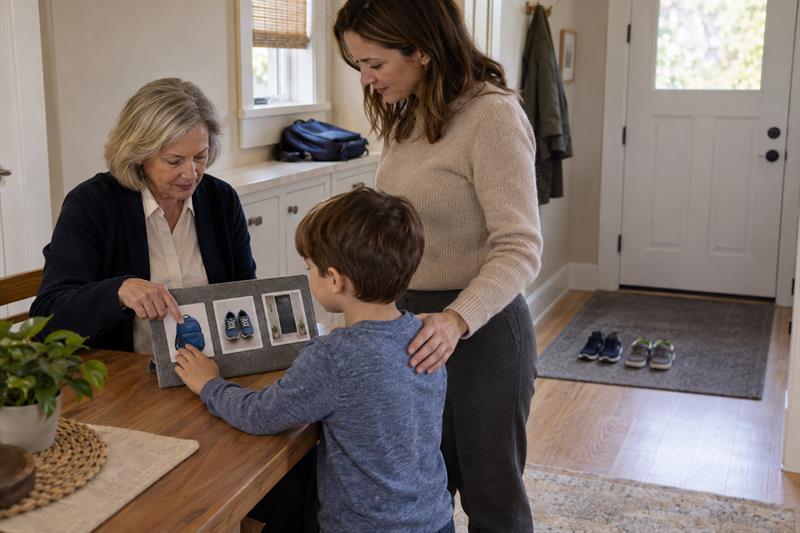
Most guidance about caregivers in ABA is written for the one-off evening. A sitter covers dinner, an aunt takes an afternoon, someone receives the routine and hands it back. A different arrangement grows quietly in many households. A grandparent picks up from school every Tuesday. A retired uncle holds the after-school hour four days a week. A grown sibling stops by most mornings. These adults are not filling a gap in the week; they are part of how the week runs, month after month, and the help they give has a shape that a handoff note does not quite describe.
A Standing Caregiver Is Not a Longer Visit
The difference between a substitute and a standing caregiver is not the number of hours. It is the horizon. A substitute holds a routine for a defined window and gives it back, which is why the tool built for that situation is short and portable; the respite and substitute caregiver handoff checklist is written for exactly that window. A standing caregiver repeats the same hour for months, so the routine stops being something they were told and becomes something they carry. Over time, their version of it becomes the household’s version.
That accumulation is the value and also the exposure. A substitute who improvises affects one evening. A standing caregiver who improvises affects every Tuesday between now and next spring, and the change is rarely visible while it happens because it arrived a few seconds at a time. Nothing about the role is passive. The adult is learning the child while the child is learning the adult, and both of those keep moving.
What Grandparents Helping Child with ABA Usually Take On
Grandparents helping child with ABA routines usually hold one or two specific slots rather than a broad share of the week. The slot might be a school pickup, the hour between the bus and dinner, one bedtime a week, weekend mornings, or a standing appointment that falls on the same day each month. What makes the role real is the repetition rather than the title. A relative who reliably holds one hour is more useful to the household than one who has been briefed on everything and holds nothing.
That is also why the label matters less than families expect. Whether the adult is a grandparent, an aunt, a neighbor who has become family, or a consistent household member, the question the plan has to answer is the same: which part of the week belongs to this person, and what does the child get from them during it? Answer that narrowly and the role holds. Answer it vaguely and the adult ends up improvising a whole evening.
A Family Caregiver ABA Routine Is Built From Slots
A family caregiver ABA routine is easier to keep when the household stops describing it as help and starts describing it as a slot. A slot has four parts: a start, a sequence, an ending, and a handback. The start is a time and often a signal, such as a car in the driveway or a bag set by the door. The sequence is the two or three steps the routine actually contains, in order. The ending is what closes it. The handback is the sentence that names who has the child next.
The ending is the part households leave out, and it is the part that decides whether the arrangement survives. A slot with no stated ending expands. The pickup becomes the afternoon, the afternoon becomes dinner, and the caregiver is running an evening that was never agreed to. Writing the slot down keeps most of that drift from starting, and a one-page support plan for home, school, and caregiver use is enough of a record, provided it names the ending as clearly as the start.
Where Extended Caregiver ABA Support Starts to Drift
Extended caregiver ABA support drifts in three recognizable ways, and all three are ordinary rather than alarming. The first is prompt creep. A caregiver who begins by waiting for the child to start begins, weeks later, to hand over the toothbrush, then to guide a hand, then to do the step. Each choice is small enough to justify in the moment. Together they turn a routine the child could run into one the adult runs.
The second is widening. An adult agreed to one bedtime and is now doing bath, teeth, story, and lights out, because each addition looked like a small favor at the time. The third is substitution. The caregiver finds a way that works better on a hard day, keeps it, and within a month the household has two versions of the same routine and no record of when the second one started.
None of this means the caregiver is doing it wrong. Drift is what happens when a capable adult meets the same problem every week without a review loop. The adaptations are often sensible, and some are better than the written plan. The difficulty is that nobody can see the change while it is happening, because it never arrives as a decision. It becomes visible when someone compares the routine as it runs to the routine as it was written down.
The One Decision a Standing Caregiver Should Not Absorb
A standing caregiver needs room to decide inside the slot. When to pause, when the routine has gone far enough for one day, how to word a prompt, whether to finish the last step or leave it: those are judgments only the adult in the room can make, and a caregiver who has to check on each one will stop using their own read of the child.
A change to a goal, a prompt level, the plan, or the schedule is a different kind of decision, and a standing caregiver should not absorb it however sensible the change looks. Those calls belong to the family and the clinical team, and the boundary usually erodes without an argument. A caregiver quietly adjusts something because it seemed obviously right, and the adjustment becomes the plan. A family care team map that names who owns each decision keeps that from becoming a household grievance six months later.
The Caregiver’s Own Hours Are Part of the Plan
A recurring slot is a commitment made by an adult with a life of their own. Grandparents age, family helpers work, and the person covering Thursday afternoons may be caring for someone else the rest of the week. A household that reads the slot as free labor tends to lose it without a conversation, when the adult simply becomes less available and stops explaining why.
Naming the size of the offer out loud keeps most of that from happening. One reliable hour is a complete offer, and saying so gives a caregiver room to decline a second hour without withdrawing from the first. It also gives the household something it can plan around, which is worth more than a vague willingness to help that cannot be scheduled.
A Monthly Ten-Minute Review
The drift described above is not corrected by a longer conversation. It is corrected by a short one that happens on a schedule. Ten minutes a month, held by whoever owns the slot and one parent, is enough. The point is not to evaluate the caregiver. It is to put the hour as it currently happens beside the version that was agreed, and then settle on one change.
Five questions cover most of what the review needs to surface:
- Which part of this slot went differently than planned?
- Has anything been added to the routine since last month?
- Is the child doing more steps alone, or fewer?
- What did the caregiver have to work around this month?
- What is the one change worth making now?
Write the answer to the last question down and leave the rest alone. One change per month is easier to read at the next review than five are, and it keeps the household from redesigning the routine around a single bad week.
When the Routine Needs the Team, Not Another Conversation
Some problems are bigger than the slot. Three signals are worth reading as a handoff back to the clinical team: the same slot breaks down for two or three weeks running, the child’s independence in that routine is dropping rather than holding, or the adults no longer agree on what the routine is for. At that point another set of house rules adds a fourth version of the routine instead of resolving anything. A conversation with the clinical team, and a plan review if the goals themselves have moved, is the shorter route.
Key Takeaways
- An arrangement that repeats for months is a different thing from a visit, and it needs its own rhythm of review.
- Naming the hours, the steps, and the stopping point is what turns regular help into a role someone can hold.
- Prompt creep, a widening routine, and a quiet second version of the plan are the three changes worth watching for.
- The adult in the room decides the moment; the family and the supervising clinician decide the plan.
- A ten-minute review once a month, with one change, keeps a long arrangement readable.
Conclusion: Getting Support in Place
Families in Oak Forest, Illinois; Chicago, Illinois; and Merrillville, Indiana can reach Strive ABA Consultants LLC for ABA therapy, diagnostic evaluations for families who suspect a child may be on the autism spectrum, parent training and family support, counseling, life skills training, social skills groups, and consultation. Transportation support is handled as access help, with availability confirmed for each family rather than assumed, and insurance and financial assistance pathways are reviewed case by case. When a household is working out which adult holds which part of the week, the next step is a conversation: make an appointment, send a message, or request a callback.