

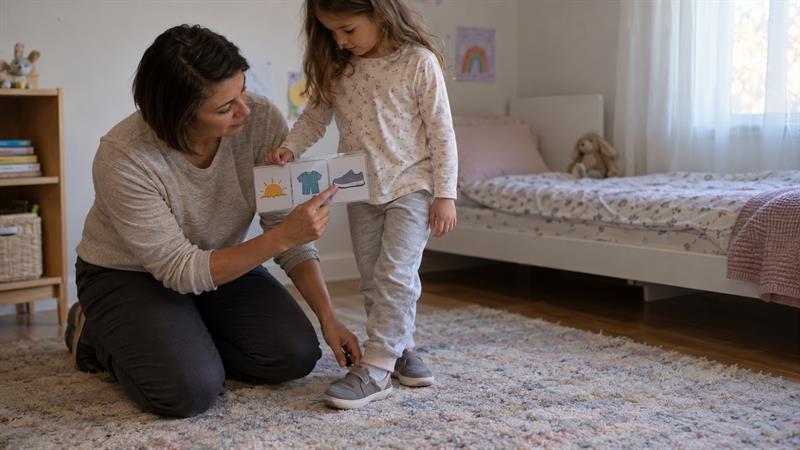
Somewhere between the evaluation and the first month of sessions, a parent hears a sentence that sounds simple: parent training is part of the plan. What follows is usually a quiet set of questions. Is this a class? A support group? Another appointment in a week that is already full? The answer is more contained than most families expect. Parent training is a defined service with its own scope, its own formats, and its own work between visits. This guide separates those three pieces so a family can tell what they are agreeing to before the schedule fills up.
A Plain Definition of ABA Parent Training
In plain terms, ABA parent training is coaching for the adults who spend the most time with the child. It comes from the child’s own ABA team, and it aims at the routines the child already lives in: the morning that stalls, the transition into the car, the bedtime sequence that keeps restarting. The person being taught is the caregiver. The subject is the routine.
Two boundaries are worth stating early, because most confusion about the service comes from them. Parent training is not the child’s direct therapy session. The one-to-one teaching that belongs to the clinical program stays where it is, and coaching the caregiver does not replace it. It is also not counseling for the adult. Counseling addresses the caregiver’s own stress, roles, and decisions, while parent training stays on the mechanics of a routine and the skills a child is learning. Families sorting out where one ends and the other begins can find a workable split in keeping counseling and ABA roles separate.
What remains is a service with a narrow, practical goal: the routine has to hold when the therapist is not in the room. Everything else in parent training follows from that.
What Stays With the Child’s Direct Program
The clinical team keeps the child’s goals, the teaching procedures, the data collection, and the updates to the plan. Those parts are not handed to the family to manage, and they do not change because a caregiver had a hard week. What moves is the carryover: the same goal practiced inside the routine the family actually has, using the words and cues the team already uses.
The split is not a hierarchy. It is a division of labor that keeps two kinds of expertise separate. A BCBA knows the teaching technology and reads the data. A parent knows which fifteen minutes of the day are unbearable and which one can be worked on this month. Parent training is where those two kinds of knowledge meet. For a fuller picture of who holds which role, an overview of ABA therapy roles and daily support goals lays out the team structure.
One consequence is worth naming: a caregiver is not expected to design the program. Being asked to practice a step is different from being asked to invent the plan.
What Parent Training for Autism Families Usually Covers
Parent training for autism families is usually built around the routines that are already difficult, not around a fixed curriculum. That is the practical difference from a class. There is no week-three syllabus. The starting question is narrower and less comfortable: which skill sets are missing, and which missing skill is holding the routine together or pulling it apart.
Once that question has an answer, the strategy gets explained before anything changes at home. A caregiver should be able to say what a step is for, what it looks like when it is working, and what to do when it is not, before the first practice attempt. The subject matter tends to cluster into a few areas:
- Social skills. Setting up a short, repeatable exchange with a sibling or a peer, and prompting it without taking it over.
- Visual schedules. A sequence the child can see and point to, used where a spoken instruction has stopped landing.
- Lists and checklists. Written steps for a routine that has too many parts to hold in memory.
- Shaping and chaining. Teaching a new step in small pieces, or linking steps in the order the routine runs.
The list is not a menu to work through in order. A single routine usually borrows one or two of these, and the rest stay in reserve.
How the Format Follows the Routine
The setting for parent training should be chosen from where the routine happens, not from what fits a calendar. That one rule settles most format questions.
When the routine breaks down at home, in-home coaching puts the coach in the room during the actual sequence. The value is context a written report never carries: the missing shoe, the sibling at the table, the television nobody turned off. Clinic-based meetings suit a different task. Reviewing data, rehearsing a step without an audience, and talking through a decision are often easier in a quiet room. Telehealth and hybrid arrangements handle review sessions well, and they can reach a second household, a grandparent, or a caregiver who cannot travel. When the hardest part of the day sits inside the school schedule, collaboration with school staff belongs in the plan.
Programs are tailored to the family’s needs rather than issued in one shape, and the arrangement is usually settled during consultation or service planning. It is reasonable to ask at that stage which format is being proposed and why.
The decision rule stays simple enough to apply without help: coach where the routine happens, and review where it is quiet.
What to Expect in ABA Parent Training, Session by Session
What to expect in ABA parent training is easier to answer when the first meeting is described as a working session rather than a class. A session usually opens on one specific moment rather than a general topic. The team may watch it happen, or ask for a walk-through of the last time it went wrong. Then a step is modeled, and the caregiver rehearses it.
The rehearsal is the part families remember, because it is the part that feels unfamiliar. Practicing a bedtime sequence with an adult playing the child is awkward for about two minutes and useful for the rest of the month. The session usually closes on two items: one practice to run before the next visit, and one question to bring back. That pairing keeps a week from turning into a performance review. If the practice does not happen, the question still works, and the next session adjusts around it.
The caregiver also holds a decision the clinical team cannot make: which routine is worth the effort right now. Some routines can wait a season. A household with a new baby, a move, or a shift change is allowed to say so.
Building Home Routine Support One Step at a Time
Home routine support gets easier to run once a family stops trying to rebuild the whole day. The first move is selection. Pick the single routine that breaks down most often, and prefer one with a clear beginning and end. Getting out the door is a routine. Having a better morning is not.
Break the chosen routine into steps a person could watch and count. Then teach one step at a time, and let the other steps stay as they are for now. A visual schedule or a short checklist belongs where steps get skipped, not on every wall in the house. The practice window should be short and land at the same time each day, because a routine is learned in the conditions it will be used.
Bad weeks are normal and worth planning for. The useful response is to shrink the routine rather than abandon it: keep the first step and the last, drop the middle, and return to the full sequence when the week settles. A routine that survives a bad week is worth more than one that ran perfectly for six days and then vanished.
Handing the Routine to Grandparents, Sitters, and After-School Caregivers
A routine that lives in one adult’s memory drifts the moment someone else runs it. The working version has to be written down in a form another adult can hold, which is why a one-page ABA support plan for home and replacement caregivers is worth setting up before a handoff rather than after one goes badly.
What belongs on the page is narrow: the routine, its steps, the words or cues the child responds to, what to do when the sequence stalls, and who to ask. What does not belong is the clinical file. A grandparent does not need the assessment history to run a bedtime sequence. A sitter does not need the data sheets to know which cue starts it.
The page should also carry a date and be updated when the routine changes. A stale page is worse than no page, because it gets followed with confidence and produces a version of the routine nobody planned.
How to Tell Carryover Is Happening
Carryover shows up in small changes that are easy to miss on a single evening and hard to miss over a month. The child begins a step with fewer reminders. A second adult runs the same sequence and reports the same order. The routine recovers after a hard day instead of collapsing. The written page stops being consulted for that one routine.
None of these is a score, and none of them means the work is finished. They are signs that a routine has moved out of the therapy session and into the household, which is the purpose of the service.
Progress reviews are where those signs get checked against the data. Questions worth bringing: which routine was the focus, is it running on the days the practice happened, what changed when it did not, and which routine should come next. A review that covers only the child’s percentage scores tends to miss the part a family can act on.
Getting Support in Place in Oak Forest, Chicago, or Merrillville
Strive ABA Consultants LLC provides ABA services to families in Oak Forest, Illinois, Chicago, Illinois, and Merrillville, Indiana. Service options include ABA therapy, diagnostic evaluations for families who suspect a child may be on the autism spectrum, parent training and family support, counseling services, life skills training, social skills groups, and consultation.
Transportation support is offered as access help, and availability is confirmed for each family rather than assumed. Insurance and financial assistance pathways exist as well, with eligibility confirmed per case. Families who would like to make an appointment, send a message, or request a callback can reach the main office at (773) 589-4667.
Key Takeaways
A few points are worth carrying into the next conversation with the team.
- Parent training coaches the adults, while the child’s direct sessions stay with the clinical team.
- The plan’s goals, data, and updates are not the caregiver’s to manage.
- The routine decides the format: coach where it happens, review where it is quiet.
- One routine, one step, and one practice at a time hold up better than a full overhaul.
- The written page is what keeps a grandparent, sitter, or after-school caregiver consistent.