

Introduction
The important question is not just whether a task happened, but what helped it happen. A spoken reminder, a pointing gesture, or an adult standing beside the right item can affect how a completed task should be understood.
For families considering Strive ABA Consultants LLC, this distinction is worth bringing into conversations about support. A progress note that says “completed the routine” does not explain independence unless it also makes clear what assistance was involved.
Prompting in ABA means adding help during teaching. Prompt fading means adjusting that help so the learner has appropriate opportunities to respond to the intended cue. The goal is useful participation, not removing assistance as quickly as possible. Understanding the difference helps families discuss progress without assuming that every support needs to disappear.
Key Takeaways
- Prompts are extra teaching assistance, such as an added reminder, gesture, or demonstration.
- Completing a task with a prompt is different from responding independently under the conditions defined for that skill.
- Fading decisions should follow patterns across learning opportunities, not a fixed number of sessions.
- Communication devices, visual schedules, and other accommodations do not need to disappear to make progress meaningful.
What Is Prompting in ABA?
A prompt in applied behavior analysis, or ABA, is assistance added to help a learner respond during teaching. It provides information beyond the intended cue that should guide the skill in everyday use. A teaching plan should explain both the assistance being used and how the team will review and adjust it.
Natural Cues, Extra Help, and Independent Responses
A natural cue signals when a skill is relevant; a prompt adds help with responding. An everyday instruction can be the intended cue, so not every spoken direction is a prompt.
Consider this hypothetical example:
- Natural cue: A family member says, “Put your bag away,” as part of the usual arrival routine.
- Added prompt: The family member points to the hook.
- Learner response: The learner hangs up the bag after the gesture.
The task was completed with a gestural prompt. That is useful information, not a failure. It identifies the assistance provided and distinguishes this response from hanging up the bag after the instruction alone.
Types of Prompts Families May Notice
Common prompt categories include verbal, gestural, model, visual, and physical prompts. These describe forms of assistance, not a universal ladder that every learner should follow. Terminology varies, and a prompt’s usefulness and intrusiveness depend on the person and task.
Verbal, Gestural, Model, and Visual Prompts
- Verbal prompt: Added spoken information, such as saying “On the hook” after the original instruction to put a bag away.
- Gestural prompt: A movement that directs attention, such as pointing toward the hook.
- Model prompt: A demonstration of the action, such as showing how to hang up another bag.
- Visual prompt: Added visual information, such as temporarily highlighting the relevant hook.
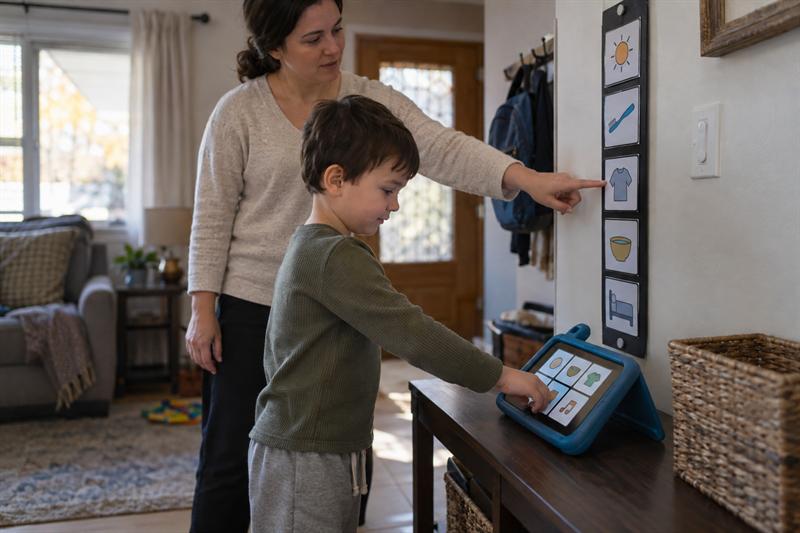
A visual support is not automatically temporary. Highlighting a location during teaching and providing a schedule someone independently consults serve different purposes. The plan should identify the tool’s role before deciding whether to change it.
Physical Prompts Require Additional Care
Physical prompts involve bodily assistance and require particular attention to autonomy, consent, and assent. Assent refers to the learner’s indications of willingness to participate, including nonverbal signals, and should be considered throughout teaching.
Physical assistance should not become a default response to hesitation. Distress or resistance calls for reassessment, not forced movement or physically compelled communication. Decisions about hands-on assistance should include consideration of less intrusive alternatives and clear guidance from the ABA team.
How Prompt Fading Works in ABA
Prompt fading systematically changes added teaching assistance so the intended cue can guide responding. Depending on the plan, this involves reducing aspects of a prompt, changing when it occurs, or adjusting the assistance used across learning opportunities.
A teaching problem can develop when help consistently arrives before the learner has an appropriate opportunity to respond and the plan does not address reducing that help. Task completion then reveals little about what would happen with less assistance. A fading plan makes those opportunities deliberate rather than leaving them to guesswork.
Most-to-Least and Least-to-Most Prompting
- Most-to-least prompting: Teaching begins with a level of assistance selected to support the response, then moves toward less assistance as responses support the change. “Most” does not mean automatically starting with physical prompting.
- Least-to-most prompting: The learner receives an opportunity to respond with little or no added assistance before more help is provided as needed within the plan.
Least-to-most prompting describes how help is added when needed; it is not a universal fading sequence. Neither approach is best for every task. Selection should reflect the skill, learning history, support needs, and the learner’s response to the procedure.
Time Delay and Changes to the Prompt Itself
Time delay changes the interval between the intended cue and the prompt. Other adjustments change the prompt itself, such as making a pointing gesture less pronounced.
For example, a plan might introduce an opportunity to respond before the pointing gesture occurs. There is no universal waiting interval. Waiting should not mean withholding necessary help during distress or an unsafe situation.
When Should Support Be Reduced in ABA?
Support should be reduced when the individualized teaching plan and observed responses support trying less assistance. Decisions should consider performance across opportunities, comfort, task demands, and what happens when help changes. One successful attempt or the passage of time alone does not establish readiness.
What the Team Looks for Across Learning Opportunities
The team needs information about both the response and the conditions that supported it:
- Accuracy: What happens with the current level of assistance?
- Reduced assistance: What happens during planned opportunities with less help?
- Initiation and timing: Does the learner start in response to the intended cue, and how much time do they need?
- Comfort and participation: Are there signs of willingness, confusion, distress, or disengagement?
- Task and context: Have materials, instructions, people, or surroundings changed?
- Recording: Are prompted and independent responses distinguished in progress information?
When independence is the goal, combining prompted and independent responses without explanation makes progress difficult to interpret. Understanding what makes a strong ABA treatment plan helps connect changes in assistance to a useful outcome, rather than treating “less prompting” as the entire goal.
When to Review the Plan Rather Than Push Ahead
Increased errors, distress, or disengagement after assistance changes are reasons to review the plan, not proof that the learner needs to try harder. The task may have become more demanding, the cue may be unclear, or the change in assistance may need adjustment.
Repeating the same approach without examining those changes can prolong difficulty without clarifying its cause. Restoring or changing assistance is not automatically lost progress. The decision should reflect what the learner is experiencing and what the observations show.
Bring unclear prompting patterns into the next progress discussion. A focused review is warranted when:
- Progress notes report completion without describing the help provided.
- The same added reminder precedes the response across comparable opportunities, with no clear explanation of the fading plan.
- Errors, distress, or disengagement increase after support is reduced.
Before reducing assistance further, clarify the intended cue, current prompt, and criteria for changing support with the ABA team.
What Prompted and Independent Progress Can Look Like
The same finished task can involve different levels of assistance. In this hypothetical bag routine, the intended cue is the usual instruction, “Put your bag away.” These examples illustrate differences, not a recommended treatment sequence.
- Completion after a model: An adult demonstrates hanging up a bag, and the learner then hangs up theirs. A demonstration was provided as added assistance.
- Completion after a gesture: The learner hangs up the bag after the adult points to the hook. A gestural prompt was provided.
- Completion after the intended cue: The learner hangs up the bag following the usual instruction, without the additional model or gesture. This is independent relative to the defined cue and conditions.
The third example does not establish mastery across every setting. It shows what happened under one set of conditions. That distinction keeps progress discussions specific and expectations realistic.
Why Different People or Places Can Change Support Needs
Using less help in one routine is different from using a skill across people and places. A different entrance, unfamiliar hook, or changed instruction alters the information available to the learner.
A transfer problem can be overlooked when success in one arrangement is assumed to mean the skill will work everywhere. Generalization means using the skill across relevant conditions; maintenance means continuing to use it over time. The ABA generalization checklist for parents can help address that broader question of transfer. One difficult day in a changed setting does not, by itself, establish regression.
Prompt Dependence or a Support That Should Stay?
Prompt dependence describes a pattern in which responding continues to rely on added prompts rather than the intended cue. Waiting for help once does not establish that pattern.
If responding repeatedly begins only after the same added reminder under comparable conditions, the reminder’s role needs examination. That observation does not identify the cause by itself. Unclear cues, processing needs, task difficulty, and discomfort also matter. Removing the reminder without understanding the situation does not address those possibilities.
Communication Tools and Accommodations Are Not Failures
Independence can include using appropriate tools and accommodations. Augmentative and alternative communication, or AAC, provides communication access; the communication system itself should not be treated as a temporary teaching prompt.
An adult pointing to each next step on a schedule is different from a learner independently checking that schedule. Similarly, prompting someone to use a communication system is different from providing access to the system. Added teaching assistance can be reviewed without removing the tool.
Treating every support as something to eliminate confuses accessibility with dependence. The goal is meaningful participation and effective use of support, not doing everything without assistance.
Questions Families Can Ask About the Fading Plan
Ask for an explanation that connects the goal, current assistance, and reason for the next change. A list of prompt names does not explain how a teaching decision is being made.
- What useful skill is being taught, and what cue should eventually guide it?
- What prompt is being used right now?
- How are prompted and independent responses recorded separately?
- What observations would support trying less assistance?
- What signs would lead the team to pause or change the plan?
- Which communication tools or accommodations should remain available?
A simple observation structure keeps the conversation concrete: “What happened first? What help was added? What happened next?” Families do not need to turn every routine into a data-collection exercise. A clearly described example gives the ABA team more context than a broad statement that someone “always needs help.”
A focused conversation with Strive ABA Consultants LLC: Bring the routine and the assistance you noticed, rather than a general request for less support. Keep questions about an existing teaching plan separate from broader questions about autism evaluation or reevaluation. Reviewing a prompt-fading procedure and completing a diagnostic evaluation address different needs.
Frequently Asked Questions About Prompting in ABA
Is a verbal instruction always a prompt in ABA?
No. A spoken instruction may be the intended cue for a skill, while an added reminder functions as a prompt. For example, “Put your bag away” could be the planned instruction; an additional “On the hook” supplies extra help. The distinction depends on the goal and context.
How long does it take to fade prompts?
There is no universal timeline. The skill, learning history, support needs, and responses across opportunities all matter. Completing a task once with less help is different from doing so consistently in the relevant routine. Fading decisions follow that pattern, not simply how many sessions have passed.
Does waiting for a reminder mean my child is prompt dependent?
Not necessarily. Waiting can also reflect unclear cues, processing needs, task difficulty, or discomfort. A pause after an unfamiliar instruction does not establish dependence on reminders. What matters is whether responding repeatedly relies on added assistance under comparable conditions, rather than whether hesitation happened once.
What if my child struggles when a prompt is reduced?
Difficulty is a reason to review the change in assistance, task demands, or context; it does not automatically mean a skill has been lost. Note what changed and whether errors, distress, or disengagement increased. Those details help the team investigate the difficulty rather than treating every unsuccessful attempt as the same problem.
Should parents use the same prompts as the therapist at home?
Not necessarily in exactly the same form. A home routine may involve different cues or materials, so consistency means following an agreed approach rather than copying every clinic detail. If the home plan is unclear, request a demonstration for that routine, including what assistance to give and when.
Does needing a visual schedule or AAC mean someone is not independent?
No. Independently using a visual schedule or AAC can itself be a meaningful skill. Consulting a schedule without an adult reminder differs from needing an adult to prompt each step. The relevant question is how the person uses the support, not whether the support exists.
Conclusion: Understand the Plan, Not Just the Completed Task
Contact Strive ABA Consultants LLC with one specific routine and the assistance involved to discuss the appropriate next step for your family. The problem is not that help exists; it is that unclear descriptions make progress difficult to interpret. Without that distinction, families risk expecting too much too soon or overlooking opportunities to adjust teaching support.
For an existing ABA plan, bring three questions to the ABA team: What prompt is being used? How is independence recorded? What observations would support changing assistance? Clarifying these points before support changes is more useful than guessing whether to help more or less. Learning what parent training in ABA therapy includes also explains how caregiver guidance fits alongside the plan.