

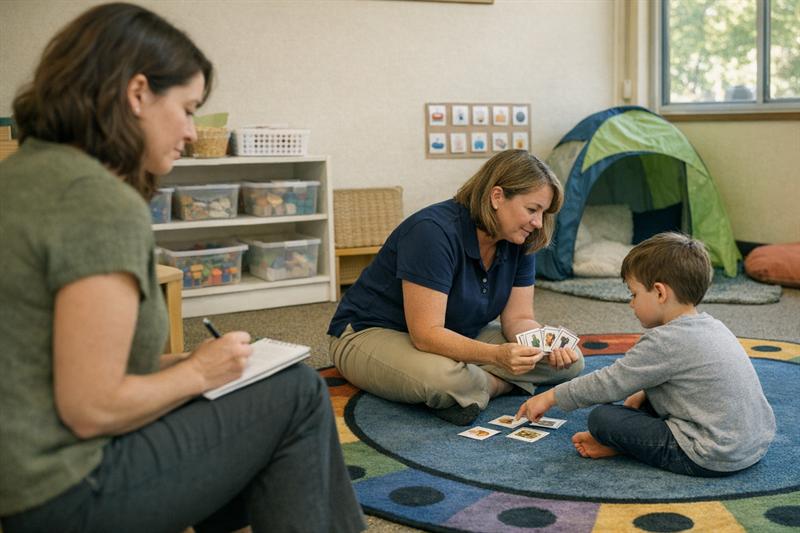
Quick Answer: A school or care program may benefit from behavior consultation when the same concerns keep disrupting routines, participation, staff consistency, or communication with families. The issue is often not one difficult moment or one child. It is a repeated pattern that the team needs to understand and address with a shared, workable support approach.
Behavior consultation for schools gives teams a structured way to examine what is happening during daily routines, identify where support is breaking down, and build responses staff can use consistently. Strive ABA Consultants LLC approaches these concerns by looking beyond an incident to the conditions that may be contributing to the pattern.
Key Takeaways
- Repeated concerns during the same routines can point to a need to review the environment, communication, expectations, and staff responses.
- Behavior consultation supports school or care-program systems, while individual ABA therapy and autism evaluations serve different purposes.
- Useful consultation recommendations fit the setting and can be carried out during real routines.
- When staff respond differently, families receive mixed messages, or support depends on one person, the program may need a shared behavior-support process.
Behavior Challenges Are Not Always an Individual Child Problem
When a child struggles repeatedly during a routine, the focus often stays on the child’s behavior. That can miss an important part of the picture. The routine itself, how directions are given, available communication supports, task demands, staffing changes, and adult responses can all affect what happens next.
A common pattern is that staff are working hard, but each person uses a different response. The child receives inconsistent cues, the routine becomes less predictable, and the same concern returns. If that pattern is not addressed, staff frustration can grow and the child’s participation may become more limited.
- The concern occurs at a predictable time or during a specific routine.
- Several staff members respond differently.
- A strategy works only when one experienced staff member is present.
- The child’s participation is becoming more limited.
- Families and providers receive inconsistent information.
These signs do not establish a diagnosis or automatically mean a child needs individual ABA therapy. They can show that the program needs a clearer understanding of the pattern and a more consistent support system.
What Is Behavior Support Consultation?
Behavior support consultation is collaborative guidance that helps schools and care programs understand recurring behavior patterns and strengthen support during daily routines. ABA consultation services generally focus on what staff are seeing, when the concern occurs, what happens around it, and which changes are practical for the setting.
Consultation is not meant to be a generic behavior plan delivered from outside the program. It should account for the classroom or care environment, daily schedule, staffing structure, group needs, and responsibilities that shape the day.
A behavior consultation process may include:
- Clarifying the concern and identifying when it happens
- Observing relevant routines or transitions
- Reviewing existing support plans or available information
- Identifying environmental and communication supports
- Developing practical staff responses
- Coaching implementation and reviewing progress
Consultation does not replace emergency support, medical care, a formal diagnostic assessment, or individualized treatment when those services are needed. Its purpose is to strengthen the setting around the child so staff have a clearer, shared way to respond.
Signs a School or Care Program May Need Outside Behavior Consultation
The Same Concerns Keep Returning Despite Staff Effort
When staff have tried several strategies and the same concern keeps returning, repeating the same response more firmly may not solve the problem. This is where teams can become stuck: they keep reacting to the incident instead of examining the pattern around it.
A behavior consultant can help the team look at what occurs before the concern, what follows it, possible communication needs, and whether the routine requires skills or supports that are not yet in place. The next step is generally a structured review, not simply more consequences.
Behavior Concerns Occur During Specific Routines or Transitions
Arrival, departure, group instruction, meals, toileting, recess, activity changes, transportation handoffs, and staffing changes all place different demands on children and staff. When concerns cluster around one of these routines, the timing can provide useful information.
A child may manage well for much of the day but struggle when expectations change quickly or communication becomes less clear. If the team treats each incident as unrelated, the routine may stay difficult. Reviewing the routine as a whole gives staff a more useful starting point for support.
Staff Responses Are Inconsistent or Teams Feel Unsure What to Do
Inconsistent responses can create confusion. One staff member may redirect, another may remove a demand, and another may use a different prompt. The child may experience changing expectations, while staff can lose confidence because no one knows which response the team is expected to follow.
Strong behavior support gives staff clear, teachable actions for before, during, and after a difficult moment. This is not about blaming educators or caregivers. It is about replacing uncertainty with a plan that can work during a busy school or care day.
Current Strategies Depend on One Person Rather Than a Sustainable System
Many programs have one staff member who seems to know what works. That knowledge is valuable, but it becomes a weak point when it is not shared. Coverage changes, substitutes arrive, shifts rotate, and support may become less consistent when that person is absent.
This can lead to repeated setbacks and uneven expectations for the child. Consultation can help turn informal knowledge into a team-based approach that staff can understand, practice, and use across routines.
Behavior Is Affecting Participation, Safety, Learning, or Daily Care
Outside consultation can be especially useful when a recurring concern limits a child’s ability to join learning activities, participate with peers, complete daily-care routines, communicate needs, or move safely through the day. The goal is not compliance for its own sake. The goal is meaningful participation and access to routines with appropriate support.
If the pattern is left unaddressed, a child may lose access to instruction, activities, relationships, and predictable routines. Staff may also begin avoiding situations that need support, which can make the concern harder to address over time.
Families and Providers Are Receiving Mixed Messages
When school staff, caregivers, and outside providers use different language or approaches, the child may receive mixed signals across settings. This can make support harder to carry from one environment to another.
With appropriate family authorization and confidentiality practices, coordinated communication can reduce contradictions and clarify shared priorities. The article How Schools and ABA Providers Can Work Together More Effectively explains why collaboration is stronger when each setting understands its role rather than trying to duplicate another provider’s work.
What an ABA Consultation Process May Include
A strong consultation process starts with the setting as it is, not as people wish it could be. The consultant needs to understand the routine, staff capacity, existing supports, and the specific concern before recommending changes.
Listening to the Team and Defining the Concern Clearly
The first step is identifying what the team needs to improve. “Behavior is getting worse” is too broad to guide a useful plan. A clearer concern might involve difficult arrivals, unsafe behavior during transitions, limited participation in group activities, inconsistent staff responses, or communication breakdowns with families.
Defining the concern clearly gives the team a shared target. It also helps prevent the consultation process from becoming a collection of unrelated strategies.
Observing Routines and Identifying Patterns
Observation focuses on what happens around the concern. That includes the setting, task demands, communication opportunities, transitions, adult responses, and the sequence of events before and after a difficult moment.
One observation does not provide every answer. It can, however, give the team direct information about patterns that may be missed when people only discuss incidents after they happen.
Reviewing Existing Plans, Data, and Relevant Information
Existing classroom plans, staff notes, incident patterns, and authorized relevant records can show what the program has already attempted. This helps prevent the team from starting over and can distinguish a strategy that was not used consistently from one that does not fit the setting.
Information sharing should follow appropriate confidentiality and permission practices. The goal is to understand the support context, not to collect unnecessary details.
Creating Practical Recommendations for the Actual Setting
Useful recommendations fit the program’s real conditions. A plan that requires extra staff at every transition, lengthy documentation during active routines, or materials the team does not have may break down quickly.
Recommendations may involve clearer transition cues, visual supports, communication choices, routine adjustments, skill teaching, or more consistent staff responses. What matters is that the plan can be used during the moments when support is actually needed.
Coaching Staff and Reviewing Implementation Over Time
A written plan does not create consistency by itself. Staff need to understand what the plan means, how to use it under pressure, and what to do when the routine does not go as expected.
A program may receive a well-written recommendation, but the strategy may not be practiced, reviewed, or adjusted. Consultation should include implementation support because a plan is only useful when the team can carry it out.
When recurring concerns are affecting routines, staff confidence, or a child’s access to participation, a shared review may be needed.
- The same behavior occurs during the same transition or activity.
- Staff disagree about how to respond or change approaches from one shift to another.
- A child is regularly missing instruction, care routines, peer activities, or community participation.
- Families are receiving inconsistent explanations about what happened and what support is being used.
These patterns call for a shared review of the environment, staff practices, and supports rather than another isolated reaction to the latest incident.
Consultation, Individual ABA Therapy, and Autism Evaluations Serve Different Purposes
These services can overlap in a child’s support network, but they answer different questions. Choosing a service that does not match the immediate concern can delay useful support. A team may focus on an individual need when the larger issue is a program routine, or focus on staff practices when a child needs individualized clinical services.
Behavior Consultation
Behavior consultation focuses on routines, staff practices, collaboration, and systems of support within a school or care setting. It may address a classroom, a recurring transition, a care-program routine, a team’s response process, or a broader pattern affecting participation.
The practical question is: what needs to change in the environment or team approach so support is clearer and more consistent?
Individual ABA Therapy
Individual ABA therapy focuses on personalized goals and direct support for a specific child when clinically appropriate. Goals may involve communication, daily living, participation, social skills, emotional regulation, or other meaningful areas of daily life.
A school or care program can support a child’s existing services without trying to replicate therapy. For a closer look at maintaining consistency across settings, read How to Support ABA Therapy at School (Without Conflicting Strategies).
Autism Evaluations and Reevaluations
Autism evaluations and reevaluations address diagnostic questions and may help clarify developmental needs and service planning. A behavior concern by itself does not establish an autism diagnosis.
When broader developmental or diagnostic questions are present, an evaluation may be an appropriate path. When the immediate concern is how a school or care environment responds to repeated patterns, behavior consultation addresses a different need.
What Strong Behavior Consultation Looks Like in Practice
Not every behavior-support recommendation is equally useful. Strong consultation gives a team a plan it can use, understand, and review. Generic strategies, consequence-heavy responses, and impractical expectations can fall short because they do not match the reality of the setting.
Recommendations Fit the Environment Instead of Creating an Impossible New System
Staff coverage, classroom flow, physical space, group demands, and daily schedules matter. A technically sound strategy can still fall short when staff cannot use it at the point of need.
A practical support approach accounts for these realities from the beginning. It creates a clearer process within the existing routine instead of adding another system that may disappear when the day gets busy.
The Plan Teaches Skills and Builds Supports, Not Just Consequences
Behavior support should include what the child needs to do, communicate, or access differently, along with what adults need to change around the routine. This can include communication options, transition supports, coping skills, self-advocacy, social participation, and clearer expectations.
When a plan focuses only on what happens after a difficult moment, it can miss the conditions leading up to it. That is why consequence-only plans may produce short-term reactions instead of strengthening daily routines.
Staff Know What to Do Before, During, and After a Difficult Moment
Clear roles matter. Staff need to know how to prepare a child for the routine, how to respond when the situation becomes difficult, and how to return to instruction or care without escalating the moment further.
The plan also needs to work when staff are busy. Perfect implementation is not realistic in a group setting. A strong plan makes the next action clear enough that staff can use it more consistently under normal day-to-day pressure.
Families Are Included Respectfully and With Appropriate Communication Practices
Families may have useful information about communication preferences, successful routines, and supports that work in other settings. Respectful collaboration can help teams avoid making assumptions or sending conflicting updates.
Coordination should be consent-aware and focused on useful information. Families navigating several providers may also benefit from How to Coordinate Your Child’s Therapy Team Across ABA, School, and Caregivers, which explores the value of shared goals across daily environments.
Progress Is Reviewed Through Observable, Meaningful Changes
“Better behavior” is too vague to evaluate a plan. Meaningful review looks at whether the child is participating more consistently, using communication supports, moving through routines with less disruption, or gaining access to activities that were previously difficult.
The team should also assess whether staff can use the recommendations consistently. If a strategy is not workable, the plan needs adjustment. That is generally more useful than blaming staff or assuming the child is unwilling to participate.
Questions to Ask Before Choosing a Behavior Consultant
School leaders and care-program directors should look beyond broad promises of behavior support. A useful consultant understands both behavior principles and the practical limits of a busy setting.
- How will the consultant learn about the program’s routines, current supports, and staff capacity?
- Who will conduct observations and make recommendations?
- How will recommendations fit a group setting, schedule, and staffing structure?
- What staff coaching or follow-up support is included?
- How will family collaboration and confidentiality be handled?
- How will the team review whether recommendations are practical and helping?
- Can the consultant coordinate with authorized outside providers when appropriate?
- What concerns fall outside the consultation scope and require another referral or service?
These questions can show whether a consultant is prepared to support implementation, not simply provide advice. If the answer centers only on a written plan and not on observation, staff clarity, follow-up, and feasibility, the program may receive recommendations that are difficult to sustain in daily practice.
When to Start the Conversation
Start the conversation when patterns begin affecting participation, staff confidence, communication with families, or the stability of daily routines. Waiting until concerns become more disruptive can mean the team spends more time reacting than learning from the pattern.
Before an initial discussion, gather the information that will make the concern clearer:
- Identify the routines or times of day where concerns occur most often.
- Note what staff have already tried and what happened next.
- Gather relevant existing plans or observations.
- Identify which staff members and leaders should be part of the conversation.
- Clarify the program’s most important goal, such as smoother transitions, stronger participation, or more consistent responses.
This preparation does not need to be perfect. It gives the team a practical starting point and can prevent the conversation from focusing only on the most recent incident.
How Strive ABA Consultants LLC Approaches Behavior Consultation
Strive ABA Consultants LLC approaches behavior consultation by looking closely at the routines where support breaks down and the conditions staff are working within. The goal is not to hand a school or care program a generic response plan. The goal is to help the team create supports that make sense during real transitions, group activities, care routines, and staffing changes.
This approach treats staff consistency as part of the solution. When a child receives clear support across the people and routines that shape the day, the team has a stronger foundation for participation, communication, and meaningful skill building.
Frequently Asked Questions About Behavior Consultation for Schools and Care Programs
When should a school seek behavior consultation?
A school may benefit from behavior consultation when concerns keep returning despite staff effort, especially when they occur during the same routines, limit participation, or lead staff to use different responses. For example, repeated difficulty during arrival, lunch, or group activities can point to a routine or support pattern that needs closer review.
Consultation is not only for severe situations. It can be appropriate when the team needs a clearer, shared approach before the pattern leads to lost learning time, reduced participation, or greater staff frustration.
What does a behavior consultant do in a school or care program?
A behavior consultant helps the team understand recurring concerns and build practical supports for the actual setting. The process can include staff and family input, observation of routines, review of existing supports, recommendations, staff coaching, and follow-up.
For example, a consultant may look at how a transition is introduced, what communication support is available, what adults do when the routine becomes difficult, and how the child returns to participation. The purpose is to create an approach that the team can use more consistently, not to deliver a generic plan.
Is behavior consultation the same as ABA therapy?
No. Behavior consultation focuses on the setting, routines, staff practices, and support systems around a child or group. Individual ABA therapy focuses on personalized goals and direct support for one child when clinically appropriate.
A school may need consultation because staff need a shared transition process or clearer communication supports. A child may also receive individual ABA therapy for separate goals. The distinction matters because a program-wide routine problem generally needs a systems response, not only an individual service referral.
Can a behavior consultant work with a child’s existing ABA provider?
Coordination can be appropriate when a family provides authorization and everyone follows relevant confidentiality practices. Shared communication can reduce conflicting strategies across home, school, therapy, and care settings.
For example, a school team and outside provider may use similar language around a transition or communication support while still respecting the different responsibilities of each setting. Coordination does not require identical plans. It requires clear priorities and fewer mixed messages for the child.
What should a care program prepare before meeting with a behavior consultant?
A care program should identify where concerns occur most often, what staff have already tried, and what existing plans or observations are available. The goal is not perfect documentation. It is enough context to understand whether the concern is isolated or part of a repeating pattern.
Useful details include the routine involved, task demands, staffing changes, adult responses, and supports that have helped even briefly. These details can help the team move from “this keeps happening” to a clearer picture of what needs to change.
Does a behavior concern mean a child needs an autism evaluation?
No. A behavior concern alone does not establish an autism diagnosis. Difficulty with communication, transitions, sensory demands, routines, learning expectations, or environmental changes can have different explanations.
An autism evaluation or reevaluation addresses broader developmental or diagnostic questions. Behavior consultation addresses how the school or care program can better understand and support a recurring concern within its own routines and environment.
Conclusion: Build a More Consistent Support System Around the Child
The real problem is not simply that a difficult behavior occurred. It is a repeated pattern that can limit participation, create inconsistent staff responses, and leave families without a clear understanding of how support is being provided. When that pattern is not addressed, the program can remain reactive and the child may lose access to routines, learning, relationships, and daily-care opportunities.
Strive ABA Consultants LLC can be a practical resource for schools and care programs that need a clearer behavior-support approach. When the same concerns are returning, staff are unsure how to respond, or support depends on one person rather than a shared system, the team can benefit from examining the routine, environment, and staff process behind the pattern.