
Quick Answer: ABA social skills groups are structured, therapist-led sessions where children practice interacting with peers. They tend to work best when a child already has some foundational communication, attention, and regulation skills. Without that base, group settings can become overwhelming and make progress harder to build.
Many parents reach a point where their child is doing well in one-on-one ABA sessions but still struggles around other children. Instructions are followed. Communication is improving. But playdates, classrooms, or group activities still feel difficult to navigate.
This is where ABA social skills groups come in. At Strive ABA Consultants LLC, families often ask when group support makes sense, and this is also where expectations can get misaligned. Group settings are not simply the next step. They introduce a different kind of learning that depends on readiness.
What Are ABA Social Skills Groups?
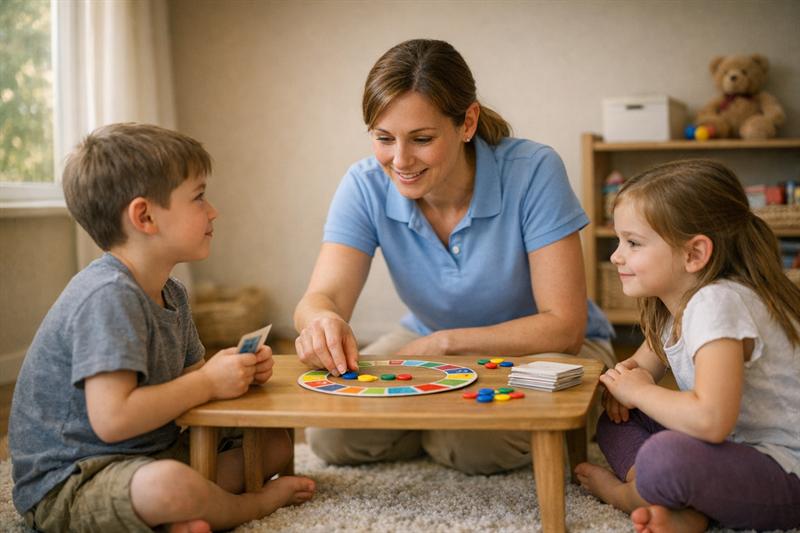
ABA social skills groups are small, structured sessions where children practice interacting with peers under the guidance of trained therapists using evidence-based strategies.
Unlike general playgroups, these sessions are built around specific, teachable skills such as turn-taking, initiating interaction, and responding to others. Each child may have individualized goals, but the shared setting creates opportunities to practice those skills in real time.
How They Fit Into ABA Therapy
Social skills groups are not a replacement for one-on-one ABA therapy. They build on it.
A common pattern is that children learn skills in structured sessions but struggle to use them outside that setting. Without opportunities to practice with peers, skills can stay tied to therapy rather than everyday situations.
Group settings are designed to support generalization, or using skills across environments. If this has been a challenge, it can help to understand why ABA skills don’t carry over and how group work can support that shift.
Group Size, Structure, and Setting
These groups are intentionally small and structured to support learning without overwhelming the child.
- Small group sizes that allow for individual attention
- Therapist-to-child ratios that provide more support than a typical group setting
- Planned activities with clear goals
- Environments set up to reduce unnecessary distractions
This structure helps children stay engaged while gradually introducing the variability of peer interaction.
What Happens During a Social Skills Group Session?
- A structured activity is introduced with a clear goal
- Therapists model appropriate social behavior
- Children practice skills with guided support
- Prompts are used and gradually reduced
- Positive behaviors are reinforced in real time
What stands out in these sessions is how intentional they are. Without that level of guidance, children may fall back into patterns that limit interaction, such as avoiding peers or relying heavily on familiar routines.
Structured Activities and Play
Activities are selected to create specific social opportunities, not just to keep children engaged.
Games may be used to teach turn-taking, sharing, and cooperation. A common misconception is that children will naturally develop these skills through play alone. In practice, many children benefit from structured support to participate more meaningfully.
Therapist Guidance and Reinforcement
Therapists guide interactions moment by moment using prompting and reinforcement.
This is where progress is shaped. Support is gradually reduced as the child becomes more independent, but it starts with clear, consistent guidance that helps the child understand what to do in social situations.
Practicing Real-Life Social Scenarios
Sessions often include practice for situations children regularly face, such as:
- Joining a group activity
- Handling disagreements
- Starting and maintaining conversations
This is where skills begin to move beyond structured tasks and into everyday use. Without this step, children may know what to do in a session but struggle to apply it elsewhere.
Skills Typically Taught in ABA Social Groups
- Initiating interaction with peers
- Responding appropriately in conversations
- Taking turns and sharing
- Recognizing and responding to social cues
- Managing frustration in group settings
These skills are taught in observable, measurable ways. Instead of broad goals, therapy focuses on specific behaviors that can be practiced and tracked.
Communication and Conversation
Children work on starting conversations, responding to others, and using appropriate verbal and nonverbal communication.
This usually builds on communication skills already introduced in one-on-one sessions.
Turn-Taking and Cooperation
These skills are important for participating in group environments.
Some children follow instructions well individually but struggle when they need to wait, share, or adjust to others. Group sessions create direct opportunities to practice those skills.
Emotional Awareness and Regulation
Group settings introduce new challenges such as waiting, losing a game, or navigating peer reactions.
This is where regulation becomes especially important. Without support in this area, children may disengage or become overwhelmed during group activities.
How Social Skills Groups Differ From One-on-One ABA
The biggest difference is the level of unpredictability.
One-on-one sessions are structured and controlled. Group sessions include other children, which introduces variables that cannot be fully planned. This shift is often important for skill use in everyday settings, but it also makes the environment more demanding.
When Individual Therapy Is Still Needed
If foundational skills are still developing, group settings tend to highlight those gaps rather than address them on their own.
When children are placed in groups too early, they may become overwhelmed or disengaged. Progress can slow because the environment requires skills that are not yet consistent.
How Skills Transfer Between Settings
Skills learned in structured settings do not automatically carry over to new environments.
Without intentional practice in varied settings, children may perform well during sessions but struggle in daily life. Group settings can help bridge that gap by introducing variability in a supported way.
When Is a Child Ready for Social Skills Groups?
- Can follow simple instructions consistently
- Has basic communication skills to express needs
- Can tolerate being near peers without significant distress
- Can participate in short, structured activities
If these skills are not yet consistent, group participation may be limited. For a broader perspective, see how ABA therapy changes by age and stage.
Foundational Skills That Support Success
Children often benefit from having a baseline of attention, communication, and behavioral regulation before entering group settings.
Without that foundation, the demands of the group can make it harder to stay engaged and learn effectively.
Signs It May Be Too Early
- Frequent distress in group environments
- Difficulty staying engaged even briefly
- Limited ability to communicate needs clearly
These signs often suggest that more one-on-one support would be helpful before introducing group work.
How Social Skills Groups Support School Readiness
Group sessions mirror many of the expectations children will encounter in school.
They practice listening, following routines, and interacting with peers in a structured setting. This can make the transition to classrooms more manageable because the expectations are more familiar.
For a deeper look, explore how ABA therapy supports school readiness beyond behavior alone.
Common Questions Parents Have About ABA Social Groups
One common expectation is that social skills will improve quickly once a child joins a group.
In reality, progress often looks uneven. A child may do well in one session and struggle in another. That variation reflects the complexity of social environments, not necessarily a lack of progress.
Another frequent question is whether group sessions replace individual therapy. They do not. Both serve different purposes, and removing one too early can create gaps in skill development.
Key Takeaways
- ABA social skills groups focus on practicing skills with peers in structured settings
- They are most effective when foundational skills are already in place
- Starting too early can lead to frustration and limited engagement
- Group settings help skills transfer into real-world situations
- One-on-one and group therapy work together, not as replacements
Conclusion
Social skills groups are not simply a next step. They are a shift into a more demanding environment where skills need to hold up during real interactions.
If this transition happens too early, children may struggle to keep up and progress can slow. When the timing is right, group work can become the point where skills start to carry over into everyday life.
At Strive ABA Consultants LLC, this decision is guided by how a child is functioning, not just how long they have been in therapy. That distinction matters because readiness affects whether group work supports progress or adds new challenges.
If your child is progressing in ABA but continues to struggle socially, this may be the point where a more structured transition plan is worth considering. Getting that step right can make a meaningful difference in how well skills carry into school, home, and community settings.
How Strive ABA Consultants LLC Approaches Social Skills Development
Some programs move children into groups based mainly on age or time in therapy. That approach can overlook whether the child is actually ready for the demands of a group setting.
At Strive ABA Consultants LLC, social skills development is approached with a focus on observable progress and consistency.
- Readiness is based on how skills show up in real situations, not just during sessions
- Consistency and access, including transportation support, are considered to help maintain participation
- Group placement is aligned with individual goals rather than availability alone
This approach can reduce the risk of placing children in environments that are too advanced for their current skill level.
FAQs
What are ABA social skills groups?
ABA social skills groups are structured sessions where children practice interacting with peers under therapist guidance. Therapists use strategies like prompting and reinforcement to teach specific skills such as communication and turn-taking. These groups are typically introduced when a child is ready to apply skills in a social setting.
At what age should a child start social skills groups in ABA?
There is no set age. Readiness depends more on whether the child can follow instructions, communicate basic needs, and tolerate peer interaction. When those skills are more consistent, group settings tend to be more effective.
How are ABA social skills groups different from regular playgroups?
ABA groups are structured and guided by trained therapists, while playgroups are usually less structured. In ABA groups, interactions are intentionally supported to build specific skills, which creates more targeted learning opportunities.
Do social skills groups replace one-on-one ABA therapy?
No. One-on-one therapy focuses on building core skills, while group sessions focus on applying those skills with others. Both are often used together to support broader progress.
How long does it take to see progress in social skills groups?
Progress varies based on the child, the goals being targeted, and how consistently they participate. Social skills usually develop over time with repeated practice, so improvement is often gradual rather than immediate.
What if my child struggles in group settings?
Difficulty in groups can point to gaps in foundational skills or readiness for that setting. Strengthening those skills through individual support often improves participation and makes future group work more productive.